Culture · Essay
Dziady: a supper laid for the grandfathers, and a poem that outlived it
A pre-Christian Slavic rite in which the dead are invited to eat at the family table, the first spoonful set aside for them. On the supper, the word that names both the ancestors and the rite, and the play that made Dziady political.Written to last.
By Confinity Editorial · 2026-04-23 · 6-minute readQuiet tools, kept out of the way.
The word dziady means grandfathers. It is used for the ancestors, and for the rite performed for them, and the doubling is the whole idea: the occasion is named after the people it is for.
What happens is a supper. The table is laid at home, the dead of the household are called by name and invited to sit, and the first portion of each dish is set aside for them, or put on the floor, or thrown into the corner or the fire. Then the family eats.
Dziady is pre-Christian in origin and Slavic in distribution, recorded across Belarus, Poland, Lithuania, Ukraine and western Russia in overlapping forms.
The core belief is simple and appears across half of Eurasia: at certain times of year the dead return to the houses they belonged to, and they are hungry. Several ordinary rules of hospitality follow from that. A window or door is left open. Nobody sits in a particular seat. Sharp implements are kept off the table so a spirit cannot be injured, and in some accounts nothing is swept out of the house that night in case something is swept out with it.
Food matters, and the dishes are specific to region: kutia, the wheat-and-honey dish that appears across the whole Slavic world at these seasons, alongside kasha, pancakes, honey, vodka. Kutia is the same object in the same role as the Orthodox koliva eaten at the Saturdays of Souls.
The main season is autumn, converging over time on the Christian dates of 1 and 2 November. Many regions also kept a spring Dziady, and in the Orthodox east that spring rite is Radonitsa, the cemetery visit after Easter.
One element separates Dziady from the general run of ancestor suppers.
In many accounts the poor, and travelling beggars in particular, were invited or expected. They were fed, and in return they prayed for the household's dead, or sang for them. In some regions the beggar was understood as standing in for the ancestors, and feeding him fed them.
That is the same machinery as English souling and Filipino pangangaluluwa: a household with dead to pray for, a person with nothing but time, and an exchange that serves both. It is one of the more decent inventions in the whole of this subject.
The Catholic and Orthodox churches took a dim view of Dziady for centuries and tried repeatedly to suppress it, with the usual result: the practice moved to the margins and continued, and the church absorbed what it could into All Souls'.
Then in 1823 Adam Mickiewicz wrote Dziady, and the rite became something else.
Mickiewicz's verse drama takes the peasant ritual as its frame, has the dead summoned and questioned, and turns it into a work about the partitioned Polish-Lithuanian lands and about Russian imperial rule. It is one of the central texts of Polish Romanticism, and it made a folk supper into a national symbol.
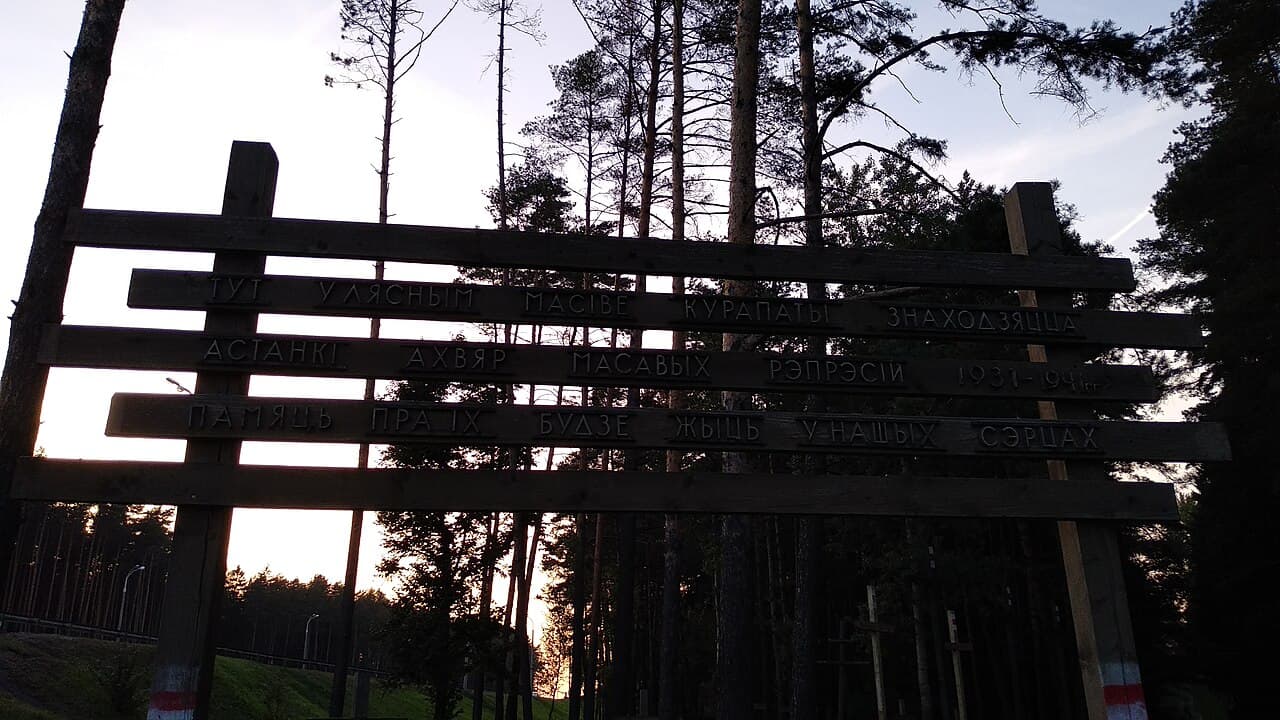 Which is why Dziady has an unusual political record for an ancestor rite. A staging in Warsaw in 1968 was closed by the authorities for drawing anti-Soviet applause, and the closure triggered the student protests of March that year. In Belarus in 1988, a Dziady commemoration at Kurapaty, where the NKVD had shot tens of thousands and buried them in a forest, was broken up by riot police, and that day is generally taken as the beginning of the Belarusian national movement.
A rite about remembering the dead becomes dangerous in exactly the places where the state would prefer certain dead not be remembered. That is not a coincidence, and it happens to this kind of observance repeatedly.
In Belarus, Dzyady is an official day of remembrance kept on 2 November, and the cemetery visit is general. The Kurapaty association has never gone away and the site remains contested.
In Poland the folk rite has largely merged into Zaduszki, and Dziady now means the play to most people. Lithuania keeps Vėlinės on the same nights. The household supper survives in rural pockets and in deliberate revivals.
The candles and the graves are in good health across all of it. The supper with the empty place, and the naming of who is being invited, is the part that has thinned.
The design feature of Dziady is that it is addressed. The dead are not commemorated in general; they are invited, individually, out loud, by somebody who knows the names.
Which means the rite carries its own requirement: a household performing it has to be able to list its dead. For as long as that was done every autumn, in front of children, the list refreshed itself.
Where the supper stopped and only the graveside candle remains, the list stopped being spoken. A candle needs no name. That is why it survived, and why it preserves less.
Which is why Dziady has an unusual political record for an ancestor rite. A staging in Warsaw in 1968 was closed by the authorities for drawing anti-Soviet applause, and the closure triggered the student protests of March that year. In Belarus in 1988, a Dziady commemoration at Kurapaty, where the NKVD had shot tens of thousands and buried them in a forest, was broken up by riot police, and that day is generally taken as the beginning of the Belarusian national movement.
A rite about remembering the dead becomes dangerous in exactly the places where the state would prefer certain dead not be remembered. That is not a coincidence, and it happens to this kind of observance repeatedly.
In Belarus, Dzyady is an official day of remembrance kept on 2 November, and the cemetery visit is general. The Kurapaty association has never gone away and the site remains contested.
In Poland the folk rite has largely merged into Zaduszki, and Dziady now means the play to most people. Lithuania keeps Vėlinės on the same nights. The household supper survives in rural pockets and in deliberate revivals.
The candles and the graves are in good health across all of it. The supper with the empty place, and the naming of who is being invited, is the part that has thinned.
The design feature of Dziady is that it is addressed. The dead are not commemorated in general; they are invited, individually, out loud, by somebody who knows the names.
Which means the rite carries its own requirement: a household performing it has to be able to list its dead. For as long as that was done every autumn, in front of children, the list refreshed itself.
Where the supper stopped and only the graveside candle remains, the list stopped being spoken. A candle needs no name. That is why it survived, and why it preserves less.
The older layer
The beggars at the door
The church, the state, and the poem