For families who want their stories to last. learn about the founding circle.

Culture · Essay

Samhain: what we actually know, and what Halloween borrowed

The Gaelic festival at the start of winter, when the boundary was held to be thin and a place was set for the dead. On the evidence that survives, the evidence that does not, and how a turnip became a pumpkin.

Written to last.

By Confinity Editorial · 2026-04-23 · 6-minute read
Quiet tools, kept out of the way.
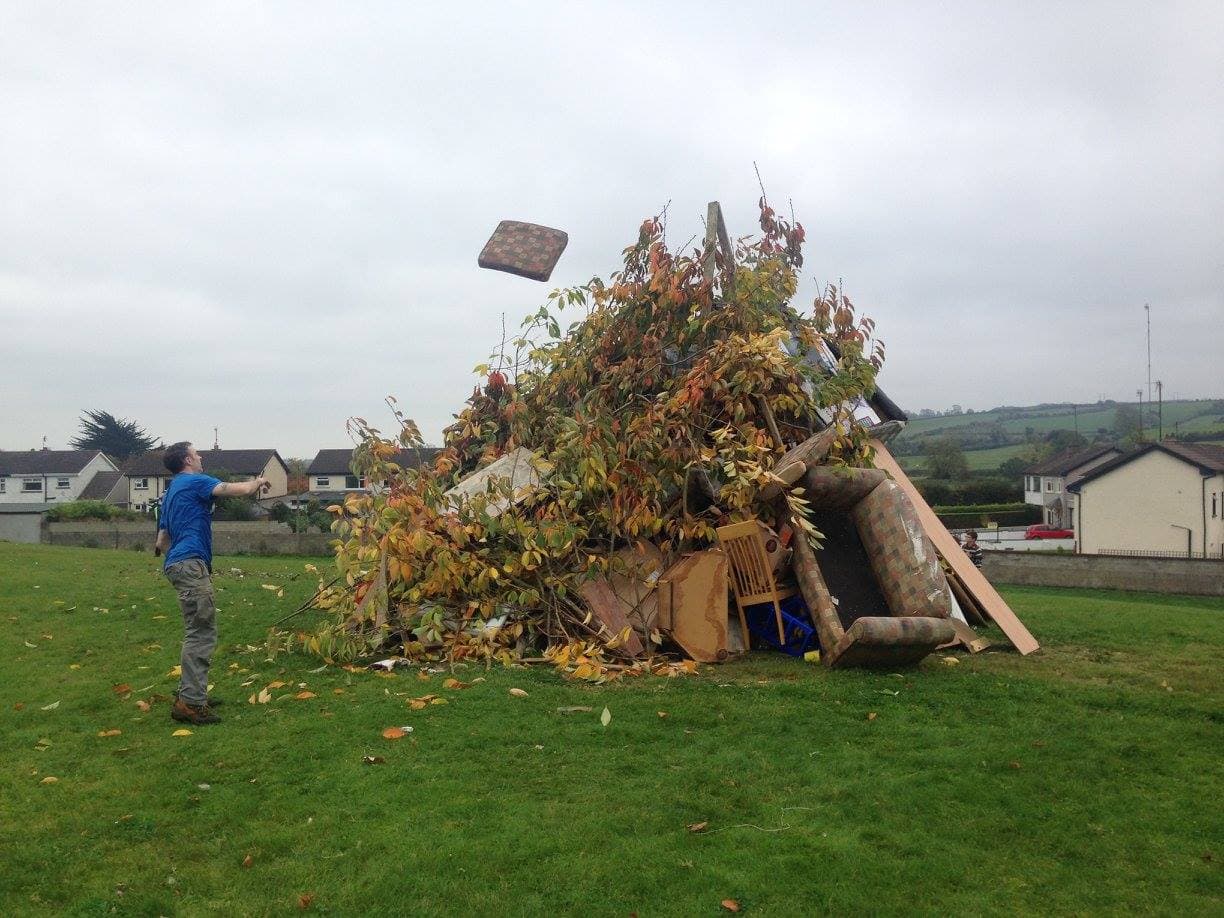
A bonfire lit at Samhain in Ireland
Samhain marks the point where the year turns cold. The harvest is in, the cattle have come down from the summer pasture, some of them have been slaughtered because they cannot be fed through winter, and the dark half of the year starts tonight. It is one of the four Gaelic quarter-days, with Imbolc, Bealtaine and Lughnasadh, and it is the one that got famous. A great deal is written about Samhain and much of it runs well ahead of the evidence. Here is the line between them. Well supported: Samhain is attested in early Irish literature as a major assembly and feast at the start of winter. The tales repeatedly use it as the night when the síd mounds open and the aos sí, the otherworldly people, move about. The Mound of the Hostages at Tara is aligned to sunrise around Samhain and Imbolc, which is a physical fact about a Neolithic monument rather than an interpretation. Later Irish, Scottish and Manx folklore records placating rituals, food and drink left out, doors left unlatched, and places set at the table for dead relatives expected to visit. Less supported, and repeated everywhere: that Samhain was "the Celtic festival of the dead" as a defined category, that it was presided over by druids at the Hill of Ward in a fixed national rite, or that there was a "lord of the dead" named Samhain. The last is a nineteenth-century error and there was no such god. The word means, roughly, summer's end. The honest position is that Samhain was a seasonal threshold with strong associations of the otherworld and the dead, recorded mostly by Christian scribes centuries later and by folklorists a millennium after that. It is quite enough to be interesting without the invented parts. The folkloric practice is the part relevant here, and it is well attested in Ireland and Scotland into the twentieth century. On Samhain night the dead of the house were expected. A place was laid, food was left out, the fire was kept in, and the door was left on the latch. Nobody was to sit in a particular chair. Some accounts have the family retiring early to leave the room free. This is not exotic. It is the same instinct as Obon, as the hungry ghost festival, as Vėlinės and Zaduszki a few hundred miles east: a fixed night, hospitality prepared, the dead treated as guests with a claim on the house. Alongside it ran divination, which is the other well-recorded strand. Apples and nuts, hazel, mirrors, the games that survive in bobbing for apples. Two hazelnuts placed in the fire to see whether a couple would stay together or jump apart. Both of the things that most people now think of as American are older than America. Guising is recorded in Scotland and Ireland: young people going door to door in disguise, offering a song, a rhyme or a trick in exchange for food. The disguise is usually explained as protection, on the reasoning that if things are abroad tonight it is safer not to be recognisable. The transaction is the ancestor of trick-or-treating, and it arrived in North America with Irish and Scottish emigration in the nineteenth century. The lantern is the better story. Carved lanterns were made from turnips, or in Ireland from swedes, hollowed out and cut with a face, lit with a coal or candle and carried. Anyone who has tried it will tell you that carving a turnip is genuinely hard work, and the surviving examples in Irish museums are small, dense and considerably more frightening than a pumpkin. The pumpkin is an American substitution, made for the sensible reason that pumpkins are large, soft and grow abundantly there. The name comes from Stingy Jack, turned away from both heaven and hell and left to wander with a coal in a hollowed turnip. All Saints' Day was moved to 1 November in the ninth century, and All Souls' Day settled on the second in the eleventh. Halloween is the eve of the first: All Hallows' Eve. Whether the church moved the feast to overwrite Samhain, or whether the dates converged for other reasons and the folk practices attached themselves afterwards, is genuinely contested among historians and the confident version in either direction is overstated. What is not contested is that in Ireland and Scotland the two ran together, so that souling, praying for the dead, and guising all happened across the same few nights, and the practices borrowed from each other freely. Halloween is now a commercial holiday of considerable scale, and almost every element of it can be traced to something in this article. The disguise, the door-to-door transaction, the lantern, the apples, the thin boundary. One element did not make the crossing: the place at the table. Everything that survived is the part facing outward, toward the street and the neighbours. The part that faced inward, toward a specific family's specific dead, and required knowing who they were and expecting them, is the part that quietly fell away. The Mexican Day of the Dead kept both halves, which is why it reads to outsiders as the more serious festival, though its costume and sugar skulls are no less playful. The lesson is not that Halloween is degraded. It is that the outward-facing half of a tradition is robust, because it needs nothing from you but participation, while the inward-facing half needs a family to still know the names.
What we preserve here

An essay is a smaller archive, a way of saying something is worth keeping in words. Confinity is the larger version of the same instinct.

More essays

All essays
Heritage library
Start your own archive