Heritage · University
Tsinghua University: Programs, Campus & Admissions Info
Tsinghua University is a leading institution offering top academic programs, research, and student life. Explore courses, campus details, and admissions info.Written to last.
By Confinity Heritage Editorial · Updated 2026-07-20 · 8-minute readQuiet tools, kept out of the way.
Tsinghua University (清华大学) is a public research university in Beijing, China, founded in 1911. It began not as a conventional college but as a preparatory school for Chinese students bound for study in the United States, paid for out of money the American government returned from the Boxer Indemnity. From that narrow purpose it grew into one of the most competitive universities in China and, for much of the twentieth century, the country's principal training ground for engineers and scientists.
Its graduates and former teachers include two consecutive top leaders of China, a Nobel laureate in physics, a Turing Award winner, and several of the scholars who defined modern Chinese studies. The campus, laid out on the grounds of a former Qing imperial garden in northwest Beijing, is among the largest and most photographed in the country, and one of its ponds is the setting of a prose essay that generations of Chinese schoolchildren still memorize.
This article traces how a scholarship college built on reparations money became a national institution, who passed through its gates, and what the university keeps of both its own history and a much older Chinese past.
Tsinghua owes its existence to the settlement that ended the Boxer Uprising of 1900. The Boxer Protocol of 1901 obliged the Qing government to pay heavy indemnities to the foreign powers whose legations had been besieged in Beijing. Within a few years, American officials argued that the United States share exceeded the actual damages claimed. After negotiation with Qing representatives, President Theodore Roosevelt secured approval from Congress in 1909 to remit roughly US$10.8 million of the American portion, on the condition that the money fund scholarships for Chinese students to study in the United States.
To select and prepare those students, a preparatory school named Tsinghua College (清华学堂, romanized as Tsinghua Xuetang) opened in the spring of 1911 on the grounds of Tsinghua Garden, a former imperial garden once linked to Prince Yinzhi, a son of the Kangxi Emperor of the Qing dynasty. The curriculum was modeled closely on American schools: it ran on a credit system, used American textbooks, and organized study so that the earlier years stressed English and American culture while the later years covered the sciences, social sciences, and humanities. Between 1909 and 1937 the wider scholarship program sent about 1,300 Chinese students to universities in the United States, making Tsinghua a central node in the early exchange between China and the American academy.
The 1911 revolution that ended the Qing dynasty interrupted the new school almost as soon as it opened. It reopened under the Republic and was renamed Tsinghua School. In 1925 it added a college department for four-year degrees, and in 1928 the Republic of China chartered it as National Tsing Hua University, giving it the standing of a full national university rather than a feeder school for study abroad.
The 1925 college department arrived alongside an Institute of National Studies, and it was this institute that first gave Tsinghua a scholarly reputation of its own. Its four most celebrated supervisors, often grouped together in later memory, were Wang Guowei, Liang Qichao, Chen Yinke, and Zhao Yuanren (the linguist also known as Yuen Ren Chao). Together they helped set the terms of modern Chinese scholarship in history, philology, and literature, and their years at Tsinghua remain a reference point for the humanities in China.
The Second Sino-Japanese War forced the university into one of its defining episodes. After the Japanese invasion of 1937, Tsinghua joined Peking University and Nankai University to form a combined wartime school, first at Changsha and then, from 1938, in Kunming as the National Southwestern Associated University, commonly shortened in Chinese to Lianda. Working under blockade, air raids, and severe shortages, the merged university nonetheless taught a generation of students who would lead Chinese science and letters after 1949. Tsinghua returned to its Beijing campus in 1946.
After the founding of the People's Republic in 1949, the government reorganized higher education along Soviet lines in 1952, assigning each institution a narrow specialty. In that reshuffle Tsinghua was pared down into a polytechnic concentrating on engineering and the applied sciences, while many of its humanities, law, and science departments were transferred to other schools such as Peking University. For roughly a quarter of a century afterward it functioned mainly as an engineering university, and it earned a lasting association with the technically trained officials who later filled the Chinese state.
The Cultural Revolution brought a decade of upheaval. The high school attached to Tsinghua was where some of the first Red Guard groups formed in 1966, and factional fighting on the campus in 1968 escalated into armed clashes that killed and injured students and staff before order was restored. Normal instruction largely collapsed during these years.
When China began its reform and opening policy in 1978, Tsinghua set about rebuilding the breadth it had lost in 1952. Over the following decades it re-established or added faculties in the sciences, economics and management, humanities, law, art, and medicine, returning to the comprehensive form of a full research university while keeping its historic strength in engineering. Today the institution is organized into more than thirty schools and around fifty departments spanning those fields.
Tsinghua is unusual among universities anywhere in the number of national leaders it has produced. Two successive top figures in Chinese politics studied engineering there: Xi Jinping, general secretary of the Communist Party since 2012, took a degree in chemical engineering, and his predecessor Hu Jintao studied hydraulic engineering. Zhu Rongji, premier of China from 1998 to 2003 and a central architect of the country's economic reforms, graduated in electrical engineering in 1951 and later served as the founding dean of Tsinghua's School of Economics and Management.
The university's record in the natural sciences is anchored by the physicist Yang Chen-Ning, also written Yang Zhenning, who shared the 1957 Nobel Prize in Physics with Tsung-Dao Lee for showing that parity is not conserved in weak interactions. Yang studied at the wartime Southwestern Associated University and, late in life, returned to Tsinghua, where he helped establish its Institute for Advanced Study; he died in October 2025 at the age of 103. In computer science, Andrew Yao (Yao Qizhi), winner of the 2000 Turing Award for his work in the theory of computation, joined the Tsinghua faculty and founded an elite undergraduate track in computer science that students informally call the "Yao Class."
Beyond the laureates, the university's alumni include figures central to China's strategic sciences. The nuclear physicist Deng Jiaxian, a leading contributor to China's atomic and hydrogen bomb programs, studied physics at the wartime Southwestern Associated University alongside Yang. The teachers who shaped the university mattered as much as the students it sent out: the architect Liang Sicheng, a pioneer in the study of historic Chinese architecture, founded Tsinghua's department of architecture in 1946 and built its early curriculum. The broader roster of graduates and former teachers extends across architecture, literature, mathematics, and public administration, and reflects the university's shifting identity from a study-abroad college to an engineering academy and, more recently, a comprehensive research university.
Tsinghua occupies about 483 hectares in the Haidian district of northwest Beijing, on and around the imperial garden after which it is named. The setting is itself historic ground: the campus adjoins the ruins of the Old Summer Palace (Yuanmingyuan), destroyed by British and French forces in 1860, and lies within a short distance of the Summer Palace, in a corner of Beijing long associated with Qing garden design. Long prized as scenery, the grounds combine classical Chinese landscape with a distinctive layer of early twentieth-century Western architecture, and several historic gardens and waterways run through the site.
 The old gate of 1909 was pulled down during the Cultural Revolution and rebuilt in 1991 from photographs and the recollections of alumni. Photograph by Soramimi, CC BY-SA 4.0, via Wikimedia Commons.
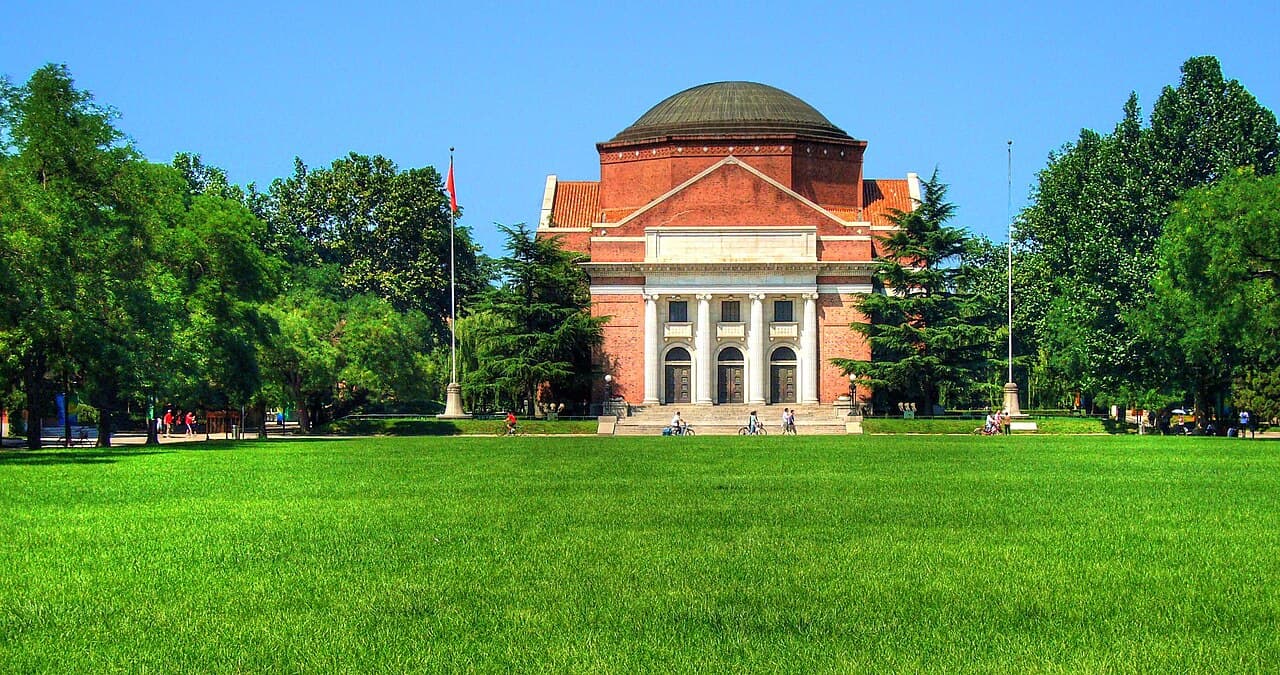
Much of that early architecture is the work of the American architect Henry Killam Murphy, who designed a group of the first permanent buildings in the 1910s and 1920s. Among them is the Grand Auditorium, a domed hall roughly 44 meters tall fronted by a white marble Ionic portico, which remains the university's main ceremonial space. Murphy also designed the science building, the gymnasium, and the eastern portion of the old library.
The building that gave the founding college its name still stands. Tsinghua Xuetang, a hall faced in black brick in a German classical style, housed the early school and later the Institute of National Studies where Wang Guowei, Liang Qichao, Chen Yinke, and Zhao Yuanren taught. Its dark facade and sloped tile roof make it one of the most recognizable structures on the campus.
Perhaps the most famous single feature is a modest lotus pond. The essayist Zhu Ziqing, who taught at Tsinghua from 1925 and led its department of Chinese, described a restless night walk beside it in "Moonlight over the Lotus Pond" (荷塘月色), published in July 1927. The essay, admired for its precise, musical prose, became a fixture of Chinese school anthologies, and it has fixed the pond in the national imagination as a place of quiet reflection. The Wanquan River and the older ponds of the former garden still thread the same part of the grounds.
Tsinghua carries a symbolic weight that few universities can match, and much of it flows from how it began. A national institution founded on returned reparations money sits at an unusual angle to the history of China's dealings with the West: the same indemnity that marked a moment of national humiliation was also, through the scholarship, redirected into the education of the country's future scientists and officials. That founding story is retold whenever the university's place in modern China is discussed.
For decades the university's graduates formed a recognizable type in Chinese public life, the technically trained administrator who moved from an engineering degree into government. The concentration of Tsinghua alumni at the highest levels of the state, including two successive party leaders, has made the university a byword for a particular route to influence in China. Alongside its neighbor Peking University, Tsinghua is one of the two schools most closely associated with academic prestige, and admission through the national college entrance examination is among the most competitive in the country.
The wartime Southwestern Associated University occupies its own place in this significance. Remembered as a rare instance of scholarship sustained under extreme hardship, the merged campus in Kunming has become a symbol of intellectual endurance, and Tsinghua's share in that history remains a source of institutional pride.
Tsinghua's stewardship of the past reaches well beyond its own records. In 2008 the university acquired a large cache of bamboo manuscripts dating to the Warring States period, around the third century BCE, and established a research center to conserve and study them under the historian Li Xueqin. The collection, known as the Tsinghua Bamboo Slips (清华简), runs to roughly 2,400 slips and fragments and contains dozens of ancient works, many of them lost for more than two thousand years.
Several of the texts bear directly on the formation of the Shangshu, or Book of Documents, one of the foundational works of the Chinese classical tradition, which has made the slips important for scholars trying to understand how those early texts took shape. Radiocarbon dating placed the bamboo in the Warring States era, consistent with the script and content. Since 2010 the university's team has published the manuscripts in a series of annotated volumes with photographic reproductions and transcriptions, releasing the material steadily to researchers rather than all at once.
The university library itself holds a collection of some 5.8 million volumes, including a body of rare thread-bound Chinese books, and the campus preserves its early twentieth-century architecture as protected heritage. Between the excavated texts, the historic buildings, and the archives of a century of Chinese higher education, Tsinghua functions as a custodian of both its own institutional memory and a far older written record.
As of the end of 2025, Tsinghua reports about 63,100 registered students, a figure that includes roughly 16,500 undergraduates, some 21,800 master's students, and nearly 24,900 doctoral candidates, taught by a faculty and staff of more than 17,000. The doctoral and master's populations together outnumber the undergraduates, a balance that reflects the university's weight toward graduate research.
The student body is substantially international, with degree and exchange students drawn from more than 130 countries, and the university maintains research partnerships and joint programs with institutions abroad. Within China it consistently sits at or near the top of national rankings, and it appears among the highest-placed Asian universities and inside the global top tier in the major international surveys of teaching and research, including the Times Higher Education and QS World University Rankings. Engineering, computer science, and the physical sciences remain particular strengths, though the reach of the university now runs well beyond the polytechnic identity it carried in the middle of the twentieth century.
More than a century after it opened as a school to prepare a few hundred students for study overseas, Tsinghua has become a comprehensive research university whose reach runs from Warring States manuscripts to advanced engineering. Its guiding motto, usually rendered "Self-Discipline and Social Commitment" (自强不息,厚德载物), is drawn from a 1914 address by Liang Qichao that quoted the ancient Book of Changes, tying the modern institution back to the classical texts it now helps to preserve.
The old gate of 1909 was pulled down during the Cultural Revolution and rebuilt in 1991 from photographs and the recollections of alumni. Photograph by Soramimi, CC BY-SA 4.0, via Wikimedia Commons.
Much of that early architecture is the work of the American architect Henry Killam Murphy, who designed a group of the first permanent buildings in the 1910s and 1920s. Among them is the Grand Auditorium, a domed hall roughly 44 meters tall fronted by a white marble Ionic portico, which remains the university's main ceremonial space. Murphy also designed the science building, the gymnasium, and the eastern portion of the old library.
The building that gave the founding college its name still stands. Tsinghua Xuetang, a hall faced in black brick in a German classical style, housed the early school and later the Institute of National Studies where Wang Guowei, Liang Qichao, Chen Yinke, and Zhao Yuanren taught. Its dark facade and sloped tile roof make it one of the most recognizable structures on the campus.
Perhaps the most famous single feature is a modest lotus pond. The essayist Zhu Ziqing, who taught at Tsinghua from 1925 and led its department of Chinese, described a restless night walk beside it in "Moonlight over the Lotus Pond" (荷塘月色), published in July 1927. The essay, admired for its precise, musical prose, became a fixture of Chinese school anthologies, and it has fixed the pond in the national imagination as a place of quiet reflection. The Wanquan River and the older ponds of the former garden still thread the same part of the grounds.
Tsinghua carries a symbolic weight that few universities can match, and much of it flows from how it began. A national institution founded on returned reparations money sits at an unusual angle to the history of China's dealings with the West: the same indemnity that marked a moment of national humiliation was also, through the scholarship, redirected into the education of the country's future scientists and officials. That founding story is retold whenever the university's place in modern China is discussed.
For decades the university's graduates formed a recognizable type in Chinese public life, the technically trained administrator who moved from an engineering degree into government. The concentration of Tsinghua alumni at the highest levels of the state, including two successive party leaders, has made the university a byword for a particular route to influence in China. Alongside its neighbor Peking University, Tsinghua is one of the two schools most closely associated with academic prestige, and admission through the national college entrance examination is among the most competitive in the country.
The wartime Southwestern Associated University occupies its own place in this significance. Remembered as a rare instance of scholarship sustained under extreme hardship, the merged campus in Kunming has become a symbol of intellectual endurance, and Tsinghua's share in that history remains a source of institutional pride.
Tsinghua's stewardship of the past reaches well beyond its own records. In 2008 the university acquired a large cache of bamboo manuscripts dating to the Warring States period, around the third century BCE, and established a research center to conserve and study them under the historian Li Xueqin. The collection, known as the Tsinghua Bamboo Slips (清华简), runs to roughly 2,400 slips and fragments and contains dozens of ancient works, many of them lost for more than two thousand years.
Several of the texts bear directly on the formation of the Shangshu, or Book of Documents, one of the foundational works of the Chinese classical tradition, which has made the slips important for scholars trying to understand how those early texts took shape. Radiocarbon dating placed the bamboo in the Warring States era, consistent with the script and content. Since 2010 the university's team has published the manuscripts in a series of annotated volumes with photographic reproductions and transcriptions, releasing the material steadily to researchers rather than all at once.
The university library itself holds a collection of some 5.8 million volumes, including a body of rare thread-bound Chinese books, and the campus preserves its early twentieth-century architecture as protected heritage. Between the excavated texts, the historic buildings, and the archives of a century of Chinese higher education, Tsinghua functions as a custodian of both its own institutional memory and a far older written record.
As of the end of 2025, Tsinghua reports about 63,100 registered students, a figure that includes roughly 16,500 undergraduates, some 21,800 master's students, and nearly 24,900 doctoral candidates, taught by a faculty and staff of more than 17,000. The doctoral and master's populations together outnumber the undergraduates, a balance that reflects the university's weight toward graduate research.
The student body is substantially international, with degree and exchange students drawn from more than 130 countries, and the university maintains research partnerships and joint programs with institutions abroad. Within China it consistently sits at or near the top of national rankings, and it appears among the highest-placed Asian universities and inside the global top tier in the major international surveys of teaching and research, including the Times Higher Education and QS World University Rankings. Engineering, computer science, and the physical sciences remain particular strengths, though the reach of the university now runs well beyond the polytechnic identity it carried in the middle of the twentieth century.
More than a century after it opened as a school to prepare a few hundred students for study overseas, Tsinghua has become a comprehensive research university whose reach runs from Warring States manuscripts to advanced engineering. Its guiding motto, usually rendered "Self-Discipline and Social Commitment" (自强不息,厚德载物), is drawn from a 1914 address by Liang Qichao that quoted the ancient Book of Changes, tying the modern institution back to the classical texts it now helps to preserve.
History and founding
Growth into a leading university
Notable scholars and alumni
The campus
Cultural significance
What it preserves
Today
References and resources
- Tsinghua University: Facts and Figures (official statistics)
- Tsinghua University: General Information (official overview)
- Tsinghua University: The Auditorium (official campus landmark page)
- Tsinghua University: Tsinghua Xuetang (official campus landmark page)
- Wikipedia: Tsinghua University
- Wikipedia: History of Tsinghua University
- Wikipedia: Boxer Indemnity Scholarship
- Wikipedia: National Southwestern Associated University
- Wikipedia: Tsinghua Bamboo Slips
- Encyclopaedia Britannica: Tsinghua University