Heritage · University
University Of Bologna: Programs, Campus & Admissions Info
University Of Bologna is a leading institution offering top academic programs, research, and student life. Explore courses, campus details, and admissions info.Written to last.
By Confinity Heritage Editorial · Updated 2026-07-20 · 8-minute readQuiet tools, kept out of the way.
The University of Bologna, known by its Latin name Alma Mater Studiorum, is widely regarded as the oldest university in continuous operation in the world. Its conventional founding date, 1088, was fixed only in the 19th century, when a committee of scholars led by the poet Giosuè Carducci traced the institution's origins to that year. The date now appears alongside the motto Alma Mater Studiorum, meaning "nourishing mother of studies," on the university's coat of arms. Bologna is also credited as the first place of study to describe itself with the word universitas, the sworn corporation of students and masters that gave the modern university both its name and its structure. What began as informal circles of students paying celebrated jurists for private instruction grew into a template that European higher education would follow for the next seven centuries.
Bologna in the late 11th century was a prosperous commune in northern Italy, sitting astride trade routes and hungry for trained lawyers to serve its merchants, courts, and competing authorities. Into this setting came the recovery of Roman law. Around the 1070s and 1080s, the jurist Irnerius began teaching the rediscovered legal code of the Emperor Justinian, the Corpus Juris Civilis, which had fallen out of systematic use in the West for centuries. His lectures drew students from across Italy and beyond, and Bologna's reputation as a centre of legal learning spread quickly.
The year 1088 marks the conventional beginning of the Studium, the medieval name for the community of teaching and study at Bologna. That date is a scholarly convention rather than a documented act of foundation. No charter was issued in 1088, and some historians observe that organised instruction on the scale of a university may not have existed until the 1150s. What is not in dispute is that by the middle of the 12th century Bologna held a concentration of masters and students without equal in Europe for the study of law.
Imperial recognition followed. In 1158, the Holy Roman Emperor Frederick I Barbarossa issued the Authentica Habita, also called the Constitutio Habita, a decree granting travelling scholars protection and legal privileges, including the right to be judged by their own masters or by the local bishop rather than by ordinary courts. The charter is often described as one of the earliest guarantees of academic freedom, and it gave the loose community at Bologna a recognised legal standing that helped it endure.
What made Bologna distinctive was who held the power. Unlike Paris, where the masters governed, Bologna was run by its students. Foreign students, who could not rely on local citizenship for protection, banded together into sworn associations called universitates scholarium. These student guilds grouped themselves by region of origin into "nations," broadly divided between the citramontani, students from the Italian peninsula, and the ultramontani, those from north of the Alps.
The students controlled the institution. They elected a rector from among their own number, negotiated fees, and set the terms of employment for their professors. A master who arrived late, skipped difficult passages, or failed to draw an audience could be fined by the student body. This student-led model proved so influential that when about a thousand scholars broke away in 1222 in search of greater freedom, they carried the pattern with them and founded the University of Padua, Italy's second university.
Law was the heart of the studium, in two branches. Civil law rested on Justinian's Corpus, glossed and taught by Irnerius and his successors. Canon law, the law of the church, was reshaped around 1140 when the monk Gratian compiled the Decretum, a systematic attempt to reconcile centuries of contradictory church rulings that became the foundational textbook of canon law across Europe. Medicine, philosophy, and the liberal arts were added over the following centuries, and by the 13th century thousands of students were at Bologna at any one time. A student who completed the course faced a demanding public examination before a board of doctors and, on passing, received the licentia docendi, the licence to teach anywhere, which is why Bologna is often called the first institution to award academic degrees in the modern sense. Its standing as a studium generale, a place of study open to scholars from every land, set it apart from the many purely local schools of the age.
The teaching method itself became a model. The early Bologna jurists were called glossators because they wrote glosses, explanatory notes inserted between the lines and in the margins of the legal texts. Irnerius, remembered by the epithet lucerna juris, the "lantern of the law," founded this School of Glossators. His work was carried on by the Four Doctors of Bologna, Bulgarus, Martinus Gosia, Jacobus, and Hugo de Porta Ravennate, and later consolidated in the 13th century by Accursius, whose Glossa Ordinaria gathered the accumulated commentary into a standard reference used for generations.
The roster of people who studied or taught at Bologna reads as a cross-section of European intellectual history. In the medieval and Renaissance periods, the poet Dante Alighieri and the humanist Petrarch spent time there. Nicolaus Copernicus, the astronomer who placed the Sun rather than the Earth at the centre of the cosmos, enrolled at Bologna in 1496 to study canon law and made astronomical observations alongside the local astronomer Domenico Maria Novara. Thomas Becket, later Archbishop of Canterbury, and the philosopher Giovanni Pico della Mirandola are also counted among those who passed through.
Bologna's record on women in scholarship is notably early. Bettisia Gozzadini is recorded as earning a law degree in 1237, among the first women in history to obtain a university degree, and by 1239 she was teaching at the university, an early instance of a woman lecturing at a university. Nearly five centuries later, Laura Bassi (1711–1778) received a doctorate from Bologna in 1732 and was appointed to teach natural philosophy, becoming the first salaried woman to hold a university teaching post and one of the earliest women to earn a doctorate in science. The physician Luigi Galvani, whose experiments on animal electricity gave us the word "galvanism," taught anatomy at Bologna in the 18th century. The university's strength in anatomy and medicine, taught in the purpose-built theatre of the Archiginnasio, drew physicians and students from across Europe throughout the early modern period.
The modern era added inventors, writers, and industrialists. Guglielmo Marconi, a pioneer of long-distance radio transmission and a Nobel laureate in physics, was closely connected with the city and its university. Enzo Ferrari, founder of the automobile company that bears his name, studied at Bologna, as did the playwright Carlo Goldoni. In the 20th century the semiotician and novelist Umberto Eco, author of "The Name of the Rose," spent much of his career on the faculty, and the poet and filmmaker Pier Paolo Pasolini studied there. Several popes, including Alexander VI, Gregory XIII, Gregory XV, and Innocent IX, were educated at Bologna as well.
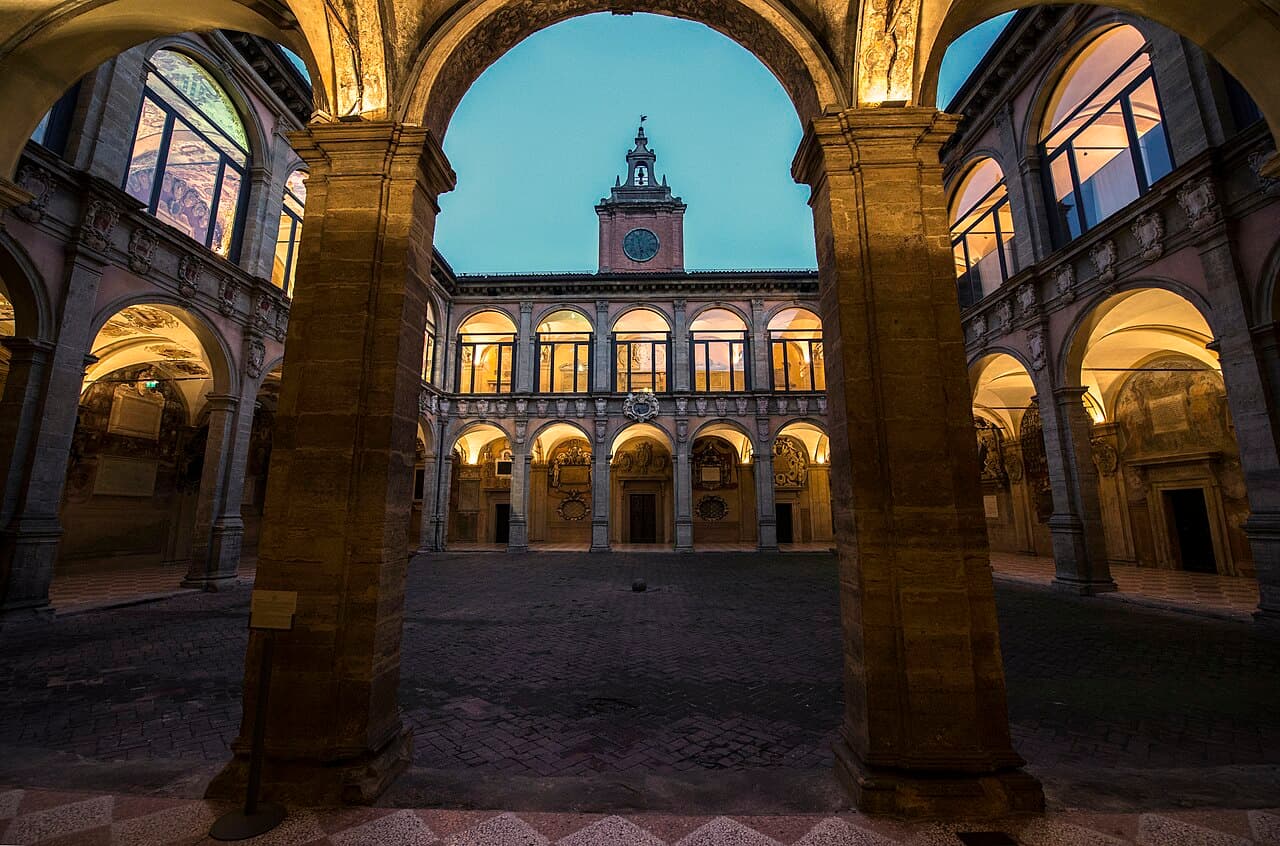
For its first five centuries the university had no single home; lectures were held in rented rooms, churches, and the houses of masters scattered across the city. That changed in the 1560s. Between 1562 and 1563, at the direction of the papal legate Cardinal Carlo Borromeo and the vice-legate Pier Donato Cesi, the architect Antonio Morandi, known as Terribilia, built the Archiginnasio to bring the dispersed teaching under one roof for the first time. Its long galleried courtyard is covered with the painted coats of arms and memorials of the students who studied there, one of the densest heraldic records anywhere in Europe.
 The theatre was destroyed by a bomb in 1944 and rebuilt from its own fragments, which is why the spruce panelling reads as original and mostly is. Photograph by Luca Borghi, public domain, via Wikimedia Commons.
At the heart of the Archiginnasio is the Anatomical Theatre, built in 1637 and carved entirely from spruce wood. Tiers of seats rise steeply around a central marble table where public dissections were performed, and the professor's canopy is held aloft by two statues of flayed figures known as gli spellati, "the skinless ones." On 29 January 1944, an air raid nearly destroyed the theatre; it was painstakingly reconstructed after the war from the original fragments recovered in the rubble. The Archiginnasio served as the university's principal seat from 1563 until 1803, and since 1838 it has housed the Municipal Library of Bologna.
When Napoleon reorganised Italian higher education, the university moved in 1803 to Palazzo Poggi on Via Zamboni, which remains its historic seat and the office of the rector today. Built between 1549 and 1560 for the Poggi family and decorated with frescoes by Pellegrino Tibaldi and others, the palace had already become the home of the Institute of Sciences in 1714, founded by the soldier and naturalist Luigi Ferdinando Marsili. Nearby stands the Specola, the university's astronomical observatory established in 1711 and described as the first public observatory in Italy. The university's botanical garden, the Orto Botanico, was founded in 1568 on the initiative of the naturalist Ulisse Aldrovandi and is among the oldest in Italy.
Bologna's importance is not only that it is old but that it invented a form. The sworn corporation of students and masters, the elected rector, the graded course of study leading to a licence to teach, and the very word universitas all took shape here and were carried outward as scholars migrated and founded new studia. Padua in 1222 was the first offshoot, but the pattern reached across the continent, and the student-centred Bologna model stood as one of the two great templates of medieval higher education, alongside the master-centred model of Paris.
The revival of Roman law at Bologna also had consequences far beyond the classroom. The systematic study of Justinian's code produced a trained class of jurists who staffed the courts, chanceries, and councils of medieval Europe, and it fed directly into the development of the ius commune, the shared body of law that shaped legal thinking across the continent for centuries.
Bologna has continued to hold a symbolic role in European education into the present. In 1988, on the occasion of the university's 900th anniversary, rectors from across Europe signed the Magna Charta Universitatum at Bologna, a declaration affirming the autonomy of universities and the freedom of teaching and research. Eleven years later, the 1999 Bologna Declaration, signed in the same city, launched the reform process that harmonised degree structures across dozens of European countries, a reform still known today as the Bologna Process.
Almost a thousand years of continuous teaching have left Bologna with archives and collections that document the growth of European learning itself. The historic seat at Palazzo Poggi holds a network of university museums whose frescoed rooms preserve the instruments and specimens of the old Institute of Sciences, from models of ships and military architecture to collections on physics, natural history, chemistry, human anatomy, and obstetrics, including the anatomical wax and terracotta models once used to teach medicine before the reliable preservation of cadavers was possible.
Among the holdings is the natural-history collection assembled by Ulisse Aldrovandi in the 16th century, one of the earliest scientific collections of its kind, together with a historic herbarium whose specimens reach back to the Renaissance. The Archiginnasio's walls carry thousands of painted student coats of arms and memorials, a visual archive of who came to study and where they came from. The university's libraries, including the University Library of Bologna and the Municipal Library housed in the Archiginnasio, safeguard manuscripts, early printed books, and archival records that trace the institution across nine centuries, and its museum network keeps these materials open to researchers and the public.
The University of Bologna is today one of the largest universities in Europe, with over 90,000 students enrolled across a multi-campus structure; recent figures record roughly 47,000 undergraduates, 36,000 postgraduates, and more than 4,000 doctoral students, taught by close to 3,000 academic staff. Beyond the historic centre of Bologna, it operates campuses in Cesena, Forlì, Ravenna, and Rimini, along with an overseas presence that includes a permanent campus in Buenos Aires and branches in New York, Brussels, and Shanghai. Its historic seat and administrative heart remain at Palazzo Poggi, Via Zamboni 33, in the university quarter around Piazza Verdi.
Visitors can see much of the university's history first-hand. The Archiginnasio and its Anatomical Theatre are open to the public in the city centre, near the Basilica of San Petronio, and the Palazzo Poggi museums display the collections of the old Institute of Sciences. The Orto Botanico on Via Irnerio, the observatory, and the frescoed halls of the historic seat are all part of a compact heritage district in the heart of a city whose porticoes were inscribed on the UNESCO World Heritage List in 2021, running for more than 60 kilometres through the same streets where students have walked for centuries. For a working university that has taught without interruption since the Middle Ages, the past is not kept behind glass so much as woven into the streets where students still gather.
The theatre was destroyed by a bomb in 1944 and rebuilt from its own fragments, which is why the spruce panelling reads as original and mostly is. Photograph by Luca Borghi, public domain, via Wikimedia Commons.
At the heart of the Archiginnasio is the Anatomical Theatre, built in 1637 and carved entirely from spruce wood. Tiers of seats rise steeply around a central marble table where public dissections were performed, and the professor's canopy is held aloft by two statues of flayed figures known as gli spellati, "the skinless ones." On 29 January 1944, an air raid nearly destroyed the theatre; it was painstakingly reconstructed after the war from the original fragments recovered in the rubble. The Archiginnasio served as the university's principal seat from 1563 until 1803, and since 1838 it has housed the Municipal Library of Bologna.
When Napoleon reorganised Italian higher education, the university moved in 1803 to Palazzo Poggi on Via Zamboni, which remains its historic seat and the office of the rector today. Built between 1549 and 1560 for the Poggi family and decorated with frescoes by Pellegrino Tibaldi and others, the palace had already become the home of the Institute of Sciences in 1714, founded by the soldier and naturalist Luigi Ferdinando Marsili. Nearby stands the Specola, the university's astronomical observatory established in 1711 and described as the first public observatory in Italy. The university's botanical garden, the Orto Botanico, was founded in 1568 on the initiative of the naturalist Ulisse Aldrovandi and is among the oldest in Italy.
Bologna's importance is not only that it is old but that it invented a form. The sworn corporation of students and masters, the elected rector, the graded course of study leading to a licence to teach, and the very word universitas all took shape here and were carried outward as scholars migrated and founded new studia. Padua in 1222 was the first offshoot, but the pattern reached across the continent, and the student-centred Bologna model stood as one of the two great templates of medieval higher education, alongside the master-centred model of Paris.
The revival of Roman law at Bologna also had consequences far beyond the classroom. The systematic study of Justinian's code produced a trained class of jurists who staffed the courts, chanceries, and councils of medieval Europe, and it fed directly into the development of the ius commune, the shared body of law that shaped legal thinking across the continent for centuries.
Bologna has continued to hold a symbolic role in European education into the present. In 1988, on the occasion of the university's 900th anniversary, rectors from across Europe signed the Magna Charta Universitatum at Bologna, a declaration affirming the autonomy of universities and the freedom of teaching and research. Eleven years later, the 1999 Bologna Declaration, signed in the same city, launched the reform process that harmonised degree structures across dozens of European countries, a reform still known today as the Bologna Process.
Almost a thousand years of continuous teaching have left Bologna with archives and collections that document the growth of European learning itself. The historic seat at Palazzo Poggi holds a network of university museums whose frescoed rooms preserve the instruments and specimens of the old Institute of Sciences, from models of ships and military architecture to collections on physics, natural history, chemistry, human anatomy, and obstetrics, including the anatomical wax and terracotta models once used to teach medicine before the reliable preservation of cadavers was possible.
Among the holdings is the natural-history collection assembled by Ulisse Aldrovandi in the 16th century, one of the earliest scientific collections of its kind, together with a historic herbarium whose specimens reach back to the Renaissance. The Archiginnasio's walls carry thousands of painted student coats of arms and memorials, a visual archive of who came to study and where they came from. The university's libraries, including the University Library of Bologna and the Municipal Library housed in the Archiginnasio, safeguard manuscripts, early printed books, and archival records that trace the institution across nine centuries, and its museum network keeps these materials open to researchers and the public.
The University of Bologna is today one of the largest universities in Europe, with over 90,000 students enrolled across a multi-campus structure; recent figures record roughly 47,000 undergraduates, 36,000 postgraduates, and more than 4,000 doctoral students, taught by close to 3,000 academic staff. Beyond the historic centre of Bologna, it operates campuses in Cesena, Forlì, Ravenna, and Rimini, along with an overseas presence that includes a permanent campus in Buenos Aires and branches in New York, Brussels, and Shanghai. Its historic seat and administrative heart remain at Palazzo Poggi, Via Zamboni 33, in the university quarter around Piazza Verdi.
Visitors can see much of the university's history first-hand. The Archiginnasio and its Anatomical Theatre are open to the public in the city centre, near the Basilica of San Petronio, and the Palazzo Poggi museums display the collections of the old Institute of Sciences. The Orto Botanico on Via Irnerio, the observatory, and the frescoed halls of the historic seat are all part of a compact heritage district in the heart of a city whose porticoes were inscribed on the UNESCO World Heritage List in 2021, running for more than 60 kilometres through the same streets where students have walked for centuries. For a working university that has taught without interruption since the Middle Ages, the past is not kept behind glass so much as woven into the streets where students still gather.
History and founding
The medieval studium
Notable scholars and alumni
The buildings
Cultural significance
What it preserves
Visiting and today
References and resources
- University of Bologna, "Our history": the university's official account of its founding and nine centuries of history.
- Wikipedia: University of Bologna: comprehensive overview with sourced dates, figures, and alumni.
- Wikipedia: List of oldest universities in continuous operation: context for Bologna's standing as the oldest.
- Wikipedia: Irnerius: the jurist who revived Roman law and founded the School of Glossators.
- Britannica: Irnerius: concise biography of the "lantern of the law."
- Wikipedia: Four Doctors of Bologna: the glossators who succeeded Irnerius in the law school.
- Wikipedia: Archiginnasio of Bologna: the historic seat and its Anatomical Theatre.
- Wikipedia: Palazzo Poggi: the university's current historic seat and museums.
- Wikipedia: Orto Botanico dell'Università di Bologna: the botanical garden founded in 1568.
- UNESCO World Heritage Centre: The Porticoes of Bologna: the city's arcaded streets, inscribed in 2021.