Heritage · University
University of Paris (Sorbonne): Programs, Campus & Admissions Info
University of Paris (Sorbonne) is a leading institution offering top academic programs, research, and student life. Explore courses, campus details, and admissions info.Written to last.
By Confinity Heritage Editorial · Updated 2026-07-20 · 8-minute readQuiet tools, kept out of the way.
For most of eight centuries there was a single University of Paris, and for much of that time the word people used for it was simply the Sorbonne. The institution grew out of the cathedral school of Notre-Dame around the middle of the twelfth century and became, alongside Bologna, one of the first universities in Europe (Britannica). Its masters set much of the pattern that later universities across the continent would copy: the faculty, the degree, and the licence to teach.
The name is where the confusion starts, and it is worth being clear at the outset. "Sorbonne" first meant only one college among many, the Collège de Sorbonne, endowed in 1257 for poor students of theology (Wikipedia). Over the centuries the college's name spread first to the faculty of theology and then to the whole university. No single University of Paris exists today. It was broken up after the upheavals of 1968, and several separate universities now carry the Sorbonne name.
What follows is the history of that institution and its afterlife: how a guild of medieval masters became the intellectual centre of Latin Christendom, how it was abolished and rebuilt more than once, and how its name still marks the buildings and the successor universities of the Latin Quarter.
The University of Paris was not founded on a date. It emerged. Through the first half of the twelfth century, teachers gathered around the cathedral school of Notre-Dame and on the slopes of the Montagne Sainte-Geneviève, drawing students who came to hear a particular master rather than to enrol in an institution. The most celebrated of them, Peter Abelard (1079–1142), taught logic and theology in Paris in the decades before any university existed, and his reputation helped turn the city into a magnet for scholars from across the Latin world (Wikipedia).
By around 1150 these masters had begun to act as a corporation, a universitas, regulating who was allowed to teach and admitting students into their guild. Formal recognition came in stages. In 1200 King Philip II Augustus granted the scholars a royal charter that placed them under the protection of the crown and the church courts rather than the officers of the city (Wikipedia). In 1215 the papal legate Robert de Courçon issued the university its first written statutes, and in 1231 Pope Gregory IX's bull Parens scientiarum confirmed its right to govern itself, frame its own rules, and suspend teaching in protest. That bull is often described as the university's charter of independence.
The university organised itself into four faculties: arts, medicine, canon law, and theology, with theology the most prestigious. Rome had forbidden the teaching of Roman civil law at Paris in 1219, so the law faculty there dealt with church law alone. The faculty of arts, by far the largest, was subdivided into four "nations" according to where a student came from: France, Normandy, Picardy, and England, the last of these later known as the German nation (Wikipedia). This structure of faculties, nations, degrees, and elected officers became a template that Oxford, Prague, Cologne, and many other foundations adapted for themselves.
The colleges were a later layer. They began as endowed halls that fed and housed students who could not otherwise afford to study, and the most famous of them gave the university its lasting nickname. Around 1253 Robert de Sorbon (1201–1274), a theologian of peasant background who served as chaplain and confessor to King Louis IX, established a residence for poor students of theology who lacked the backing of a religious order (Wikipedia). Confirmed by royal and papal authority in 1257, the Collège de Sorbonne opened with roughly twenty students and grew into the most respected theological college in France. Its name slowly came to stand for the faculty of theology as a whole, and in time for the university itself.
The thirteenth century was the university's intellectual height. Paris became the leading centre of scholasticism, the method of reasoning that set out to reconcile Christian doctrine with the newly recovered philosophy of Aristotle through close logical argument. The Dominican and Franciscan orders sent their ablest members to teach there, and the list of masters active in a single generation is remarkable. Albertus Magnus, his pupil Thomas Aquinas, who composed much of the Summa Theologiae while teaching in Paris, and the Franciscan Bonaventure all held chairs in the faculty of theology (Britannica). Roger Bacon lectured there on Aristotle, and in the generations that followed John Duns Scotus and William of Ockham carried the tradition of scholastic dispute forward.
Teaching was conducted entirely in Latin, which meant a student trained in Paris could move to Oxford or Cologne and pick up where he left off. A young man typically entered the arts faculty in his teens, spent years on grammar, logic, and the works of Aristotle, and received the licentia docendi, the licence to teach, before some went on to the far longer study required in theology, law, or medicine. Masters and students lived scattered through the streets of the Left Bank, an arrangement that gave the Latin Quarter its name and its enduring character as a district of learning.
The faculty of theology carried an authority that reached well beyond the classroom. Its rulings on questions of doctrine were sought across Christendom, and its leading figures acted on the largest stage of European affairs. The chancellor Jean Gerson helped bring an end to the Great Schism of the papacy at the Council of Constance in the early fifteenth century. The same authority could be turned to darker ends: in 1431 the theologians of Paris drew up the twelve articles of condemnation used against Joan of Arc at her trial in Rouen, and supplied assessors to the court that sentenced her (Wikipedia).
The Sorbonne was also an early home of print. In 1470 two of the college's officers invited printers trained in the German workshops to install a press in the Sorbonne's buildings, one of the first in France, and it began issuing editions of classical and scholarly texts for the university's own use (Wikipedia). The college's library, one of the largest in medieval Europe, made it a place where books were not only read but copied, corrected, and increasingly produced.
The university's pull on the ambitious did not fade with the Middle Ages. In the sixteenth century it drew students who would go on to divide and reshape the church. The humanist Erasmus studied theology in Paris in the 1490s; the young Jean Calvin, later the reformer of Geneva, attended the austere Collège de Montaigu; and Ignatius of Loyola, founder of the Jesuits, took his degree at Paris in 1534 after years in its colleges. The city's reputation as the arbiter of orthodox theology is exactly why so many who challenged that orthodoxy passed through it first.
After the university was rebuilt in the nineteenth century, its faculties of science and letters in the new Sorbonne became a hub of French intellectual life, and its association with modern discovery is strongest here. Marie Curie studied physics and mathematics at the Faculty of Sciences in the 1890s, and on the death of her husband Pierre she was appointed to his chair in 1906, becoming the first woman to hold a professorship at the University of Paris (Wikipedia). In the twentieth century the philosopher Simone de Beauvoir studied for her agrégation in philosophy at the Sorbonne, part of a generation of writers and thinkers whose formation ran through its lecture halls.
That record of achievement continues under the university's modern successors. Counting only the institution now called Sorbonne University, its alumni and professors had by 2021 won 33 Nobel Prizes, six Fields Medals, and one Turing Award (Wikipedia). Recent laureates connected with it include the physicists Serge Haroche (2012) and Gérard Mourou (2018), and the biochemist Emmanuelle Charpentier, who shared the 2020 Nobel Prize in Chemistry for the development of CRISPR gene editing. The names span eight hundred years, from a Dominican friar arguing about Aristotle to a laboratory rewriting the code of living cells.
The institution's continuity has been broken more than once. During the French Revolution the old university, with its clerical faculties and inherited privileges, was regarded as a relic of the old order, and on 15 September 1793 the Convention abolished it together with every other university in France (Wikipedia). The colleges, the Sorbonne among them, were closed and their property seized. Napoleon rebuilt higher education on a new plan, founding in 1808 a centralised Imperial University of France within which the Paris faculties formed a part.
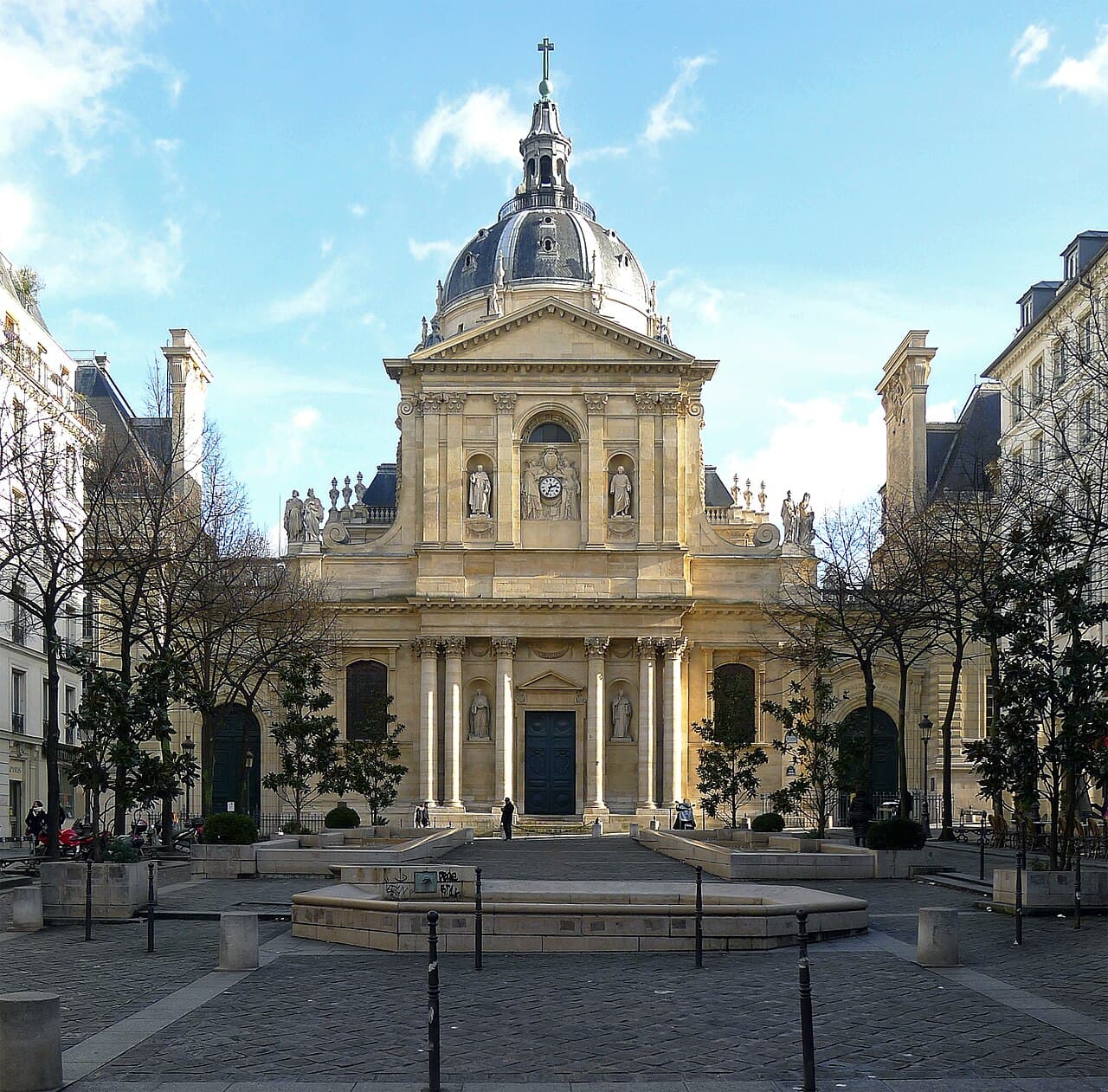
 The building is nineteenth century, put up between 1885 and 1901 around Richelieu's seventeenth-century chapel, which is the only part of the old college left standing. Photograph by Michal Osmenda, CC BY-SA 2.0, via Wikimedia Commons.
Through the nineteenth century those faculties of letters and science recovered their standing, and the Third Republic gave them a building to match their ambitions. Between 1885 and 1901 the crumbling medieval Sorbonne was demolished and replaced by the immense neo-Renaissance complex that stands today, designed by the architect Henri-Paul Nénot at the direction of the education minister Jules Ferry; the first section was inaugurated in 1889 for the centenary of the Revolution (Chancellerie des universités de Paris). In 1896 the reorganised faculties were formally reunited as the University of Paris.
Then came the rupture that ended the single university. In May 1968 the Sorbonne became one of the flashpoints of the largest protest movement in modern French history. Student demonstrations that began at the university's Nanterre campus spread into the Latin Quarter, the Sorbonne was occupied repeatedly through the month, and the unrest merged with a general strike that briefly halted the country before the building was cleared in mid-June (Chancellerie des universités de Paris). In response the government passed the Faure orientation law of 12 November 1968, which gave universities elected presidents and a measure of self-government. Under that reform the single University of Paris was dismantled. Between 1970 and 1971 it was divided into thirteen independent universities, numbered Paris 1 to Paris 13 (Wikipedia).
Several of the successors kept the old name, which is why "the Sorbonne" now points to more than one thing. Four French universities carry "Sorbonne" in their title today: Paris 1 Panthéon-Sorbonne, Sorbonne Nouvelle (Paris 3), Sorbonne Paris Nord (Paris 13), and Sorbonne University (Wikipedia). The last of these, Sorbonne Université, was created on 1 January 2018 by merging Paris-Sorbonne University (Paris 4), heir to the old faculties of letters, with Pierre and Marie Curie University (Paris 6), heir to the faculties of science (Wikipedia). It is organised in three faculties, arts and humanities, science and engineering, and medicine, and enrolled about 55,600 students in 2019. Its motto reaches back past every rupture: Créateurs de futurs depuis 1257, "creators of futures since 1257."
The historic building itself belongs to no single university. The Chancellerie des universités de Paris, a public body created in 1971, owns and administers the Sorbonne building and the shared assets of the former University of Paris, and its rooms are used by several of the successor institutions and the rectorate of the Paris academy (Chancellerie des universités de Paris). Inside it, the domed chapel that Cardinal Richelieu built between 1635 and 1642, when he was the college's administrator, still stands over his tomb, a survivor of the college that gave the whole enterprise its name.
Few institutions have shaped the idea of a university as completely as this one. The medieval Paris model, in which a self-governing guild of masters granted degrees recognised across borders, spread outward until it underlay much of European higher education. The vocabulary of academic life still in daily use, faculty and dean, rector and provost, licence and doctorate, was worked out in large part on the Left Bank of Paris in the thirteenth century.
The name carries a second meaning inside France itself. Because the Third Republic rebuilt the Sorbonne as a monument to secular, state-run learning, the building became a national symbol of science and culture standing free of the church that had once run it. To study "at the Sorbonne" came to mean entry into the intellectual life of the republic, and the phrase still carries that weight in French, out of proportion to any single university that now occupies the site.
The Sorbonne has also lent its name far beyond Paris. Sorbonne University runs a full campus in Abu Dhabi, and agreements bearing the name reach into partnerships around the world. That an institution legally dissolved more than fifty years ago can still license its identity across continents is a measure of how much the word came to mean, and how completely it detached from any one set of walls.
The Sorbonne is an unusual case in the study of heritage, because the thing itself, the single University of Paris, no longer exists. It was abolished in 1793, rebuilt, and then divided in 1970 into more than a dozen separate bodies. And yet almost nobody would say the Sorbonne is gone. Its name is on new buildings, its motto counts its age from 1257, and its scholars still trace a line back to Abelard and Aquinas. What survived was not the legal institution but something harder to dissolve: a continuity of memory and practice that outlived every reorganisation.
That is worth sitting with, because it shows how institutions actually persist. What carried across the ruptures was not the charter, which was torn up, nor even the buildings, which were demolished and rebuilt. It was the record: the libraries copied and recopied, the degrees whose meaning stayed constant, the roll of names each generation chose to remember and claim as its own. The University of Paris endured because enough people kept deciding that its story was theirs to continue, and kept the documents, the customs, and the reputation that made the claim credible.
The lesson holds at any scale. A single family, like a university, is not preserved by any one object or address, both of which can be lost. It is preserved by the continuity of what is written down and handed on, and by successors willing to take up the record and carry it further. The Sorbonne survived seven centuries of change not because nothing was destroyed, but because its memory was kept deliberately, generation after generation, and passed to the people who came next.
The historic Sorbonne stands in the 5th arrondissement, in the heart of the Latin Quarter, its long facades running between the Rue des Écoles and the tree-lined Place de la Sorbonne. Most of the interior is reserved for students and staff, but the exterior, the square, and the great courtyard are part of the everyday life of the quarter. The nearest Métro is Cluny–La Sorbonne on line 10, and the RER B stop at Luxembourg is a short walk away; the district is dense and walkable, and the surrounding streets hold much of what a visitor comes to see.
Access to the interior, including the seventeenth-century chapel with Richelieu's tomb and the painted ceremonial halls, is limited and generally arranged through guided tours or special events rather than casual entry. Because the building is shared among the Chancellerie and several successor universities, opening arrangements change with the academic calendar, and the most reliable source is the official site of the Chancellerie des universités de Paris or of Sorbonne University (Sorbonne University). Anyone planning a visit should check current tour availability in advance rather than expecting to walk in.
The setting rewards the walk regardless. The Panthéon, where many of the figures named in this article are buried, stands a few streets uphill; the medieval Collège des Bernardins and the Musée de Cluny, with its collection of the Middle Ages, are close by; and the Jardin du Luxembourg lies just beyond. To stand in the Place de la Sorbonne is to stand at the centre of a quarter that has been given over to study for the better part of nine hundred years, which is finally the most durable thing the Sorbonne has to show.
The building is nineteenth century, put up between 1885 and 1901 around Richelieu's seventeenth-century chapel, which is the only part of the old college left standing. Photograph by Michal Osmenda, CC BY-SA 2.0, via Wikimedia Commons.
Through the nineteenth century those faculties of letters and science recovered their standing, and the Third Republic gave them a building to match their ambitions. Between 1885 and 1901 the crumbling medieval Sorbonne was demolished and replaced by the immense neo-Renaissance complex that stands today, designed by the architect Henri-Paul Nénot at the direction of the education minister Jules Ferry; the first section was inaugurated in 1889 for the centenary of the Revolution (Chancellerie des universités de Paris). In 1896 the reorganised faculties were formally reunited as the University of Paris.
Then came the rupture that ended the single university. In May 1968 the Sorbonne became one of the flashpoints of the largest protest movement in modern French history. Student demonstrations that began at the university's Nanterre campus spread into the Latin Quarter, the Sorbonne was occupied repeatedly through the month, and the unrest merged with a general strike that briefly halted the country before the building was cleared in mid-June (Chancellerie des universités de Paris). In response the government passed the Faure orientation law of 12 November 1968, which gave universities elected presidents and a measure of self-government. Under that reform the single University of Paris was dismantled. Between 1970 and 1971 it was divided into thirteen independent universities, numbered Paris 1 to Paris 13 (Wikipedia).
Several of the successors kept the old name, which is why "the Sorbonne" now points to more than one thing. Four French universities carry "Sorbonne" in their title today: Paris 1 Panthéon-Sorbonne, Sorbonne Nouvelle (Paris 3), Sorbonne Paris Nord (Paris 13), and Sorbonne University (Wikipedia). The last of these, Sorbonne Université, was created on 1 January 2018 by merging Paris-Sorbonne University (Paris 4), heir to the old faculties of letters, with Pierre and Marie Curie University (Paris 6), heir to the faculties of science (Wikipedia). It is organised in three faculties, arts and humanities, science and engineering, and medicine, and enrolled about 55,600 students in 2019. Its motto reaches back past every rupture: Créateurs de futurs depuis 1257, "creators of futures since 1257."
The historic building itself belongs to no single university. The Chancellerie des universités de Paris, a public body created in 1971, owns and administers the Sorbonne building and the shared assets of the former University of Paris, and its rooms are used by several of the successor institutions and the rectorate of the Paris academy (Chancellerie des universités de Paris). Inside it, the domed chapel that Cardinal Richelieu built between 1635 and 1642, when he was the college's administrator, still stands over his tomb, a survivor of the college that gave the whole enterprise its name.
Few institutions have shaped the idea of a university as completely as this one. The medieval Paris model, in which a self-governing guild of masters granted degrees recognised across borders, spread outward until it underlay much of European higher education. The vocabulary of academic life still in daily use, faculty and dean, rector and provost, licence and doctorate, was worked out in large part on the Left Bank of Paris in the thirteenth century.
The name carries a second meaning inside France itself. Because the Third Republic rebuilt the Sorbonne as a monument to secular, state-run learning, the building became a national symbol of science and culture standing free of the church that had once run it. To study "at the Sorbonne" came to mean entry into the intellectual life of the republic, and the phrase still carries that weight in French, out of proportion to any single university that now occupies the site.
The Sorbonne has also lent its name far beyond Paris. Sorbonne University runs a full campus in Abu Dhabi, and agreements bearing the name reach into partnerships around the world. That an institution legally dissolved more than fifty years ago can still license its identity across continents is a measure of how much the word came to mean, and how completely it detached from any one set of walls.
The Sorbonne is an unusual case in the study of heritage, because the thing itself, the single University of Paris, no longer exists. It was abolished in 1793, rebuilt, and then divided in 1970 into more than a dozen separate bodies. And yet almost nobody would say the Sorbonne is gone. Its name is on new buildings, its motto counts its age from 1257, and its scholars still trace a line back to Abelard and Aquinas. What survived was not the legal institution but something harder to dissolve: a continuity of memory and practice that outlived every reorganisation.
That is worth sitting with, because it shows how institutions actually persist. What carried across the ruptures was not the charter, which was torn up, nor even the buildings, which were demolished and rebuilt. It was the record: the libraries copied and recopied, the degrees whose meaning stayed constant, the roll of names each generation chose to remember and claim as its own. The University of Paris endured because enough people kept deciding that its story was theirs to continue, and kept the documents, the customs, and the reputation that made the claim credible.
The lesson holds at any scale. A single family, like a university, is not preserved by any one object or address, both of which can be lost. It is preserved by the continuity of what is written down and handed on, and by successors willing to take up the record and carry it further. The Sorbonne survived seven centuries of change not because nothing was destroyed, but because its memory was kept deliberately, generation after generation, and passed to the people who came next.
The historic Sorbonne stands in the 5th arrondissement, in the heart of the Latin Quarter, its long facades running between the Rue des Écoles and the tree-lined Place de la Sorbonne. Most of the interior is reserved for students and staff, but the exterior, the square, and the great courtyard are part of the everyday life of the quarter. The nearest Métro is Cluny–La Sorbonne on line 10, and the RER B stop at Luxembourg is a short walk away; the district is dense and walkable, and the surrounding streets hold much of what a visitor comes to see.
Access to the interior, including the seventeenth-century chapel with Richelieu's tomb and the painted ceremonial halls, is limited and generally arranged through guided tours or special events rather than casual entry. Because the building is shared among the Chancellerie and several successor universities, opening arrangements change with the academic calendar, and the most reliable source is the official site of the Chancellerie des universités de Paris or of Sorbonne University (Sorbonne University). Anyone planning a visit should check current tour availability in advance rather than expecting to walk in.
The setting rewards the walk regardless. The Panthéon, where many of the figures named in this article are buried, stands a few streets uphill; the medieval Collège des Bernardins and the Musée de Cluny, with its collection of the Middle Ages, are close by; and the Jardin du Luxembourg lies just beyond. To stand in the Place de la Sorbonne is to stand at the centre of a quarter that has been given over to study for the better part of nine hundred years, which is finally the most durable thing the Sorbonne has to show.
History and founding
The medieval university
Notable scholars and alumni
Division and the modern Sorbonne
Cultural significance
What it preserves
Visiting and today
References and resources
- Sorbonne University, official site: the modern university formed in 2018, its faculties, figures, and visitor information.
- La Chancellerie des universités de Paris: history of the Sorbonne: authoritative account of the building, the 1885–1901 rebuild, and the 1970s division.
- Wikipedia: University of Paris: origins around 1150, the medieval faculties and nations, suppression in 1793, and the split into thirteen universities.
- Wikipedia: Collège de Sorbonne: the 1257 foundation, Robert de Sorbon, Richelieu's rebuilding, and the early printing press.
- Wikipedia: Sorbonne University: the 2018 merger of Paris 4 and Paris 6, student numbers, and prize record.
- Wikipedia: Sorbonne (building): the historic building and the present-day universities that carry the name.
- Wikipedia: Robert de Sorbon: the founder's life and his role at the court of Louis IX.
- Britannica: University of Paris: concise overview of the university's medieval rise, scholasticism, and its great teachers.