Heritage · Country
Djibouti Culture and Heritage
Djibouti's heritage lives largely in the spoken word: Somali gabay poetry and Afar oral tradition serve as the national archive, alongside the salt caravans of Lake Assal, the rock engravings of Abourma and a radio vault of five thousand reels. A guide to a nation that remembers aloud.Written to last.
By Confinity Heritage Editorial · 2026-07-10 · 8-minute readQuiet tools, kept out of the way.
Djibouti is one of the smallest countries in Africa and one of the richest in a resource that fits in no museum case: the trained human memory. Its two great communities, the Somali and the Afar, are both heirs to oral civilisations in which poetry, genealogy and customary law were composed, memorised and transmitted without writing for centuries. When the explorer Richard Burton passed through the region in 1854 he reported that "the country teems with poets", and the Somalis have been called a nation of bards ever since. In Djibouti, verse is not decoration; it is the archive, the newspaper, the law report and the memorial.
The land holds its own records too. At Abourma, in the northern mountains, nearly three kilometres of rock engravings preserve the herds and hunts of a Neolithic world; at Lake Assal, the lowest point in Africa, Afar caravans still cut and carry salt as they have for generations; and in the capital, a radio vault of five thousand master tapes guards half a century of Horn of Africa music.
Djibouti covers about 23,200 square kilometres at the mouth of the Red Sea, bordered by Eritrea to the north, Ethiopia to the west and south, and Somalia to the south-east, facing Yemen across the Bab el-Mandeb strait, one of the busiest shipping lanes on earth. The landscape is volcanic and extreme: the Gulf of Tadjoura bites deep into the coast, ending in the eerie sunken bay of Ghoubbet al-Kharab; Lake Assal lies 155 metres below sea level, the lowest point in Africa and among the saltiest waters anywhere; the Grand Bara desert spreads white and flat to the south; and Mousa Ali, on the triple border with Eritrea and Ethiopia, rises to 2,028 metres. In the Goda Mountains, the Day Forest preserves a relic stand of juniper, a green island in a mineral country.
The population of roughly 1.1 million is concentrated overwhelmingly in the capital. Somalis, chiefly of the Issa clan, form the majority; the Afar, whose lands stretch across the north and west into Ethiopia and Eritrea, are the second great community; and Arab, Ethiopian, Yemeni and French residents add further layers. French and Arabic are the official languages, Somali and Afar the languages of home and poetry. The economy turns on the port, the railway to Addis Ababa, and the foreign military bases drawn by a location that has made this coast a crossroads since antiquity.
Djibouti City. The capital, home to well over half the population, was laid out by the French from 1888 on coral islets and causeways, and became the colony's capital in 1896. Its European Quarter keeps arcaded, whitewashed colonial buildings around the Place Menelik; the African quarters bustle around the central market and the Hamoudi Mosque, the city's early twentieth-century landmark; and the port, railway station and container terminals are the country's economic heart.
Balbala. Begun in the 1960s as an informal settlement beyond the colonial control line, Balbala is now a city in its own right, holding roughly half the capital's people. It is the youthful, working face of urban Djibouti, and its mosques, markets and football pitches are where the country's future culture is being made.
Tadjoura. The white-painted town on the north shore of the gulf is among the oldest settlements on this coast, seat of a historic Afar sultanate, long a terminus of caravan trade with the Ethiopian interior, and known for its old mosques. The poet Arthur Rimbaud passed through in the 1880s organising caravans to Harar.
Obock. The first French foothold, acquired by treaty in 1862 and briefly the colonial capital before the administration moved across the gulf. Today it is a quiet fishing town facing the strait, with the ruins of its short imperial moment around it.
Ali Sabieh and Dikhil. The chief towns of the interior south, railway and caravan towns respectively, anchor the Issa pastoral country and the Gobaad plain, where markets, livestock and cross-border kinship keep the nomadic economy turning.
The Djibouti area has been a corridor for as long as humans have moved between Africa and Arabia. Obsidian and shells travelled through here in prehistory, and the engravings of Abourma, discovered on the Makarassou massif in the Tadjoura region, record a vanished pastoral world of giraffes, antelopes, herders and hunters across nearly three kilometres of rock, the largest rock-art site in the country and one of the most extensive in the Horn. Ancient Egyptian texts placed the incense land of Punt somewhere on these coasts, and the ports of the gulf later traded within the orbit of Aksum and the medieval Muslim sultanates of Ifat and Adal, through which Islam arrived early and peacefully along the caravan roads.
For centuries the Afar sultanates of Tadjoura, Raheita and Gobaad and the Issa clan structures governed the land between coast and plateau. The French bought the anchorage of Obock in 1862 and, as the Suez Canal transformed the Red Sea into a global artery, built French Somaliland around the new harbour of Djibouti, its capital from 1896. The railway inland, begun in 1897, reached Addis Ababa in 1917 and bound the colony's fortunes to Ethiopia's trade. After contested referendums in 1958 and 1967, the territory was renamed the French Territory of the Afars and the Issas; independence came at last on 27 June 1977, with Hassan Gouled Aptidon as first president. A civil war between the government and the Afar-led FRUD movement in the 1990s ended in peace accords and power-sharing, completed in 2001, and the state has since balanced its two communities within a single national project, symbolised by the flag's blue and green bands joined at a red star of unity.
The origin of the name Djibouti is itself a piece of oral tradition, told rather than documented. The most cited account derives it from an Afar word, often given as gabouti, for a woven palm-fibre plate or mat, an everyday nomad object raised to the dignity of a national name; other tellings point to the shape of the coast or older place names. Tadjoura, Obock and Assal likewise carry Afar meanings, and the map of the country reads as a gazetteer of pastoral life.
Somali and Afar are both Cushitic languages, kin within the Afroasiatic family, and both are above all languages of the voice. Somali was written systematically only from 1972, when Somalia adopted a Latin orthography; in Djibouti it remains chiefly a spoken and broadcast language, its prestige carried by poetry rather than print. Afar, too, is increasingly written in Latin script, but its deep literature is oral: genealogies, songs and the narrative repertoire of the elders. French, the language of administration and schooling since the colonial era, and Arabic, the language of faith and of long trade across the strait, complete a four-language everyday in which a market conversation can move through all four without ceremony. This layering is the linguistic memory of the country: each language marks an era and a relationship, and none has erased the others.
Poetry stands where other nations put their monuments. Somali verse is a formal art with named genres, the long, grave gabay for argument and public affairs, the jiifto, the geeraar once composed on horseback, the buraanbur of women's celebration and lament, governed by strict rules of metre and alliteration that make a poem memorable, checkable and quotable across generations. A powerful poem travels: it is memorised by reciters, answered by rival poets in chain-debates, and can settle or inflame a dispute years after its composition. The Issa carry, alongside this, the xeer, a customary law held entirely in memory by elders and applied through negotiated judgement. Afar society keeps its own oral order, including the dagu, the formal exchange of news in which two travellers who meet sit and render account of everything worth knowing from the roads behind them, a peer-to-peer information network older than any telegraph, still functioning across the desert.
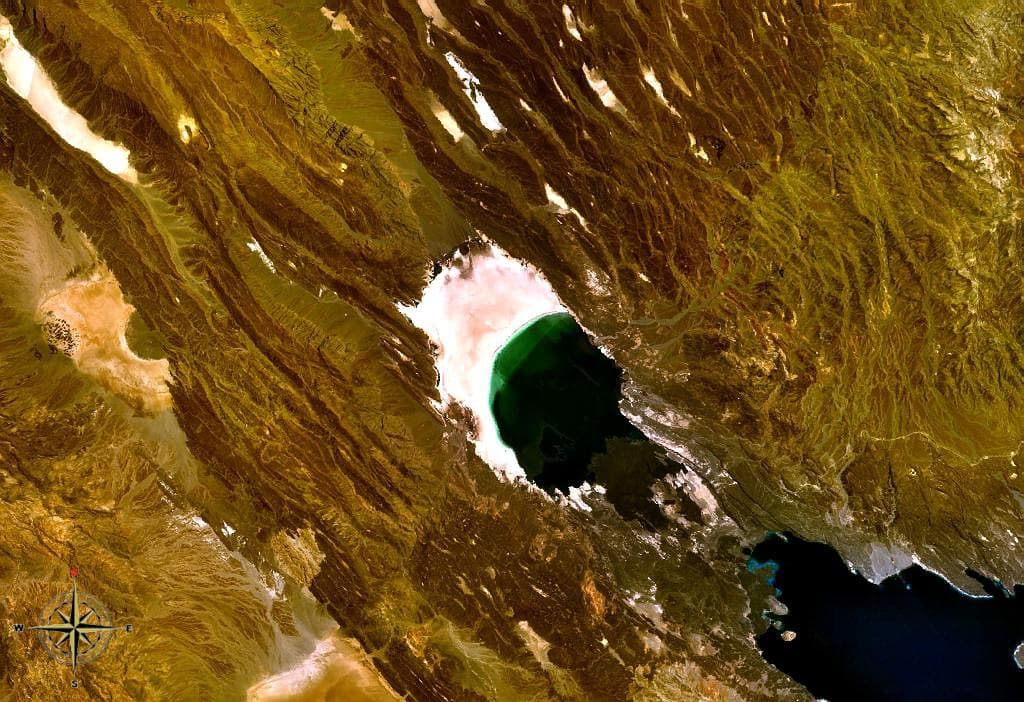
 Lake Assal is the lowest point in Africa and among the saltiest bodies of water on earth, and Afar caravans have cut salt here and traded it inland for centuries. Photograph by Benlilkon93, CC BY-SA 4.0, via Wikimedia Commons.
Nomadic skill remains the substrate of material culture: the portable house of bent boughs and woven mats, loaded onto camels at each move; mats, fans and vessels plaited from palm fibre; the salt caravans that carry slabs from Lake Assal towards the highlands. Cuisine tells the crossroads story, Yemeni-style oven fish in the capital, skoudehkaris rice with meat, lahoh flatbreads, spiced tea, and the afternoon khat session, at which much of the country's conversation, business and poetry actually happens. Music and dance bind both communities: the dhaanto rhythm, wedding dances, and the oud-led urban orchestras that made independent Djibouti's sound. At a wedding, the xeedho, a decorated vessel of dried camel meat prepared by the bride's family and ceremonially opened by the groom's, condenses hospitality, kinship and craft into a single object, and in 2023 it became the country's first element inscribed by UNESCO.
Djibouti is a Muslim country almost in its entirety; Islam is the state religion, practised in the Sunni tradition under the Shafi'i school, and the constitution guarantees freedom of worship to others. Islam here is old and oceanic, carried across the strait in the faith's first centuries by traders and refugees rather than armies, and its practice bears the gentle imprint of Sufi tradition: reverence for saintly figures, dhikr recitation, and pilgrimage to tombs such as that of Sheikh Abu Yazid in the Goda Mountains. The mosque anchors every settlement, from the Hamoudi Mosque in the capital's old centre to the prayer grounds of nomad camps marked by a line of stones towards Mecca.
Older Cushitic cosmologies, shared once by Somali and Afar ancestors, survive in traces, in place names, in stories of jinn that inhabit ruins and islands (the "Devil's Island" of the Ghoubbet is the most famous), and in weather and healing lore that sits comfortably beneath Islamic practice. Ramadan and the two Eids structure the year; religious festivals are family reunions as much as observances, drawing relatives home from the diaspora. Small Christian communities, Ethiopian Orthodox, Roman Catholic, Greek Orthodox and Protestant, serve residents of Ethiopian, European and other origins, a reminder that this port has always held more peoples than its size suggests.
Death in Djibouti is met with the speed and simplicity of Islamic rite, and with the full weight of two communal traditions. The dead are buried quickly, the same day where possible. The body is washed and perfumed by relatives of the same sex, wrapped in plain white cloth, prayed over in the janazah, and carried by the men to the cemetery, where the grave is simple and faces Mecca; lavish tombs are discouraged, for all are equal in death. The community's part then begins in earnest: for three days the family receives condolences, tacsi, while neighbours and kin bring food so that the bereaved household need not cook, and the Qur'an is recited through the sitting hours. Grief is expected to be real but measured; loud despair is thought to question God's decree. A widow observes the iddah of four months and ten days. Charity given in the name of the dead, and prayers offered for them at the two Eids and on visits to the grave, keep the relationship open.
Alongside the rites of faith runs the remembrance of the word. In cultures where poetry is the record, an elegy is a monument: Somali tradition includes the baroorodiiq, the poem of lament composed on the death of a notable person, weighing a life in public verse, and the great dead of both communities live on in poems, songs and genealogies recited long after the graves themselves have faded into the desert. Genealogy is itself an act of remembrance; children learn chains of ancestors' names by heart, so every person carries a spoken family archive. The Afar dagu ensures that news of a death travels reliably across vast distances, obliging kin to mourn together even when scattered, and today the telephone and the diaspora's group chats extend the same duty worldwide: a death in Balbala is mourned the same evening in Paris and Minneapolis, and remittances flow home to honour the funeral obligations. The landscape holds older memorials too: pre-Islamic burial cairns and tumuli stand across the country, studied by Djiboutian archaeologists as the stone remembrance of peoples whose names the poems no longer carry, a quiet argument for writing things down as well as reciting them.
Djibouti's family record is spoken, and it is spoken in a form that makes it verifiable. Somali genealogy runs on abtirsiin, the recitation of a line of fathers, and a person is expected to be able to name a long sequence of ancestors and to place themselves within a clan and sub-clan by doing so. Afar descent works through similar recitation of kedo, the lineage. In both, the genealogy is not private family history: it is how a person is located socially, legally and territorially.
The written record is French and it is partial. The colony of French Somaliland took shape from the 1880s, and civil registration was applied first and most completely to French citizens, less so to the Somali and Afar population it governed. Those series are split between Djibouti's own archives and the French overseas archives at Aix-en-Provence. Independence came in 1977, and modern civil registration has been built out since.
Two other archives matter for Djiboutian families. The port and railway to Addis Ababa generated employment records covering a large share of the working population for much of the twentieth century. And Djibouti has been a country of arrival as well as departure, hosting refugees from Somalia, Ethiopia and Yemen, so a great many families here appear in the registration systems of UNHCR rather than of any state.
Institutional preservation is young and centred on the Centre d'Études et de Recherche de Djibouti (CERD), the state research body founded in 1979, whose remit spans archaeology, languages and cultural heritage; its Institute of Archaeological and Historical Research, created in 2014, surveys and rescues sites, including the burial tumuli and rock art threatened by infrastructure works. A 2005 framework law protects tangible cultural heritage, and Djibouti works within UNESCO's conventions, with the 2003 intangible-heritage convention bearing the first fruit: the 2023 inscription of the xeedho, achieved with a safeguarding plan that formed an association of women practitioners and trained thirty girls and thirty teachers in the tradition.
The World Heritage file is the next frontier. Djibouti's tentative list, drawn up in 2015, includes Lake Assal, the Abourma engravings and other natural and cultural sites, and the state has moved deliberately on Abourma: UNESCO-supported preparation of the nomination, a national monument declaration, and the formal submission of the file for what would be the country's first World Heritage site. Heritage work here contends with harsh realities, extreme climate, thin budgets, urban growth, and the fact that so much of the national inheritance is intangible and therefore mortal, which is why the safeguarding of practices and recordings carries the urgency that stone conservation has elsewhere.
Djibouti's most celebrated digital heritage story begins in a cool, guarded room at Radiodiffusion-Télévision de Djibouti. Since independence in 1977 the national broadcaster preserved its master recordings, over five thousand reels and cassettes of music, poetry and speeches from across the Horn, one of the best-kept sound archives in Africa. From 2019, after long negotiation, the label Ostinato Records was permitted to digitise the vault, and the resulting "Djibouti Archives" releases, beginning with the anthology of the forty-member supergroup 4 Mars, carried Djiboutian music to global audiences for the first time; the national radio band Groupe RTD's The Dancing Devils of Djibouti followed as a new studio recording. A new national library and archives building has since risen in the capital to house the country's records.
Beyond the vault, digital work is distributed and largely informal: CERD documents sites, languages and traditions; scholars record gabay and buraanbur performances that once lived only in memory; and the diaspora uploads weddings, dhaanto dances and poetry duels daily, building an unplanned national archive on commercial platforms. The task ahead, as elders who hold whole poetic repertoires age, is systematic recording, an archive of the voice to stand beside the archive of the tape.
Djibouti's modern literature grew, paradoxically, in French. William Syad, with his 1959 collection Khamsine, opened the path, and Abdourahman A. Waberi, born in Djibouti City in 1965, has become the country's most translated voice, mapping his homeland in The Land Without Shadows, Transit and Passage of Tears, and reimagining the world's order in In the United States of Africa; writers such as Mouna-Hodan Ahmed have brought women's experience and social questions into the novel. The spoken arts have their contemporary stages too: the Fest'Horn festival, founded in 2000 by young Djiboutian organisers, gathers musicians from across the Horn each December under the banner of peace, and government cultural weeks keep dhaanto troupes and poets in front of new audiences.
The capital's soundscape mixes Somali pop from radio and satellite, Afar songs, Arabic devotional music and French hip-hop, and the Red Sea wind of global traffic blows through everything: sailors, soldiers, traders and railway engineers from five continents pass along the same seafront where caravans once loaded salt. The diaspora in France, North America and the Gulf sustains associations, festivals and publishing, and sends home not only money but recordings, footnotes and questions, the raw material of heritage in a country whose story is still mostly told aloud.
The xeedho joins the world's heritage. In December 2023, at the UNESCO committee meeting in Kasane, the xeedho wedding tradition became Djibouti's first inscribed element of intangible cultural heritage, with a safeguarding project that has already trained a new generation of women practitioners and teachers.
A radio vault opens. The patient preservation of RTD's five thousand master tapes, and their digitisation from 2019, rescued half a century of Horn of Africa music and returned bands such as 4 Mars to the world's ears, proof that a small country's archive can be a global treasure.
Abourma steps towards the World Heritage List. The declaration of the Abourma rock art site as a national monument and the submission of its nomination file have put Djibouti on the road to its first World Heritage site, with UNESCO support and Djiboutian researchers leading the documentation.
A literature finds its readers. From Syad's pioneering verse to Waberi's international career, Djiboutian writing has moved in two generations from colonial margin to world literature, carrying the cadences of an oral civilisation into print.
Lake Assal is the lowest point in Africa and among the saltiest bodies of water on earth, and Afar caravans have cut salt here and traded it inland for centuries. Photograph by Benlilkon93, CC BY-SA 4.0, via Wikimedia Commons.
Nomadic skill remains the substrate of material culture: the portable house of bent boughs and woven mats, loaded onto camels at each move; mats, fans and vessels plaited from palm fibre; the salt caravans that carry slabs from Lake Assal towards the highlands. Cuisine tells the crossroads story, Yemeni-style oven fish in the capital, skoudehkaris rice with meat, lahoh flatbreads, spiced tea, and the afternoon khat session, at which much of the country's conversation, business and poetry actually happens. Music and dance bind both communities: the dhaanto rhythm, wedding dances, and the oud-led urban orchestras that made independent Djibouti's sound. At a wedding, the xeedho, a decorated vessel of dried camel meat prepared by the bride's family and ceremonially opened by the groom's, condenses hospitality, kinship and craft into a single object, and in 2023 it became the country's first element inscribed by UNESCO.
Djibouti is a Muslim country almost in its entirety; Islam is the state religion, practised in the Sunni tradition under the Shafi'i school, and the constitution guarantees freedom of worship to others. Islam here is old and oceanic, carried across the strait in the faith's first centuries by traders and refugees rather than armies, and its practice bears the gentle imprint of Sufi tradition: reverence for saintly figures, dhikr recitation, and pilgrimage to tombs such as that of Sheikh Abu Yazid in the Goda Mountains. The mosque anchors every settlement, from the Hamoudi Mosque in the capital's old centre to the prayer grounds of nomad camps marked by a line of stones towards Mecca.
Older Cushitic cosmologies, shared once by Somali and Afar ancestors, survive in traces, in place names, in stories of jinn that inhabit ruins and islands (the "Devil's Island" of the Ghoubbet is the most famous), and in weather and healing lore that sits comfortably beneath Islamic practice. Ramadan and the two Eids structure the year; religious festivals are family reunions as much as observances, drawing relatives home from the diaspora. Small Christian communities, Ethiopian Orthodox, Roman Catholic, Greek Orthodox and Protestant, serve residents of Ethiopian, European and other origins, a reminder that this port has always held more peoples than its size suggests.
Death in Djibouti is met with the speed and simplicity of Islamic rite, and with the full weight of two communal traditions. The dead are buried quickly, the same day where possible. The body is washed and perfumed by relatives of the same sex, wrapped in plain white cloth, prayed over in the janazah, and carried by the men to the cemetery, where the grave is simple and faces Mecca; lavish tombs are discouraged, for all are equal in death. The community's part then begins in earnest: for three days the family receives condolences, tacsi, while neighbours and kin bring food so that the bereaved household need not cook, and the Qur'an is recited through the sitting hours. Grief is expected to be real but measured; loud despair is thought to question God's decree. A widow observes the iddah of four months and ten days. Charity given in the name of the dead, and prayers offered for them at the two Eids and on visits to the grave, keep the relationship open.
Alongside the rites of faith runs the remembrance of the word. In cultures where poetry is the record, an elegy is a monument: Somali tradition includes the baroorodiiq, the poem of lament composed on the death of a notable person, weighing a life in public verse, and the great dead of both communities live on in poems, songs and genealogies recited long after the graves themselves have faded into the desert. Genealogy is itself an act of remembrance; children learn chains of ancestors' names by heart, so every person carries a spoken family archive. The Afar dagu ensures that news of a death travels reliably across vast distances, obliging kin to mourn together even when scattered, and today the telephone and the diaspora's group chats extend the same duty worldwide: a death in Balbala is mourned the same evening in Paris and Minneapolis, and remittances flow home to honour the funeral obligations. The landscape holds older memorials too: pre-Islamic burial cairns and tumuli stand across the country, studied by Djiboutian archaeologists as the stone remembrance of peoples whose names the poems no longer carry, a quiet argument for writing things down as well as reciting them.
Djibouti's family record is spoken, and it is spoken in a form that makes it verifiable. Somali genealogy runs on abtirsiin, the recitation of a line of fathers, and a person is expected to be able to name a long sequence of ancestors and to place themselves within a clan and sub-clan by doing so. Afar descent works through similar recitation of kedo, the lineage. In both, the genealogy is not private family history: it is how a person is located socially, legally and territorially.
The written record is French and it is partial. The colony of French Somaliland took shape from the 1880s, and civil registration was applied first and most completely to French citizens, less so to the Somali and Afar population it governed. Those series are split between Djibouti's own archives and the French overseas archives at Aix-en-Provence. Independence came in 1977, and modern civil registration has been built out since.
Two other archives matter for Djiboutian families. The port and railway to Addis Ababa generated employment records covering a large share of the working population for much of the twentieth century. And Djibouti has been a country of arrival as well as departure, hosting refugees from Somalia, Ethiopia and Yemen, so a great many families here appear in the registration systems of UNHCR rather than of any state.
Institutional preservation is young and centred on the Centre d'Études et de Recherche de Djibouti (CERD), the state research body founded in 1979, whose remit spans archaeology, languages and cultural heritage; its Institute of Archaeological and Historical Research, created in 2014, surveys and rescues sites, including the burial tumuli and rock art threatened by infrastructure works. A 2005 framework law protects tangible cultural heritage, and Djibouti works within UNESCO's conventions, with the 2003 intangible-heritage convention bearing the first fruit: the 2023 inscription of the xeedho, achieved with a safeguarding plan that formed an association of women practitioners and trained thirty girls and thirty teachers in the tradition.
The World Heritage file is the next frontier. Djibouti's tentative list, drawn up in 2015, includes Lake Assal, the Abourma engravings and other natural and cultural sites, and the state has moved deliberately on Abourma: UNESCO-supported preparation of the nomination, a national monument declaration, and the formal submission of the file for what would be the country's first World Heritage site. Heritage work here contends with harsh realities, extreme climate, thin budgets, urban growth, and the fact that so much of the national inheritance is intangible and therefore mortal, which is why the safeguarding of practices and recordings carries the urgency that stone conservation has elsewhere.
Djibouti's most celebrated digital heritage story begins in a cool, guarded room at Radiodiffusion-Télévision de Djibouti. Since independence in 1977 the national broadcaster preserved its master recordings, over five thousand reels and cassettes of music, poetry and speeches from across the Horn, one of the best-kept sound archives in Africa. From 2019, after long negotiation, the label Ostinato Records was permitted to digitise the vault, and the resulting "Djibouti Archives" releases, beginning with the anthology of the forty-member supergroup 4 Mars, carried Djiboutian music to global audiences for the first time; the national radio band Groupe RTD's The Dancing Devils of Djibouti followed as a new studio recording. A new national library and archives building has since risen in the capital to house the country's records.
Beyond the vault, digital work is distributed and largely informal: CERD documents sites, languages and traditions; scholars record gabay and buraanbur performances that once lived only in memory; and the diaspora uploads weddings, dhaanto dances and poetry duels daily, building an unplanned national archive on commercial platforms. The task ahead, as elders who hold whole poetic repertoires age, is systematic recording, an archive of the voice to stand beside the archive of the tape.
Djibouti's modern literature grew, paradoxically, in French. William Syad, with his 1959 collection Khamsine, opened the path, and Abdourahman A. Waberi, born in Djibouti City in 1965, has become the country's most translated voice, mapping his homeland in The Land Without Shadows, Transit and Passage of Tears, and reimagining the world's order in In the United States of Africa; writers such as Mouna-Hodan Ahmed have brought women's experience and social questions into the novel. The spoken arts have their contemporary stages too: the Fest'Horn festival, founded in 2000 by young Djiboutian organisers, gathers musicians from across the Horn each December under the banner of peace, and government cultural weeks keep dhaanto troupes and poets in front of new audiences.
The capital's soundscape mixes Somali pop from radio and satellite, Afar songs, Arabic devotional music and French hip-hop, and the Red Sea wind of global traffic blows through everything: sailors, soldiers, traders and railway engineers from five continents pass along the same seafront where caravans once loaded salt. The diaspora in France, North America and the Gulf sustains associations, festivals and publishing, and sends home not only money but recordings, footnotes and questions, the raw material of heritage in a country whose story is still mostly told aloud.
The xeedho joins the world's heritage. In December 2023, at the UNESCO committee meeting in Kasane, the xeedho wedding tradition became Djibouti's first inscribed element of intangible cultural heritage, with a safeguarding project that has already trained a new generation of women practitioners and teachers.
A radio vault opens. The patient preservation of RTD's five thousand master tapes, and their digitisation from 2019, rescued half a century of Horn of Africa music and returned bands such as 4 Mars to the world's ears, proof that a small country's archive can be a global treasure.
Abourma steps towards the World Heritage List. The declaration of the Abourma rock art site as a national monument and the submission of its nomination file have put Djibouti on the road to its first World Heritage site, with UNESCO support and Djiboutian researchers leading the documentation.
A literature finds its readers. From Syad's pioneering verse to Waberi's international career, Djiboutian writing has moved in two generations from colonial margin to world literature, carrying the cadences of an oral civilisation into print.
National Overview
Notable Cities
Historical Foundations
Linguistic and Etymological Roots
Cultural Identity
Religion and Spirituality
Remembrance and Mourning Traditions
Tracing a Family in Djibouti
Heritage Preservation Efforts
Digital Heritage
Contemporary Cultural Influences
Success Stories
References and resources
- UNESCO Intangible Cultural Heritage, Xeedho, the 2023 inscription record and safeguarding measures.
- UNESCO, Xeedho: first intangible cultural heritage treasure from Djibouti, background on the tradition and the inscription.
- UNESCO World Heritage Centre, Djibouti, state-party page and tentative list.
- UNESCO, Djibouti considers nominating Abourma rock art site to the World Heritage List, the nomination effort for the country's first site.
- Middle East Eye, How the "Djibouti Archives" restored a forgotten chapter of the country's musical history, the RTD vault and its digitisation.
- Centre d'Études et de Recherche de Djibouti (CERD), the national research institution for archaeology, languages and heritage.
- African Studies Centre Leiden, Somali literature web dossier, Somali oral poetry, its genres and scholarship.
- EthnoMed, Somali funeral traditions, burial, condolence and mourning practice as observed in Somali communities.
- Encyclopaedia Britannica, Djibouti, geography, history and political background.