Heritage · Landmark
Machu Picchu — the city that was never lost
An Inca royal estate on a cloud-forest ridge, farmed by local families long before the explorers arrived, now balancing a million and a half visitors a year against fragile stone — while Quechua culture keeps the living memory of the Andes.Written to last.
By Confinity Heritage Editorial · 2026-07-10 · 7-minute readQuiet tools, kept out of the way.
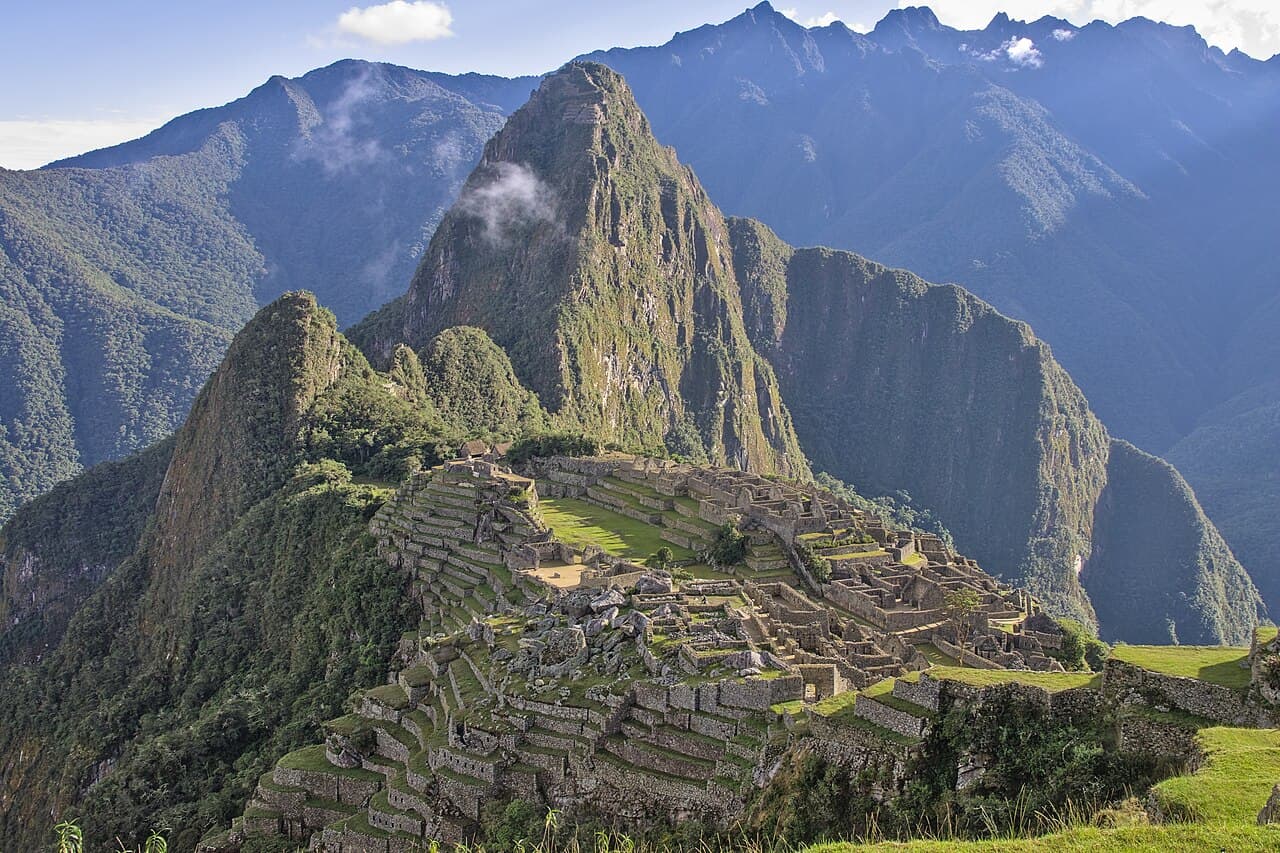
The photographs make Machu Picchu look like an ending, a lost city, empty and silent, waiting on its ridge to be found. The truth runs the other way. Machu Picchu was never lost to the people of the valley below, who farmed its terraces, knew its paths, and occasionally scratched their names on its walls while the outside world imagined it into legend. The site's real story is not about discovery at all. It is about who keeps a place in memory when history stops writing it down, and what happens when the world finally notices.
Machu Picchu sits at about 2,430 metres above sea level, on a narrow saddle between two peaks above a hairpin bend of the Urubamba River, where the Andes fall away into cloud forest. Most archaeologists agree it was built around the middle of the fifteenth century as an estate of the emperor Pachacuti, the ruler whose conquests transformed the Inca state into the largest empire of the pre-Columbian Americas. It was a royal retreat and a ceremonial centre, home to perhaps 750 people at its height, nobles, attendants, priests, and the farmers and craftspeople who sustained them.
What survives is a masterclass in building with a mountain rather than on it. Some two hundred structures step down the ridge on granite terraces that double as retaining walls and farmland. Spring water was channelled through a descending chain of stone fountains. The finest buildings, the Temple of the Sun, the Intihuatana stone, the Temple of the Three Windows, are worked in mortarless ashlar masonry so precise that the joints have shed five centuries of earthquakes. The city was occupied for scarcely a hundred years. After the Spanish invasion shattered the Inca state in the sixteenth century, the estate lost its purpose and its patrons, and the forest closed over the upper terraces. The Spanish, as far as records show, never found it.
On 24 July 1911 the American explorer Hiram Bingham, guided up the ridge by a local farmer named Melchor Arteaga, walked into the overgrown ruins and into history. His expeditions, backed by Yale University and the National Geographic Society, cleared, mapped, and photographed the site, and his book Lost City of the Incas fixed the romance of discovery in the world's imagination.
But Bingham found families already living there, farming the old terraces, and it was a local boy who led him along the final stretch of path. Nine years earlier, in 1902, the Cusco farmer Agustín Lizárraga had visited the ruins and left his name and the date written in charcoal on a wall of the Temple of the Three Windows. The place appears on a Peruvian atlas published in 1904. And in 2022, the historian Donato Amado Gonzales and the archaeologist Brian S. Bauer published evidence that the Incas themselves called the town Huayna Picchu, after the sharp peak beside it, the name Machu Picchu, "old peak" in Quechua, belonging properly to the taller mountain behind. Even the site's name, it turns out, was a memory held locally and mislaid globally.
The afterlife of Bingham's expeditions carried its own lesson. Thousands of excavated objects, ceramics, stone and metal work, human remains, were shipped to Yale, and Peru spent the better part of a century asking for them back. Under an agreement reached in November 2010, the collections returned between 2011 and 2012 to Cusco, where they are now held and displayed at the Casa Concha museum under a joint research centre run by Yale and the National University of San Antonio Abad del Cusco. Memory, the settlement acknowledged, belongs closest to its source.
In 1983 UNESCO inscribed the Historic Sanctuary of Machu Picchu on the World Heritage List as a mixed cultural and natural site, a rare double recognition. The sanctuary protects more than 32,000 hectares of the surrounding landscape: the archaeological network of the ridge, dozens of linked sites along the Inca Trail, and cloud-forest habitat that shelters orchids by the hundred species and the endangered Andean spectacled bear. In 2014 the Qhapaq Ñan, the vast Andean road system of which the trail to Machu Picchu is one thread, was inscribed as well, across six countries. The listings describe a single truth: the citadel is not an isolated monument but the visible knot in a web of roads, terraces, shrines, and settlements that organised an entire mountain world.
 The terraces are structural as much as agricultural: layers of stone, gravel and soil that drain a site which takes about two metres of rain a year. Photograph by F Delventhal, CC BY 2.0, via Wikimedia Commons.
Machu Picchu's risks are the risks of being loved at industrial scale.
The first is wear. The site was built for hundreds of residents and now receives well over a million visitors in a good year. Feet polish and loosen stone treads, compact the earth of the plazas, and erode the paths; the terraces that hold the ridge together were engineered for crops. The setting compounds the problem: steep slopes, heavy seasonal rain, and real landslide risk in the gorge below, where the town of Machupicchu Pueblo, the railhead formerly known as Aguas Calientes, has grown rapidly and unplanned to serve the flow.
The second is pressure on the wider sanctuary. UNESCO's committee has repeatedly pressed Peru over visitor management, the state of the town, and infrastructure proposals in the region, including a long-debated new airport for the Sacred Valley. The concern is cumulative: no single project would undo the site, but each one redraws the landscape the sanctuary was created to protect.
Peru's answer has been to meter access. Timed entry tickets arrived in 2017, fixed one-way walking circuits in 2019, and from June 2024 a reorganised system of three circuits and ten routes distributes visitors across the site, with daily caps of 4,500 in low season rising to 5,600 at peak periods. Climbs up Huayna Picchu and Machu Picchu mountain carry small separate quotas, and the Inca Trail itself is limited to 500 people a day including guides and porters, closing each February for maintenance. The caps are imperfect and contested, livelihoods depend on volume, but they mark a shift from mining the site's fame to husbanding it.
The deepest continuity at Machu Picchu is not stone but speech. Quechua, the language family of the Inca state, is still spoken by millions of people across the Andes, and the sanctuary sits inside a living Quechua landscape. The porters who carry the Inca Trail's expedition loads are mostly Quechua-speaking farmers from highland communities; the terraces around the sanctuary still grow potatoes and maize by methods the Incas would recognise; weavers in the Cusco region keep textile traditions that pre-date the citadel itself. In Andean practice the peaks around the site, including the two Picchus, are apus, mountain lords, addressed with offerings and respect. For the communities of the valley, the citadel was never a mystery to be solved. It was a neighbour: a place grazed, farmed, and storied across the centuries in a language the guidebooks took a hundred years to consult.
The lesson of Machu Picchu is that memory does not vanish when the record-keepers look away; it moves into humbler hands. For four centuries the city survived in the knowledge of farming families, a path known, a name used, a terrace planted, while empires and archives forgot it entirely. Family memory works on exactly that scale. The events that matter are witnessed by a handful of people, and whether they survive depends not on fame but on whether someone ordinary keeps them: retells the story, keeps the photograph, writes the name on the wall. Confinity is built on the Lizárraga principle rather than the Bingham one, that the point is not to discover a family's past dramatically, later, from outside, but to keep it quietly, now, from within.
The terraces are structural as much as agricultural: layers of stone, gravel and soil that drain a site which takes about two metres of rain a year. Photograph by F Delventhal, CC BY 2.0, via Wikimedia Commons.
Machu Picchu's risks are the risks of being loved at industrial scale.
The first is wear. The site was built for hundreds of residents and now receives well over a million visitors in a good year. Feet polish and loosen stone treads, compact the earth of the plazas, and erode the paths; the terraces that hold the ridge together were engineered for crops. The setting compounds the problem: steep slopes, heavy seasonal rain, and real landslide risk in the gorge below, where the town of Machupicchu Pueblo, the railhead formerly known as Aguas Calientes, has grown rapidly and unplanned to serve the flow.
The second is pressure on the wider sanctuary. UNESCO's committee has repeatedly pressed Peru over visitor management, the state of the town, and infrastructure proposals in the region, including a long-debated new airport for the Sacred Valley. The concern is cumulative: no single project would undo the site, but each one redraws the landscape the sanctuary was created to protect.
Peru's answer has been to meter access. Timed entry tickets arrived in 2017, fixed one-way walking circuits in 2019, and from June 2024 a reorganised system of three circuits and ten routes distributes visitors across the site, with daily caps of 4,500 in low season rising to 5,600 at peak periods. Climbs up Huayna Picchu and Machu Picchu mountain carry small separate quotas, and the Inca Trail itself is limited to 500 people a day including guides and porters, closing each February for maintenance. The caps are imperfect and contested, livelihoods depend on volume, but they mark a shift from mining the site's fame to husbanding it.
The deepest continuity at Machu Picchu is not stone but speech. Quechua, the language family of the Inca state, is still spoken by millions of people across the Andes, and the sanctuary sits inside a living Quechua landscape. The porters who carry the Inca Trail's expedition loads are mostly Quechua-speaking farmers from highland communities; the terraces around the sanctuary still grow potatoes and maize by methods the Incas would recognise; weavers in the Cusco region keep textile traditions that pre-date the citadel itself. In Andean practice the peaks around the site, including the two Picchus, are apus, mountain lords, addressed with offerings and respect. For the communities of the valley, the citadel was never a mystery to be solved. It was a neighbour: a place grazed, farmed, and storied across the centuries in a language the guidebooks took a hundred years to consult.
The lesson of Machu Picchu is that memory does not vanish when the record-keepers look away; it moves into humbler hands. For four centuries the city survived in the knowledge of farming families, a path known, a name used, a terrace planted, while empires and archives forgot it entirely. Family memory works on exactly that scale. The events that matter are witnessed by a handful of people, and whether they survive depends not on fame but on whether someone ordinary keeps them: retells the story, keeps the photograph, writes the name on the wall. Confinity is built on the Lizárraga principle rather than the Bingham one, that the point is not to discover a family's past dramatically, later, from outside, but to keep it quietly, now, from within.
A royal estate in the clouds
The rediscovery that wasn't
A sanctuary of stone and cloud forest
What is at risk
Quechua living heritage
What Machu Picchu teaches about keeping
References and resources
- UNESCO World Heritage Centre, Historic Sanctuary of Machu Picchu
- UNESCO World Heritage Centre, Qhapaq Ñan, Andean Road System
- Yale News, Peru-Yale partnership for the future of Machu Picchu artifacts
- ScienceDaily, Study reconsiders name of Peru's Machu Picchu (Amado Gonzales and Bauer, 2022)
- CNN, Machu Picchu has been called the wrong name for over 100 years
- Latinoamérica 21, The "discovery" of Machu Picchu and the duel of narratives
- Ministry of Culture of Peru, official Machu Picchu ticketing and circuits