Heritage · University
Columbia University: History and Overview
Columbia University, founded in 1754 as King's College, is an Ivy League research university in New York City that administers the Pulitzer Prizes.Written to last.
By Confinity Heritage Editorial · Updated 2026-08-25 · 8-minute readQuiet tools, kept out of the way.
Columbia University is a private Ivy League research university in New York City and the oldest institution of higher education in the state of New York. Chartered in 1754 as King's College under George II, it has grown from a single colonial college into a research university with campuses across Morningside Heights and other parts of Manhattan. Columbia is widely known for its research output, its undergraduate Core Curriculum, and for administering the Pulitzer Prizes, awarded annually since 1917. Its story runs closely alongside that of New York City and the early American Republic.
Columbia traces its origins to 1754, when King's College was established by royal charter of George II, making it the fifth-oldest institution of higher education in the United States. Its first president was the clergyman and philosopher Samuel Johnson, who taught the earliest class near Trinity Church in Lower Manhattan. Early students and trustees included figures who would help shape the new nation, among them Alexander Hamilton and John Jay.
The American Revolution interrupted the college's work. After the war reached New York in 1776, instruction was suspended for about eight years; the library was looted and the college's sole building was requisitioned as a military hospital. When the institution reopened, the New York legislature passed an act in 1784 renaming it Columbia College, a gesture of support for the young republic.
Through the nineteenth century the college outgrew successive homes. It occupied its original Park Place site until 1857, then moved to a campus near 49th Street and Madison Avenue, where it remained until the 1890s. Under President Seth Low, the university relocated uptown to Morningside Heights, opening its new campus in 1897. The plan was carried out by the architects McKim, Mead and White, with Charles Follen McKim leading a monumental, classical design organized around a central library and open courts.
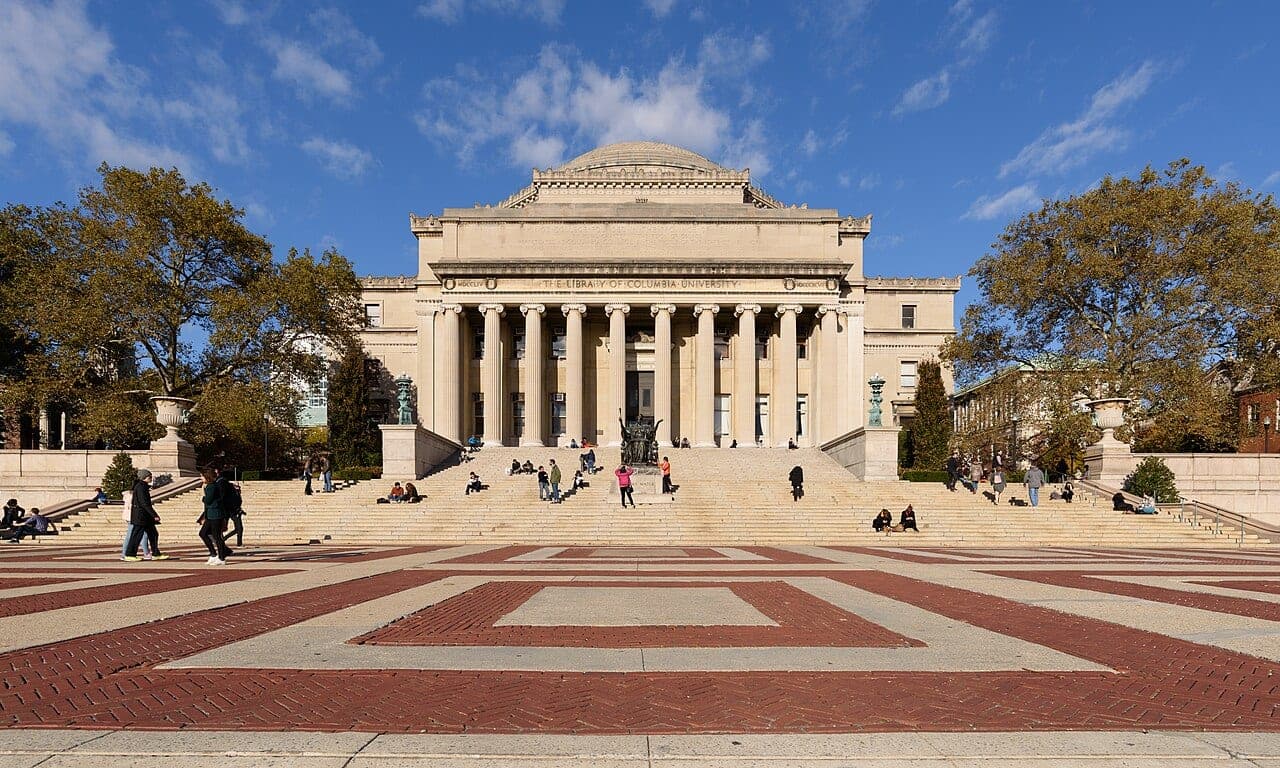
The Morningside Heights campus centers on Low Memorial Library, the domed Beaux-Arts building that gave the campus its architectural anchor and now houses university offices. Butler Library, completed in the 1930s, serves as the main research library and faces Low across the central green. Together the two buildings frame one of the most recognizable academic quadrangles in the country.
 Low Library has not been a library since 1934. It holds the administration, which is why occupying it has been the standard move in every Columbia protest since 1968. Photograph by Ajay Suresh, CC BY 2.0, via Wikimedia Commons.
Academically, Columbia is known for its Core Curriculum, a required sequence for undergraduates in Columbia College that grew out of a wartime course introduced during World War I and developed into classes such as Contemporary Civilization and Literature Humanities. The university comprises numerous schools and affiliated institutions, including Columbia College, the Fu Foundation School of Engineering and Applied Science, and graduate and professional schools of law, business, medicine, journalism, international affairs, and the arts. Barnard College and Teachers College are affiliated institutions with their own histories and governance.
Columbia is among the most research-intensive universities in the world, and it counts a large number of Nobel laureates among its faculty, alumni, and researchers; Britannica reports a figure on the order of one hundred. The university's most public scholarly role may be its stewardship of the Pulitzer Prizes, established by a bequest from the publisher Joseph Pulitzer and administered by Columbia since the first awards in 1917. The prizes, presented in journalism, letters, drama, and music, are overseen through the university and its Graduate School of Journalism.
Columbia's alumni and faculty include several U.S. presidents, Supreme Court justices, and many Nobel and Pulitzer winners, among them founding-era figures such as Alexander Hamilton and John Jay and later leaders across science, letters, and public life.
Allan Nevins came to Columbia's history faculty in 1928 out of newspaper work and was named DeWitt Clinton Professor of History in 1939. Writing lives of Grover Cleveland, Hamilton Fish, and John D. Rockefeller, he kept meeting the same hole in the record. The people who had done the deciding no longer wrote long letters, the telephone left nothing behind, and what they knew would go into the ground with them. His answer was to go and ask them while there was still time, with a stenographer in the room.
The office he founded at Columbia in 1948 was, by the centre's own account, the world's first institutional home of oral history. The university gave him almost nothing to begin with and told him not to expect operational funding. The method he improvised anyway, a long interview conducted across several sittings, recorded, transcribed, and reviewed with the narrator before release, became the standard practice of a discipline that did not exist before he started.
The archive that grew out of it now holds more than twenty thousand hours of recorded and transcribed interview and is consulted by almost anyone writing on the twentieth century. Frances Perkins, Bayard Rustin, and Thurgood Marshall sat for it at length. Ninety-three voices in it chronicle the African American press. More than six hundred are personal accounts of New Yorkers gathered after September 11, 2001. The collection sits in the Rare Book and Manuscript Library in Butler, while the interviewing continues from a separate research centre that has been recording the official oral history of the Obama presidency since 2019, a project planned at four hundred narrators and twelve hundred hours of audio and video. Nevins's premise has held: a life told aloud, taken down with care, is a source.
Today Columbia operates as a large private research university, drawing students from across the United States and around the world to its schools in Manhattan. In addition to the historic Morningside Heights campus, the university runs a medical campus at Columbia University Irving Medical Center and has developed the Manhattanville campus in West Harlem to add teaching and research space. It remains a member of the Ivy League and a fixture of New York City's academic and cultural life.
Columbia's main campus sits in Morningside Heights on the Upper West Side of Manhattan, roughly between Broadway and Amsterdam Avenue near 116th Street. The grounds are reachable by subway and bus, and the central campus around Low Library and College Walk is generally open to visitors, though access to specific buildings and libraries may be restricted to students and staff. Visitors should check the university's official website for current campus access, tour, and event information before arriving.
Low Library has not been a library since 1934. It holds the administration, which is why occupying it has been the standard move in every Columbia protest since 1968. Photograph by Ajay Suresh, CC BY 2.0, via Wikimedia Commons.
Academically, Columbia is known for its Core Curriculum, a required sequence for undergraduates in Columbia College that grew out of a wartime course introduced during World War I and developed into classes such as Contemporary Civilization and Literature Humanities. The university comprises numerous schools and affiliated institutions, including Columbia College, the Fu Foundation School of Engineering and Applied Science, and graduate and professional schools of law, business, medicine, journalism, international affairs, and the arts. Barnard College and Teachers College are affiliated institutions with their own histories and governance.
Columbia is among the most research-intensive universities in the world, and it counts a large number of Nobel laureates among its faculty, alumni, and researchers; Britannica reports a figure on the order of one hundred. The university's most public scholarly role may be its stewardship of the Pulitzer Prizes, established by a bequest from the publisher Joseph Pulitzer and administered by Columbia since the first awards in 1917. The prizes, presented in journalism, letters, drama, and music, are overseen through the university and its Graduate School of Journalism.
Columbia's alumni and faculty include several U.S. presidents, Supreme Court justices, and many Nobel and Pulitzer winners, among them founding-era figures such as Alexander Hamilton and John Jay and later leaders across science, letters, and public life.
Allan Nevins came to Columbia's history faculty in 1928 out of newspaper work and was named DeWitt Clinton Professor of History in 1939. Writing lives of Grover Cleveland, Hamilton Fish, and John D. Rockefeller, he kept meeting the same hole in the record. The people who had done the deciding no longer wrote long letters, the telephone left nothing behind, and what they knew would go into the ground with them. His answer was to go and ask them while there was still time, with a stenographer in the room.
The office he founded at Columbia in 1948 was, by the centre's own account, the world's first institutional home of oral history. The university gave him almost nothing to begin with and told him not to expect operational funding. The method he improvised anyway, a long interview conducted across several sittings, recorded, transcribed, and reviewed with the narrator before release, became the standard practice of a discipline that did not exist before he started.
The archive that grew out of it now holds more than twenty thousand hours of recorded and transcribed interview and is consulted by almost anyone writing on the twentieth century. Frances Perkins, Bayard Rustin, and Thurgood Marshall sat for it at length. Ninety-three voices in it chronicle the African American press. More than six hundred are personal accounts of New Yorkers gathered after September 11, 2001. The collection sits in the Rare Book and Manuscript Library in Butler, while the interviewing continues from a separate research centre that has been recording the official oral history of the Obama presidency since 2019, a project planned at four hundred narrators and twelve hundred hours of audio and video. Nevins's premise has held: a life told aloud, taken down with care, is a source.
Today Columbia operates as a large private research university, drawing students from across the United States and around the world to its schools in Manhattan. In addition to the historic Morningside Heights campus, the university runs a medical campus at Columbia University Irving Medical Center and has developed the Manhattanville campus in West Harlem to add teaching and research space. It remains a member of the Ivy League and a fixture of New York City's academic and cultural life.
Columbia's main campus sits in Morningside Heights on the Upper West Side of Manhattan, roughly between Broadway and Amsterdam Avenue near 116th Street. The grounds are reachable by subway and bus, and the central campus around Low Library and College Walk is generally open to visitors, though access to specific buildings and libraries may be restricted to students and staff. Visitors should check the university's official website for current campus access, tour, and event information before arriving.
History
Campus and academics
Scholarship
Allan Nevins and the first oral history office
Columbia today
Visiting
References and resources
- Encyclopaedia Britannica, "Columbia University," https://www.britannica.com/topic/Columbia-University
- Columbia University (official website), https://www.columbia.edu/
- The Pulitzer Prizes, "Columbia University and the Graduate School of Journalism," https://www.pulitzer.org/winners/columbia-university-and-graduate-school-journalism
- Wikipedia, "Columbia University," https://en.wikipedia.org/wiki/Columbia_University