Heritage · University
ETH Zurich: History and Overview
Founded in 1855, ETH Zurich is a leading Swiss science and technology university where Albert Einstein studied and later taught.Written to last.
By Confinity Heritage Editorial · Updated 2026-07-31 · 8-minute readQuiet tools, kept out of the way.
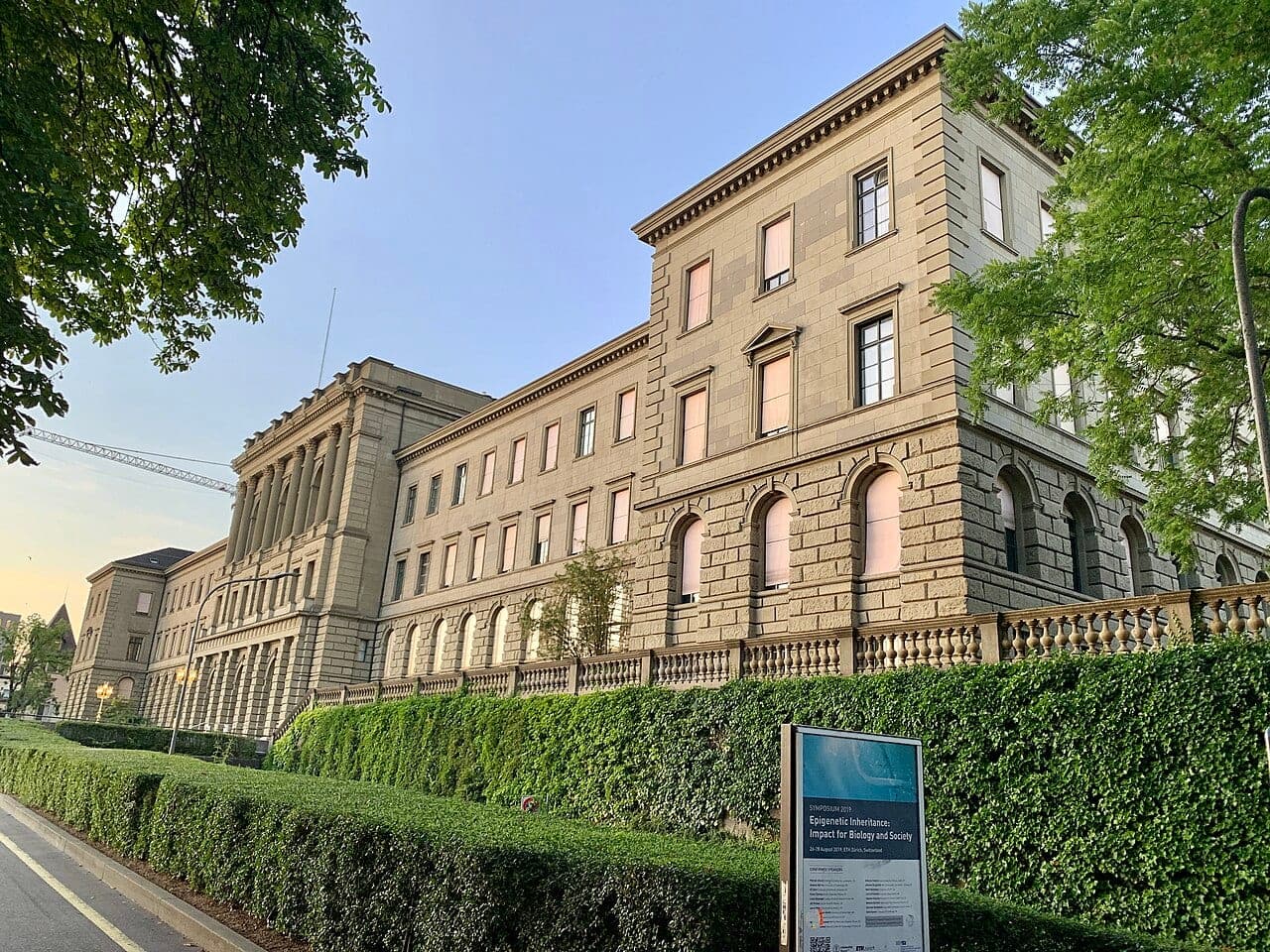
ETH Zurich, formally the Swiss Federal Institute of Technology in Zurich, is one of the foremost science and technology universities in Europe. It sits in the centre of Zurich, Switzerland, its neoclassical main building looking out over the old town toward the lake and the Alps beyond. Created in the middle of the nineteenth century to give the young Swiss federation a school of engineers and scientists, it has grown into a research university whose graduates and faculty include Albert Einstein and a long line of Nobel laureates (Britannica; Wikipedia).
Its reputation rests on a narrow but deep specialism. ETH concentrates on the natural sciences, mathematics, engineering and, increasingly, computer science, and it is placed year after year among the strongest institutions in the world in those fields. The name most often attached to the school belongs to a student who nearly failed to get in: Einstein passed through its lecture halls as a young man and returned two decades later as a professor.
The school opened its doors on 16 October 1855 as the eidgenössische polytechnische Schule, the federal polytechnic school, following a federal act passed the previous year (Wikipedia). Switzerland had become a unified federal state only in 1848, and the new polytechnic was among the young confederation's first national institutions, built to train the engineers, architects and industrial chemists that a modernising country would need.
Through the second half of the nineteenth century the school grew alongside Swiss industry, supplying expertise for the railways, tunnels, bridges and machine works that were reshaping the Alpine economy. In 1911 it was renamed the Eidgenössische Technische Hochschule, the name it still carries in abbreviated form, and gained the right to award doctorates (Wikipedia). Over the twentieth century it broadened from a training college into a full research university, adding laboratories, institutes and, after the Second World War, a second campus for the natural sciences. Today it is one of two federal institutes of technology in Switzerland, the other being its French-speaking counterpart in Lausanne.
ETH is built around two main sites. The historic Zentrum campus occupies the hillside above Zurich's old town, dominated by the main building designed by the German architect Gottfried Semper and constructed between 1858 and 1864 (Wikipedia). Semper, who had settled in Switzerland after the failed revolutions of 1848, gave the school a monumental facade whose terrace remains one of the best public viewpoints in the city.
 Gottfried Semper designed the main building in the 1860s while teaching architecture inside it, having fled Germany with a warrant out for his part in the Dresden uprising. Photograph by Leonhard Lenz, CC0, via Wikimedia Commons.
As the sciences expanded, the university developed a second campus at Hönggerberg, on a plateau to the north of the city, from the 1960s onward. This science campus houses much of the work in physics, chemistry, materials and the life sciences, along with student housing, and continues to grow (Wikipedia). The two sites are linked by a shuttle service that the university runs between them.
Academically the institution is organised into sixteen departments, spanning architecture and civil engineering, mechanical and electrical engineering, computer science, mathematics, physics, chemistry, biology, earth and environmental sciences, and management and social sciences (Wikipedia). Teaching is offered in German at bachelor's level and increasingly in English at master's and doctoral level, reflecting an international student body.
No name is more closely tied to ETH than Albert Einstein. He enrolled at the polytechnic in 1896 to train as a subject teacher in mathematics and physics, graduating in 1900 (ETH Library). It was here that he met Mileva Marić, a fellow physics student who became his first wife. After years at the patent office in Bern, where he published the papers of 1905 that reshaped physics, he returned to ETH as a professor of theoretical physics from 1912 to 1914, teaching mechanics and thermodynamics before leaving for Berlin (ETH Library).
Einstein is the most famous of a broader scientific lineage. ETH is linked to more than twenty Nobel laureates over its history, though the exact figure depends on whether one counts only faculty, or also former students and researchers who did their prizewinning work elsewhere (Britannica; Wikipedia). Among the earliest was Wilhelm Röntgen, who studied mechanical engineering at the polytechnic before discovering the X-rays that won him the first Nobel Prize in Physics in 1901 (UZH). The institution remains particularly strong in physics, chemistry, mathematics and engineering, and in recent decades it has built a leading computer science department whose graduates are prominent across the technology industry.
Among the most requested documents in the ETH Zurich University Archives is the file the school kept on a young man who had failed its entrance examination. The archives publish that record online: his matriculation entry and Mileva Marić's, his marks in the intermediate diploma examinations of October 1898, a written reprimand from the school's management for skipping Jean Pernet's practical course in physics together with the lowest possible mark of 1 for it, his leaving certificate of 28 July 1900, and the short memoir he wrote for the school's centenary in 1955 (ETH Library). The file preserves the ordinary humiliations as well: his four fellow graduates were all given assistant posts at the polytechnic, and he was passed over.
The boundaries are worth stating plainly. Einstein's doctorate was awarded by the University of Zurich in 1905, at a time when ETH could not yet confer one; his literary estate belongs to the Hebrew University of Jerusalem, and the scholarly edition of his papers is edited at Caltech. What ETH has beyond its own administrative record is original correspondence, a good deal of it gathered by Carl Seelig, the Zurich writer who became Einstein's first biographer and whose Einstein collection came to the library.
The habit reaches well past one man. The ETH Library's Collections and Archives hold rare books, the Graphische Sammlung, maps, the collection of scientific instruments, the literary papers of Thomas Mann and of Max Frisch, and an image archive of some three million photographs, among them the Swissair picture archive covering 1931 to 2001 and the aerial survey of Switzerland flown between 1918 and 2011, a growing share of which has been released on Wikimedia Commons (Wikipedia). A school founded to train engineers turned out to be very good at keeping things.
ETH Zurich now enrols roughly 27,000 students and employs several thousand researchers, drawn from well over a hundred countries (Wikipedia). As a federal institution it is funded largely by the Swiss confederation, which keeps tuition low compared with private universities elsewhere and helps the school recruit talent internationally. Its laboratories work across quantum science, robotics, climate and earth systems, biotechnology and artificial intelligence, and it maintains close ties to Swiss industry and to a cluster of spin-off companies founded by its researchers (ETH Zurich). In international comparisons it ranks among the strongest universities in continental Europe.
The central campus is open to the public and easy to reach, though it is a place of work first. The main building sits above the old town at Rämistrasse 101 and is served directly by the Polybahn, a short funicular that climbs from Central square by the river, as well as by tram and bus (Wikipedia). The terrace in front of the main building offers a wide view over the city, the lake and the mountains, and it is free to visit. The Hönggerberg science campus lies a little further out and is connected to the centre by public transport and the university shuttle. Zurich itself is compact and walkable, with a main railway station a few minutes away that links the campus to the rest of Switzerland and to Zurich Airport. Anyone planning to attend public lectures, exhibitions or events should check the university's official website for current details (ETH Zurich).
Gottfried Semper designed the main building in the 1860s while teaching architecture inside it, having fled Germany with a warrant out for his part in the Dresden uprising. Photograph by Leonhard Lenz, CC0, via Wikimedia Commons.
As the sciences expanded, the university developed a second campus at Hönggerberg, on a plateau to the north of the city, from the 1960s onward. This science campus houses much of the work in physics, chemistry, materials and the life sciences, along with student housing, and continues to grow (Wikipedia). The two sites are linked by a shuttle service that the university runs between them.
Academically the institution is organised into sixteen departments, spanning architecture and civil engineering, mechanical and electrical engineering, computer science, mathematics, physics, chemistry, biology, earth and environmental sciences, and management and social sciences (Wikipedia). Teaching is offered in German at bachelor's level and increasingly in English at master's and doctoral level, reflecting an international student body.
No name is more closely tied to ETH than Albert Einstein. He enrolled at the polytechnic in 1896 to train as a subject teacher in mathematics and physics, graduating in 1900 (ETH Library). It was here that he met Mileva Marić, a fellow physics student who became his first wife. After years at the patent office in Bern, where he published the papers of 1905 that reshaped physics, he returned to ETH as a professor of theoretical physics from 1912 to 1914, teaching mechanics and thermodynamics before leaving for Berlin (ETH Library).
Einstein is the most famous of a broader scientific lineage. ETH is linked to more than twenty Nobel laureates over its history, though the exact figure depends on whether one counts only faculty, or also former students and researchers who did their prizewinning work elsewhere (Britannica; Wikipedia). Among the earliest was Wilhelm Röntgen, who studied mechanical engineering at the polytechnic before discovering the X-rays that won him the first Nobel Prize in Physics in 1901 (UZH). The institution remains particularly strong in physics, chemistry, mathematics and engineering, and in recent decades it has built a leading computer science department whose graduates are prominent across the technology industry.
Among the most requested documents in the ETH Zurich University Archives is the file the school kept on a young man who had failed its entrance examination. The archives publish that record online: his matriculation entry and Mileva Marić's, his marks in the intermediate diploma examinations of October 1898, a written reprimand from the school's management for skipping Jean Pernet's practical course in physics together with the lowest possible mark of 1 for it, his leaving certificate of 28 July 1900, and the short memoir he wrote for the school's centenary in 1955 (ETH Library). The file preserves the ordinary humiliations as well: his four fellow graduates were all given assistant posts at the polytechnic, and he was passed over.
The boundaries are worth stating plainly. Einstein's doctorate was awarded by the University of Zurich in 1905, at a time when ETH could not yet confer one; his literary estate belongs to the Hebrew University of Jerusalem, and the scholarly edition of his papers is edited at Caltech. What ETH has beyond its own administrative record is original correspondence, a good deal of it gathered by Carl Seelig, the Zurich writer who became Einstein's first biographer and whose Einstein collection came to the library.
The habit reaches well past one man. The ETH Library's Collections and Archives hold rare books, the Graphische Sammlung, maps, the collection of scientific instruments, the literary papers of Thomas Mann and of Max Frisch, and an image archive of some three million photographs, among them the Swissair picture archive covering 1931 to 2001 and the aerial survey of Switzerland flown between 1918 and 2011, a growing share of which has been released on Wikimedia Commons (Wikipedia). A school founded to train engineers turned out to be very good at keeping things.
ETH Zurich now enrols roughly 27,000 students and employs several thousand researchers, drawn from well over a hundred countries (Wikipedia). As a federal institution it is funded largely by the Swiss confederation, which keeps tuition low compared with private universities elsewhere and helps the school recruit talent internationally. Its laboratories work across quantum science, robotics, climate and earth systems, biotechnology and artificial intelligence, and it maintains close ties to Swiss industry and to a cluster of spin-off companies founded by its researchers (ETH Zurich). In international comparisons it ranks among the strongest universities in continental Europe.
The central campus is open to the public and easy to reach, though it is a place of work first. The main building sits above the old town at Rämistrasse 101 and is served directly by the Polybahn, a short funicular that climbs from Central square by the river, as well as by tram and bus (Wikipedia). The terrace in front of the main building offers a wide view over the city, the lake and the mountains, and it is free to visit. The Hönggerberg science campus lies a little further out and is connected to the centre by public transport and the university shuttle. Zurich itself is compact and walkable, with a main railway station a few minutes away that links the campus to the rest of Switzerland and to Zurich Airport. Anyone planning to attend public lectures, exhibitions or events should check the university's official website for current details (ETH Zurich).
History
Campus and academics
Scholarship
Einstein's student file and the Seelig collection
ETH today
Visiting
References and resources
- Encyclopaedia Britannica: ETH Zurich: overview, founding and Nobel laureates.
- ETH Zurich (official): current facts, research areas and visitor information.
- Wikipedia: ETH Zurich: founding, renaming, campuses, departments and enrolment.
- ETH Library: Albert Einstein (1879–1955): Einstein's student years, 1896 to 1900.
- ETH Library: Professor at ETH Zurich (1912–1914): Einstein's professorship.
- University of Zurich: Wilhelm Conrad Röntgen: Röntgen and the 1901 Nobel Prize in Physics.