Heritage · University
Princeton University: History and Overview
Princeton University, founded 1746 as the College of New Jersey, is a private Ivy League research university in New Jersey; Nassau Hall dates to 1756.Written to last.
By Confinity Heritage Editorial · Updated 2026-07-31 · 8-minute readQuiet tools, kept out of the way.
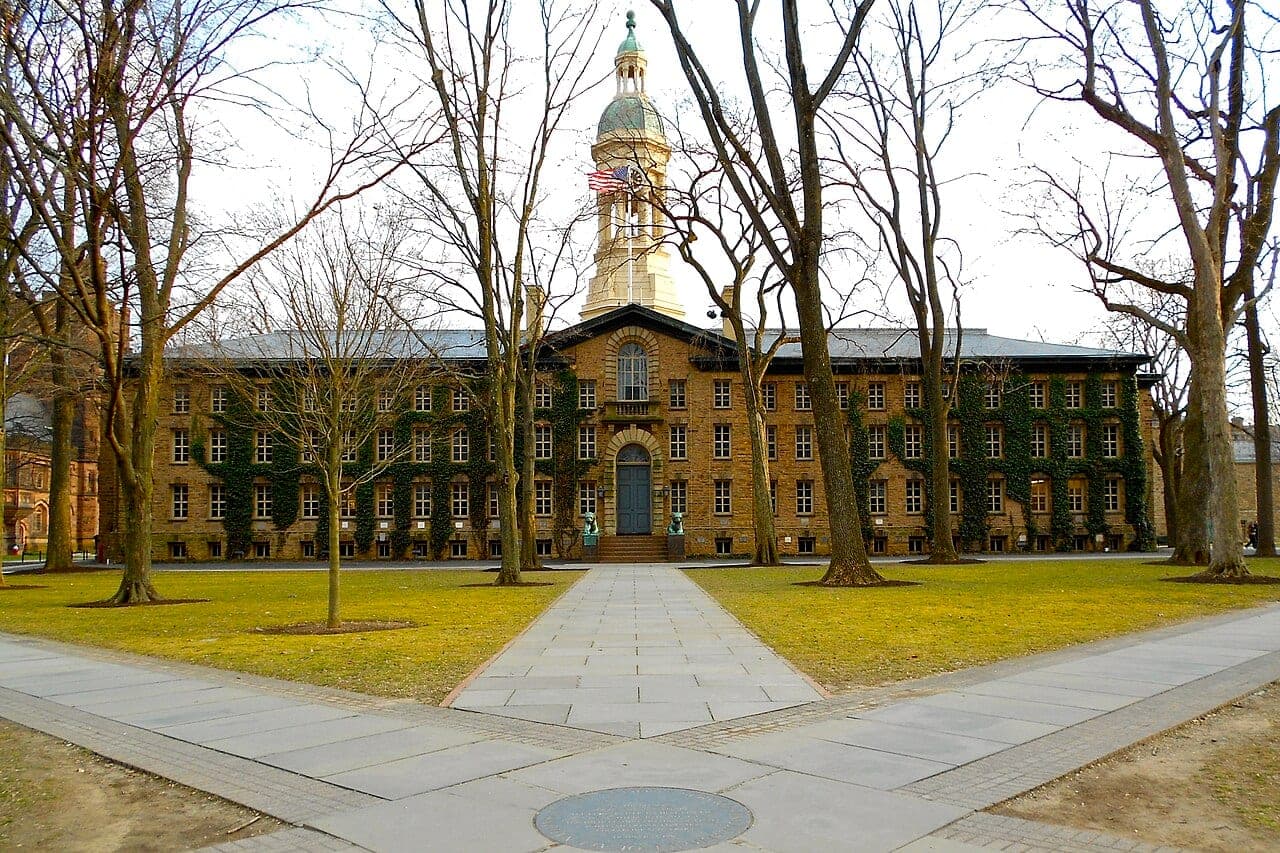
Princeton University is a private Ivy League research university in Princeton, New Jersey, and one of the oldest institutions of higher education in the United States. Chartered in 1746, it is the fourth-oldest college in the country and is known today for pairing an unusually strong focus on undergraduate teaching with leading research. Its landmark building, Nassau Hall, completed in 1756, remains the symbolic centre of the campus and once served, briefly, as the seat of the national government.
The university began as the College of New Jersey, chartered on 22 October 1746, which made it the fourth college founded in Britain's American colonies. It first opened in Elizabeth, then a small New Jersey town, and moved to Newark in 1747. After about nine years there, the trustees sought a more central and less crowded site, and in 1756 the college settled permanently in Princeton.
The move coincided with the completion of Nassau Hall, begun in 1754 and finished in 1756. For decades the building was, in effect, the whole college, holding classrooms, dormitory rooms, a library, a chapel and the dining hall under one roof. Its most remarkable moment came in 1783, when the Continental Congress met in Nassau Hall from 30 June to 4 November, making Princeton the temporary capital of the United States for roughly four months. It was there that Congress received formal word that the Treaty of Paris would end the Revolutionary War.
The school kept its founding name for a century and a half. In 1896, as its graduate offerings and research reputation grew, the College of New Jersey was officially renamed Princeton University.
Among its most influential and most debated leaders was Woodrow Wilson, president of the university from 1902 to 1910 before he entered national politics and, later, the White House. Wilson introduced the preceptorial system of small-group teaching and reshaped the undergraduate curriculum, reforms whose influence endures. His record on race, however, was harmful: he kept Princeton effectively closed to Black applicants during his tenure, and as U.S. president he oversaw the resegregation of parts of the federal government. In 2020 the university removed his name from its school of public and international affairs in recognition of that legacy.
Nassau Hall still anchors the campus and now houses the university's central administration and the office of the president. The surrounding grounds mix Collegiate Gothic quadrangles with modern buildings, and the campus is widely regarded as one of the most attractive in the country.
 Nassau Hall was the whole college in 1756, was shelled during the Battle of Princeton, and housed the Congress of the United States for four months in 1783. Photograph by John Phelan, CC BY-SA 3.0, via Wikimedia Commons.
Princeton is distinctive among major research universities for the weight it places on undergraduate teaching. Every senior completes an independent thesis, and small preceptorials remain central to the experience. Social and dining life for many upperclass students revolves around the eating clubs, a row of private houses along Prospect Avenue that provide meals and gathering space; the first appeared in the late nineteenth century and they remain a signature feature of student life.
The university is especially strong in mathematics, physics, and public and international affairs, and it maintains highly regarded programmes across the humanities, engineering and the social sciences. It operates the Princeton Plasma Physics Laboratory, a national centre for research into fusion energy.
Over its history Princeton has been affiliated with dozens of Nobel laureates along with numerous Fields Medalists and Turing Award winners. Its faculty and alumni include the mathematician John Nash, the physicist Richard Feynman, who earned his doctorate there in 1942, and the novelist Toni Morrison, who taught at Princeton for many years, among many others across the sciences and letters.
One frequent confusion is worth correcting. The Institute for Advanced Study, where Albert Einstein spent the final decades of his career, is a separate and fully independent institution. It has never been part of Princeton University. It was founded in 1930 as an independent centre for theoretical research and sits close to the campus, and the two have long enjoyed a friendly working relationship, but the Institute has no formal organisational tie to the university. Einstein joined the Institute and arrived in Princeton in 1933; he was never a member of the university's faculty. Because both share the town's name and its reputation for scholarship, the two are often mistaken for one, yet they remain distinct.
Princeton's memory of itself is kept a short walk from Nassau Hall, in the Seeley G. Mudd Manuscript Library. Opened in 1976 as part of the university library's special collections, Mudd is Princeton's institutional archive, and it holds two things at once: the record of the university, its students, its faculty, its business and its student life, and a large twentieth-century public policy archive built from the papers of people and organisations who shaped foreign policy, journalism and the law (Princeton University Library). The American Civil Liberties Union, the Council on Foreign Relations, the diplomat George F. Kennan, Adlai Stevenson and Paul Volcker all left their papers there, alongside tens of thousands of linear feet of Princeton's own records (Wikipedia).
The holding most particular to Princeton follows from a decision taken in 1923, when President John Grier Hibben introduced the senior thesis as part of his New Plan of Study. The archives have been the repository for those theses, and for doctoral dissertations, ever since. A century of undergraduate work sits on those shelves, most of it never published and rarely asked for, kept because the university decided that what a twenty-one-year-old wrote in a final year was worth keeping.
Those same archives supplied the evidence for the Princeton and Slavery Project, which ran from 2013 to 2024 and published hundreds of primary sources and some eighty essays, the majority of its contributors being students (Princeton and Slavery). In April 2018 the trustees named two campus spaces for James Collins Johnson and Betsey Stockton, enslaved people who had lived and worked on the campus and whose stories came out of that record. The papers had been there the whole time. What changed was that somebody went looking.
Today Princeton is a member of the Ivy League and among the most selective universities in the United States. It keeps a comparatively small student body, with a strong emphasis on the residential undergraduate college and on need-based financial aid, while supporting graduate study and research across the sciences, humanities and social sciences. Its endowment is among the largest per student of any university, which helps fund teaching, research and one of the most generous aid programmes in American higher education.
The campus is open to visitors, and the grounds themselves are a draw. Free student-led tours introduce Nassau Hall and the surrounding historic buildings, and the Princeton University Art Museum holds a wide-ranging collection, though visitors should check current arrangements, as the museum has been undergoing a major rebuilding. The town of Princeton, with its colonial-era streets and shops, adjoins the campus and is easily explored on foot. Because opening hours and tour schedules change, it is worth confirming details on the university's website before travelling.
Nassau Hall was the whole college in 1756, was shelled during the Battle of Princeton, and housed the Congress of the United States for four months in 1783. Photograph by John Phelan, CC BY-SA 3.0, via Wikimedia Commons.
Princeton is distinctive among major research universities for the weight it places on undergraduate teaching. Every senior completes an independent thesis, and small preceptorials remain central to the experience. Social and dining life for many upperclass students revolves around the eating clubs, a row of private houses along Prospect Avenue that provide meals and gathering space; the first appeared in the late nineteenth century and they remain a signature feature of student life.
The university is especially strong in mathematics, physics, and public and international affairs, and it maintains highly regarded programmes across the humanities, engineering and the social sciences. It operates the Princeton Plasma Physics Laboratory, a national centre for research into fusion energy.
Over its history Princeton has been affiliated with dozens of Nobel laureates along with numerous Fields Medalists and Turing Award winners. Its faculty and alumni include the mathematician John Nash, the physicist Richard Feynman, who earned his doctorate there in 1942, and the novelist Toni Morrison, who taught at Princeton for many years, among many others across the sciences and letters.
One frequent confusion is worth correcting. The Institute for Advanced Study, where Albert Einstein spent the final decades of his career, is a separate and fully independent institution. It has never been part of Princeton University. It was founded in 1930 as an independent centre for theoretical research and sits close to the campus, and the two have long enjoyed a friendly working relationship, but the Institute has no formal organisational tie to the university. Einstein joined the Institute and arrived in Princeton in 1933; he was never a member of the university's faculty. Because both share the town's name and its reputation for scholarship, the two are often mistaken for one, yet they remain distinct.
Princeton's memory of itself is kept a short walk from Nassau Hall, in the Seeley G. Mudd Manuscript Library. Opened in 1976 as part of the university library's special collections, Mudd is Princeton's institutional archive, and it holds two things at once: the record of the university, its students, its faculty, its business and its student life, and a large twentieth-century public policy archive built from the papers of people and organisations who shaped foreign policy, journalism and the law (Princeton University Library). The American Civil Liberties Union, the Council on Foreign Relations, the diplomat George F. Kennan, Adlai Stevenson and Paul Volcker all left their papers there, alongside tens of thousands of linear feet of Princeton's own records (Wikipedia).
The holding most particular to Princeton follows from a decision taken in 1923, when President John Grier Hibben introduced the senior thesis as part of his New Plan of Study. The archives have been the repository for those theses, and for doctoral dissertations, ever since. A century of undergraduate work sits on those shelves, most of it never published and rarely asked for, kept because the university decided that what a twenty-one-year-old wrote in a final year was worth keeping.
Those same archives supplied the evidence for the Princeton and Slavery Project, which ran from 2013 to 2024 and published hundreds of primary sources and some eighty essays, the majority of its contributors being students (Princeton and Slavery). In April 2018 the trustees named two campus spaces for James Collins Johnson and Betsey Stockton, enslaved people who had lived and worked on the campus and whose stories came out of that record. The papers had been there the whole time. What changed was that somebody went looking.
Today Princeton is a member of the Ivy League and among the most selective universities in the United States. It keeps a comparatively small student body, with a strong emphasis on the residential undergraduate college and on need-based financial aid, while supporting graduate study and research across the sciences, humanities and social sciences. Its endowment is among the largest per student of any university, which helps fund teaching, research and one of the most generous aid programmes in American higher education.
The campus is open to visitors, and the grounds themselves are a draw. Free student-led tours introduce Nassau Hall and the surrounding historic buildings, and the Princeton University Art Museum holds a wide-ranging collection, though visitors should check current arrangements, as the museum has been undergoing a major rebuilding. The town of Princeton, with its colonial-era streets and shops, adjoins the campus and is easily explored on foot. Because opening hours and tour schedules change, it is worth confirming details on the university's website before travelling.
History
Campus and academics
Scholarship
The Mudd Library and the shelf of senior theses
Princeton today
Visiting
References and resources
- Encyclopaedia Britannica: Princeton University: overview of the university's founding, history and academic profile.
- Princeton University (official): admissions, academics and visitor information from the university.
- Wikipedia: Princeton University: detailed history, campus, Nassau Hall and notable figures with sources.