Heritage · Country
Bhutan Culture and Heritage
Bhutan writes cultural preservation into its national measure of progress. From the fortress-monasteries of Punakha and Trongsa to tshechu festivals, Dzongkha and the forty-nine days of the bardo, a guide to how the Land of the Thunder Dragon keeps its memory alive.Written to last.
By Confinity Heritage Editorial · 2026-07-10 · 8-minute readQuiet tools, kept out of the way.
Bhutan is the only country in the world that has written the preservation of culture into its central measure of national progress. Gross National Happiness, the development philosophy articulated by the Fourth King in the 1970s, rests on four pillars, and the preservation and promotion of culture stands among them, alongside good governance, equitable development and environmental conservation. In this small Himalayan kingdom, which was never colonised and which admitted television only in 1999, heritage is not a sector to be funded when times are good. It is a stated reason the state exists.
That heritage is unusually alive. The great dzongs, the fortress-monasteries that command Bhutan's river valleys, are not museums but working seats of government and monastic life. The tshechu festivals that fill their courtyards each year are acts of devotion before they are performances. And when a Bhutanese person dies, the family enters forty-nine days of ritual that count among the most complete mourning traditions still practised anywhere.
Bhutan sits on the southern slope of the eastern Himalaya, wedged between the Tibetan plateau of China to the north and the Indian states of Sikkim, West Bengal, Assam and Arunachal Pradesh on its other borders. Within roughly 38,394 square kilometres the land climbs from subtropical duars at a few hundred metres to Gangkhar Puensum at 7,570 metres, the highest unclimbed mountain on earth, kept unclimbed by a Bhutanese ban on mountaineering above six thousand metres out of respect for the deities believed to dwell on the peaks. The constitution requires that at least sixty per cent of the country remain under forest in perpetuity, and in practice more than seventy per cent does; Bhutan is one of the very few carbon-negative countries in the world.
The population is under eight hundred thousand. The Ngalop of the western valleys, culturally close to Tibet, the Sharchop of the east, and the Lhotshampa of the southern belt, largely Nepali-speaking Hindus, are the main communities, alongside many small valley peoples with their own languages. Bhutanese call their country Druk Yul, the Land of the Thunder Dragon, and themselves Drukpa. Since 2008 Bhutan has been a constitutional monarchy under the fifth Druk Gyalpo, Jigme Khesar Namgyel Wangchuck, with an elected parliament and a tourism policy of "high value, low volume" whose visitor levy helps fund conservation and free healthcare and education.
Thimphu. The capital since 1961, and one of the few capitals in the world without a traffic light, Thimphu stretches along the Wang Chhu river at about 2,300 metres. Tashichho Dzong, the "fortress of the glorious religion", houses the throne room, government offices and the summer seat of the central monastic body. The National Memorial Chorten, built in 1974 in memory of the third king, is circled at all hours by elderly residents turning prayer wheels, a piece of living remembrance at the heart of the city, while the giant Buddha Dordenma statue, completed in 2015, watches over the valley. The city also holds the National Library, the Folk Heritage Museum, the National Textile Museum and the National Institute for Zorig Chusum, where the thirteen traditional arts are taught.
Paro. The broad western valley that holds the country's only international airport is dense with sacred sites. Rinpung Dzong, the "fortress on a heap of jewels", presides over the town; above it the round Ta Dzong watchtower of 1649 has housed the National Museum since 1968. Kyichu Lhakhang is one of Bhutan's two seventh-century temples, and high on a cliff face north of the valley clings Paro Taktsang, the Tiger's Nest, built around the cave where Guru Rinpoche is said to have meditated after flying there on the back of a tigress.
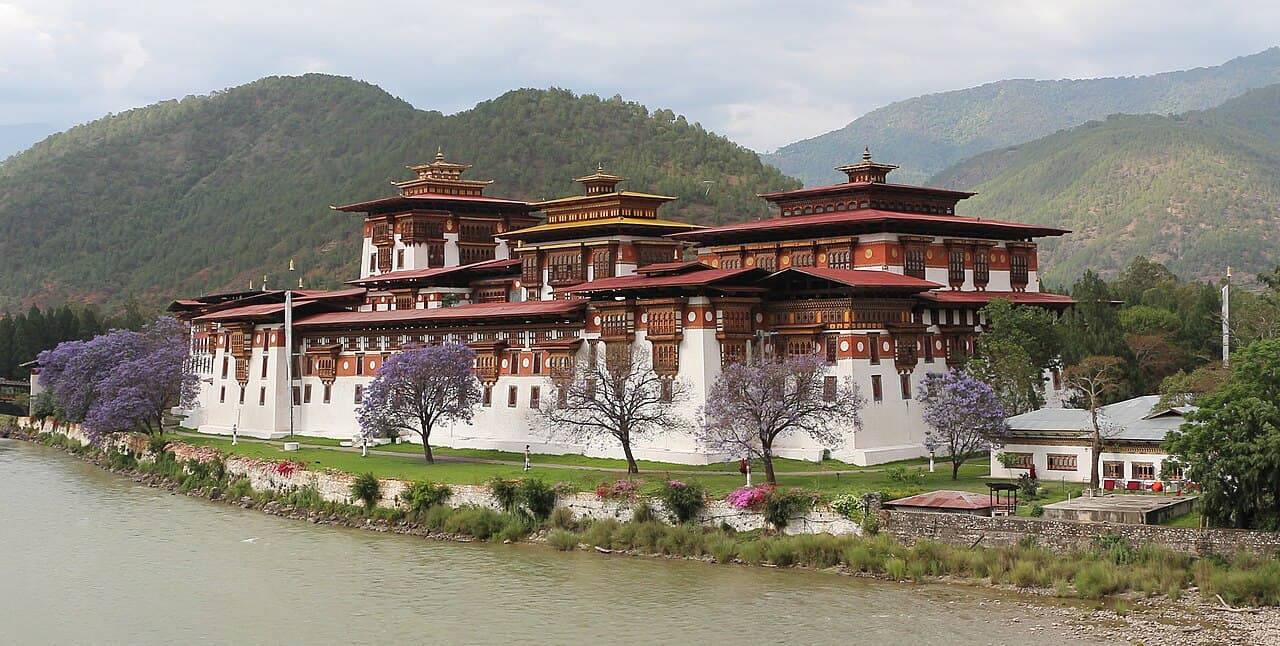
Punakha. The seat of government until the mid-twentieth century, Punakha guards Bhutan's most beautiful building: Punakha Dzong, properly Pungthang Dewa Chhenbi Phodrang, the "palace of great bliss", raised by the Zhabdrung in 1637 to 1638 at the confluence of the Pho Chhu and Mo Chhu rivers. It remains the winter residence of the Je Khenpo and the central monastic body, held the coronation of the first king in 1907 and the wedding of the fifth in 2011, and each spring stages the Punakha Drubchen, a festival that re-enacts the seventeenth-century defence of the valley against Tibetan invasion.
Trongsa. Halfway along the lateral road, Trongsa Dzong is the largest fortress in Bhutan, a labyrinth stepped down a ridge above the Mangde Chhu gorge. It is the ancestral seat of the Wangchuck dynasty, and crown princes traditionally hold the post of Trongsa Penlop before ascending the throne. The watchtower above it now houses the Tower of Trongsa museum of royal history.
Jakar and the Bumthang valleys. Bumthang, a cluster of four high valleys around the town of Jakar, is the spiritual heartland of the kingdom. Jambay Lhakhang shares seventh-century origins with Kyichu Lhakhang; Kurje Lhakhang preserves the rock bearing the body-imprint of Guru Rinpoche; and Tamzhing Monastery, founded by the treasure-revealer Pema Lingpa in 1501, keeps his ritual dance tradition alive. The Jambay Lhakhang Drup festival, with its midnight fire blessing, is among the country's most atmospheric.
Buddhism reached these valleys early. Tradition holds that the Tibetan emperor Songtsen Gampo built Kyichu Lhakhang in Paro and Jambay Lhakhang in Bumthang in the seventh century, two of a chain of temples said to pin down a demoness who lay across the Himalaya. In the eighth century Guru Rinpoche (Padmasambhava), the tantric master revered across the Himalayan world as the Second Buddha, came at the invitation of a Bumthang king; his meditation sites at Kurje and Taktsang became the poles of Bhutanese sacred geography, and nearly every festival in the country honours his deeds. In the following centuries Tibetan Buddhist schools planted lineages throughout the valleys, and Bhutan produced saints of its own, above all Pema Lingpa (1450 to 1521), the Bumthang treasure-revealer, from whose line the royal dynasty descends.
 Punakha Dzong is a fortress, a monastery and an administrative seat in one building, and it is still all three. Photograph by Bernard Gagnon, CC BY-SA 4.0, via Wikimedia Commons.
The unifier arrived in 1616. Zhabdrung Ngawang Namgyal, a high lama of the Drukpa Kagyu school fleeing a succession dispute in Tibet, welded the fractious valleys into a state, repelled repeated Tibetan invasions, built the great dzongs as combined fortresses, monasteries and administrative centres, and gave the country its dual system of government, with a Je Khenpo heading religious affairs and a temporal ruler heading civil ones. He also began codifying the distinct dress and etiquette that became Driglam Namzha. So essential was he that his death in 1651 was concealed by the state for around half a century. The two centuries after the dual system weakened were marked by rivalry among regional governors, from which the penlops of Trongsa emerged strongest. On 17 December 1907, at Punakha Dzong, an assembly of clergy, officials and people unanimously elected Ugyen Wangchuck the first hereditary king, the date now celebrated as National Day.
Bhutan was never colonised. The Treaty of Punakha in 1910 gave British India guidance of foreign affairs while leaving internal rule untouched, an arrangement continued with independent India in 1949 and renegotiated as an equal friendship treaty in 2007. The third king, Jigme Dorji Wangchuck, began deliberate modernisation, establishing the National Assembly in 1953, abolishing serfdom and taking Bhutan into the United Nations in 1971. The fourth, Jigme Singye Wangchuck, articulated Gross National Happiness, then did something almost without precedent: he introduced democracy against no popular demand, abdicating in 2006 so that his son could oversee the first parliamentary elections and the adoption of the constitution in 2008.
The country's own name tells its religious history. Druk Yul, the Land of the Thunder Dragon, derives from the Drukpa Kagyu school, itself named for the dragon (druk) whose thunder its founder is said to have heard in the sky over the monastery of Namdruk in Tibet. The English name "Bhutan" is usually traced to Sanskrit, either Bhota-anta, "the end of Tibet", or bhu-uttan, "highlands"; it was the name outsiders used, and it stuck.
Dzongkha, "the language of the dzong", is the national language, declared so in 1971 and rooted in the speech of the western valleys. A Tibetic language written in Tibetan script, it coexists with Chöke, the classical liturgical language of the monasteries, in which most of Bhutan's vast manuscript heritage is written. But Bhutan is far more multilingual than its size suggests: some nineteen languages are spoken. Tshangla, often called Sharchopkha, is the lingua franca of the east; Lhotshamkha (Nepali) dominates the south; Bumthangkha, Khengkha and their relatives fill the centre. At the fragile end stand Gongduk, spoken by perhaps a thousand people in villages above the Kuri Chhu and so distinct that linguists treat it as the sole survivor of its own branch of Tibeto-Burman, preserving archaic verb agreement lost almost everywhere else; Lhokpu, with a few thousand speakers in the south-west, possibly descended from the region's earliest inhabitants; and Olekha, the Black Mountain Mönpa tongue, now remembered fluently by only a handful of elderly speakers. The Dzongkha Development Commission, established in 1986, standardises the national language and has supported documentation of the smaller ones; for languages like Olekha, documentation is now a race against the lifespan of the last speakers.
Place names carry the sacred landscape into everyday speech: Punakha's dzong is the "palace of great bliss", Tashichho Dzong the "fortress of the glorious religion", and Kurje, literally "body imprint", records the mark Guru Rinpoche is believed to have left in the rock.
Bhutanese identity is codified to a degree rare anywhere. Driglam Namzha, the code of etiquette and dress whose roots go back to the Zhabdrung, governs how to enter a dzong, how to greet a superior, how to serve and be served; since 1989 the national dress it prescribes has been mandatory in schools, government offices and formal settings. Men wear the gho, a knee-length robe belted to form a capacious front pouch; women the kira, an ankle-length wrapped dress worn with a blouse and jacket. Ceremony adds the kabney, the raw-silk scarf whose colour announces rank, white for commoners, saffron reserved for the king and the Je Khenpo, and the rachu, the embroidered shoulder cloth worn by women. Weaving itself, thagzo, is a national art: the intricate kishuthara silks of Lhuentse in the east take months on a backstrap loom and pass between generations as heirlooms.
The thirteen traditional arts and crafts, zorig chusum, codified in the seventeenth century, run from painting, sculpture and wood carving to paper-making, bronze casting, embroidery and bamboo work, and are still taught formally at national institutes. The great public expression of culture is the tshechu, the festival held in each district on and around the tenth day of a lunar month to honour Guru Rinpoche. Monks and laymen perform cham, masked dances that enact the subjugation of demons and the judgement of the dead, while atsaras, sacred clowns, mock the solemnity they protect. At the largest tshechus, in Paro and Thimphu, a thongdrel, a giant appliqué sacred image several storeys tall, is unfurled before dawn on the final day; simply seeing it is believed to cleanse the sins of a lifetime. Around all of this sits a distinct everyday culture: archery as the national sport, contested between villages with songs and elaborate taunting; khuru darts; a cuisine built on chillies as vegetable rather than seasoning, above all ema datshi, chillies with cheese, eaten with red rice and washed down with suja, salted butter tea; and the exchange of doma, areca nut with betel leaf, as a gesture of friendship.
Bhutan is the last sovereign state where Vajrayana Buddhism is the dominant public tradition. Around three quarters of the population are Buddhists, and the constitution names Buddhism the "spiritual heritage" of Bhutan while making the king the protector of all religions. The state monastic body, the Dratshang, headed by the Je Khenpo, migrates with the seasons, wintering in Punakha Dzong and summering in Thimphu, a rhythm unchanged since the Zhabdrung's time. The Drukpa Kagyu school is the official lineage; the Nyingma tradition, heir to Guru Rinpoche and Pema Lingpa, is strong in the centre and east. Roughly a fifth of the population, chiefly the Lhotshampa of the south, are Hindus, and the Hindu festival of Dashain is marked nationally.
Punakha Dzong is a fortress, a monastery and an administrative seat in one building, and it is still all three. Photograph by Bernard Gagnon, CC BY-SA 4.0, via Wikimedia Commons.
The unifier arrived in 1616. Zhabdrung Ngawang Namgyal, a high lama of the Drukpa Kagyu school fleeing a succession dispute in Tibet, welded the fractious valleys into a state, repelled repeated Tibetan invasions, built the great dzongs as combined fortresses, monasteries and administrative centres, and gave the country its dual system of government, with a Je Khenpo heading religious affairs and a temporal ruler heading civil ones. He also began codifying the distinct dress and etiquette that became Driglam Namzha. So essential was he that his death in 1651 was concealed by the state for around half a century. The two centuries after the dual system weakened were marked by rivalry among regional governors, from which the penlops of Trongsa emerged strongest. On 17 December 1907, at Punakha Dzong, an assembly of clergy, officials and people unanimously elected Ugyen Wangchuck the first hereditary king, the date now celebrated as National Day.
Bhutan was never colonised. The Treaty of Punakha in 1910 gave British India guidance of foreign affairs while leaving internal rule untouched, an arrangement continued with independent India in 1949 and renegotiated as an equal friendship treaty in 2007. The third king, Jigme Dorji Wangchuck, began deliberate modernisation, establishing the National Assembly in 1953, abolishing serfdom and taking Bhutan into the United Nations in 1971. The fourth, Jigme Singye Wangchuck, articulated Gross National Happiness, then did something almost without precedent: he introduced democracy against no popular demand, abdicating in 2006 so that his son could oversee the first parliamentary elections and the adoption of the constitution in 2008.
The country's own name tells its religious history. Druk Yul, the Land of the Thunder Dragon, derives from the Drukpa Kagyu school, itself named for the dragon (druk) whose thunder its founder is said to have heard in the sky over the monastery of Namdruk in Tibet. The English name "Bhutan" is usually traced to Sanskrit, either Bhota-anta, "the end of Tibet", or bhu-uttan, "highlands"; it was the name outsiders used, and it stuck.
Dzongkha, "the language of the dzong", is the national language, declared so in 1971 and rooted in the speech of the western valleys. A Tibetic language written in Tibetan script, it coexists with Chöke, the classical liturgical language of the monasteries, in which most of Bhutan's vast manuscript heritage is written. But Bhutan is far more multilingual than its size suggests: some nineteen languages are spoken. Tshangla, often called Sharchopkha, is the lingua franca of the east; Lhotshamkha (Nepali) dominates the south; Bumthangkha, Khengkha and their relatives fill the centre. At the fragile end stand Gongduk, spoken by perhaps a thousand people in villages above the Kuri Chhu and so distinct that linguists treat it as the sole survivor of its own branch of Tibeto-Burman, preserving archaic verb agreement lost almost everywhere else; Lhokpu, with a few thousand speakers in the south-west, possibly descended from the region's earliest inhabitants; and Olekha, the Black Mountain Mönpa tongue, now remembered fluently by only a handful of elderly speakers. The Dzongkha Development Commission, established in 1986, standardises the national language and has supported documentation of the smaller ones; for languages like Olekha, documentation is now a race against the lifespan of the last speakers.
Place names carry the sacred landscape into everyday speech: Punakha's dzong is the "palace of great bliss", Tashichho Dzong the "fortress of the glorious religion", and Kurje, literally "body imprint", records the mark Guru Rinpoche is believed to have left in the rock.
Bhutanese identity is codified to a degree rare anywhere. Driglam Namzha, the code of etiquette and dress whose roots go back to the Zhabdrung, governs how to enter a dzong, how to greet a superior, how to serve and be served; since 1989 the national dress it prescribes has been mandatory in schools, government offices and formal settings. Men wear the gho, a knee-length robe belted to form a capacious front pouch; women the kira, an ankle-length wrapped dress worn with a blouse and jacket. Ceremony adds the kabney, the raw-silk scarf whose colour announces rank, white for commoners, saffron reserved for the king and the Je Khenpo, and the rachu, the embroidered shoulder cloth worn by women. Weaving itself, thagzo, is a national art: the intricate kishuthara silks of Lhuentse in the east take months on a backstrap loom and pass between generations as heirlooms.
The thirteen traditional arts and crafts, zorig chusum, codified in the seventeenth century, run from painting, sculpture and wood carving to paper-making, bronze casting, embroidery and bamboo work, and are still taught formally at national institutes. The great public expression of culture is the tshechu, the festival held in each district on and around the tenth day of a lunar month to honour Guru Rinpoche. Monks and laymen perform cham, masked dances that enact the subjugation of demons and the judgement of the dead, while atsaras, sacred clowns, mock the solemnity they protect. At the largest tshechus, in Paro and Thimphu, a thongdrel, a giant appliqué sacred image several storeys tall, is unfurled before dawn on the final day; simply seeing it is believed to cleanse the sins of a lifetime. Around all of this sits a distinct everyday culture: archery as the national sport, contested between villages with songs and elaborate taunting; khuru darts; a cuisine built on chillies as vegetable rather than seasoning, above all ema datshi, chillies with cheese, eaten with red rice and washed down with suja, salted butter tea; and the exchange of doma, areca nut with betel leaf, as a gesture of friendship.
Bhutan is the last sovereign state where Vajrayana Buddhism is the dominant public tradition. Around three quarters of the population are Buddhists, and the constitution names Buddhism the "spiritual heritage" of Bhutan while making the king the protector of all religions. The state monastic body, the Dratshang, headed by the Je Khenpo, migrates with the seasons, wintering in Punakha Dzong and summering in Thimphu, a rhythm unchanged since the Zhabdrung's time. The Drukpa Kagyu school is the official lineage; the Nyingma tradition, heir to Guru Rinpoche and Pema Lingpa, is strong in the centre and east. Roughly a fifth of the population, chiefly the Lhotshampa of the south, are Hindus, and the Hindu festival of Dashain is marked nationally.
 Taktsang burned in 1998 and was rebuilt on the same ledge, by hand, with materials carried up the mountain. Photograph by Gerd Eichmann, CC BY-SA 4.0, via Wikimedia Commons.
Beneath the Buddhist frame lies an older spiritual landscape that Buddhism absorbed rather than erased. Every valley has its yul lha, its local protective deity; lakes and springs house lu, serpent spirits who must not be polluted; mountain passes are crossed with a shout of praise to the gods and the raising of prayer flags. Households hang prayer flags for luck and for the dead, keep altar rooms, and call lamas or lay ritualists for blessings at births, illnesses, house-raisings and departures. Pilgrimage, neykor, structures devotion: Bhutanese circumambulate chortens and temples, visit the great sites of Guru Rinpoche, and prostrate the lengths of temple courtyards. Religion here is not an event of the calendar week; it is the assumed background of daily life.
Death in Bhutan is treated as the most important transition of existence, and the living take active responsibility for helping the dead through it. The understanding comes from the Vajrayana teaching of the bardo, the intermediate state between death and rebirth, held to last up to forty-nine days. From the moment of death the family summons lamas and monks, who perform phowa, the transference of consciousness, and begin reading the Bardo Thodol, the "Liberation through Hearing in the Intermediate State", aloud to guide the deceased through the visions of the bardo. An astrologer casts a death horoscope that sets the auspicious day for cremation and prescribes the rites the family must sponsor.
Until cremation, the dead are treated as still present. The body, placed in a wooden frame, is kept at home or in a tent nearby, and meals are served to it at meal times, because the consciousness in the bardo is understood to still be attached to this life and in need of care. Cremation is the near-universal custom in most of the country: the body is burned on a pyre presided over by lamas, with family, neighbours and often the whole village in attendance. Practice varies at the margins in ways that record older regional cultures, most strikingly among the Brokpa herders of Merak and Sakteng in the far east, who have traditionally practised sky burial, and in some regions water burial, particularly for children.
The forty-nine days that follow are a structured programme of remembrance. Rituals are performed on every seventh day, with the twenty-first and above all the forty-ninth day marked by major rites, when the household sponsors prayers, feeds monks and guests, and burns butter lamps for the dead. In the deceased's name the family raises 108 tall white prayer flags on ridges and riversides, one of the most visible sights in the Bhutanese landscape; every flag that snaps in the wind is understood to send merit to the departed. The ashes may be scattered in rivers or mixed with clay and moulded into tsatsa, miniature stupas placed in cliff niches, caves and holy places. There are no family graveyards and no headstones: memory is maintained not in stone but in action.
Nor does remembrance end at the forty-ninth day, when the consciousness is held to have taken rebirth. Families mark the death anniversary with rituals for three successive years, the third often observed on the scale of the funeral itself, and thereafter fold their dead into the annual round of household rites and temple offerings, giving alms and sponsoring recitations to keep transferring merit. The nation remembers the same way: the National Memorial Chorten in Thimphu, raised for the third king, is animated every day by circumambulating mourners of a whole society, and Zhabdrung Kuchoe, the anniversary of the Zhabdrung's death in 1651, remains a national holiday. For a platform like Confinity, built on the conviction that memory is something families must actively keep, Bhutan offers perhaps the world's clearest working example: remembrance here is not an annual visit to a grave but forty-nine days of guidance, three years of anniversaries, and a lifetime of merit made in another's name.
Bhutan does not run a civil register in the ordinary sense. It runs a household register, and it decides who a citizen is.
Every Bhutanese belongs to a household in a gewog, a village block, and the record of that household is the family record: who is in it, their relationships, and the thram, the land registration, that goes with it. The census of the household is the document that matters, and it is administered rather than published.
That system had consequences that the country is still living with. The Citizenship Act of 1985 and the census that followed in southern Bhutan classified residents into categories, and people who could not produce evidence of residence in 1958 were reclassified as non-nationals. Roughly a sixth of the population, mostly Lhotshampa of Nepali origin, left or were expelled in the early 1990s, and around a hundred thousand people spent two decades in camps in eastern Nepal before most were resettled to third countries. For those families the Bhutanese record either does not exist or does not say what they say, and their family history is now documented in UNHCR files and in the immigration records of the United States, Canada and Australia.
Inside Bhutan the older record is monastic. Dzongs and monasteries hold chronicles, land grants and the genealogies of the noble and religious lineages, and the choe-sid arrangement between religious and secular authority means those two archives are the same archive.
Responsibility for tangible and intangible culture rests with the Department of Culture and Dzongkha Development under the Ministry of Home Affairs, working alongside the monastic body, which remains the custodian of most living religious heritage. Bhutan ratified the World Heritage Convention and in 2012 placed eight properties on its tentative list, including a serial nomination of five great dzongs, Punakha, Wangdue Phodrang, Paro, Trongsa and Dagana, put forward precisely as living monuments in which festivals, ritual and administration continue daily. A comprehensive Cultural Heritage Bill, long in preparation, is intended to bind protection of sites, artefacts and intangible heritage into a single law.
The kingdom's preservation record has been forged by disaster. Paro Taktsang was gutted by fire in 1998 and rebuilt by 2005; earthquakes in 2009 and 2011 damaged dozens of temples and dzongs, especially in the east; and in June 2012 Wangdue Phodrang Dzong, one of the five tentative-list fortresses, burned almost to its stone shell. Reconstruction in every case has relied on the zorig chusum crafts themselves, rammed earth, hand-cut timber, traditional painting, so that each rebuilding becomes a transmission of skills as well as a restoration of fabric. International partners, including UNESCO, the United States Ambassadors Fund for Cultural Preservation and Indian government funding, have supported documentation, seismic strengthening and reconstruction. Museums anchor the institutional landscape: the National Museum in Paro's Ta Dzong, the National Library (founded 1967) with its vast holdings of religious texts and xylographic blocks, the National Textile Museum and Folk Heritage Museum in Thimphu, and the Tower of Trongsa. In Bumthang, Wangduechhoeling Palace, the nineteenth-century birthplace of the first king, has been painstakingly restored to serve as a museum of the monarchy's origins.
For a country whose heritage lives in remote temple libraries and in the memories of villagers, digitisation has become a central act of preservation. The National Library and Archives runs a continuing survey and digitisation programme for manuscripts held in temples and private homes across the country. The most sustained effort has come through the British Library's Endangered Archives Programme working with the Loden Foundation and the Shejun agency: successive projects have digitised the complete manuscript collections of Gangtey monastery, the temple libraries of Drametse and the manor of Ogyen Choling, the collections of Thadrak, Tshamdrak and Neyphug, and, in the latest phase, twenty further remote archives, building on the documentation of more than forty temple libraries. These books, hand-copied, wood-block-printed, vulnerable to fire, damp and rodents, are now backed by open digital copies held in Bhutan and London.
Intangible heritage has its own digital home. The Bhutan Cultural Library, created by the University of Virginia with Shejun and now sustained through the Loden Foundation, holds thousands of audio-visual recordings of oral traditions, songs, local histories and ritual practices, transcribed and freely accessible, one of the most comprehensive open archives of any Himalayan culture. Bhutanese materials, including documentation of the Drametse Ngacham, are shared through the ichLinks platform of UNESCO's Asia-Pacific intangible-heritage centre, and Google Street View imagery now lets the dispersed Bhutanese diaspora, and the world, walk virtually through valleys that remain expensive and slow to reach. Each tshechu season, clips of cham dances and thongdrel unfurlings flow through social media, an informal national archive assembled by the audience itself.
Bhutan's contemporary culture moves confidently between the monastery and the world. Its cinema announced itself with Travellers and Magicians (2003), the first feature shot entirely inside the kingdom in Dzongkha, directed by the lama and film-maker Khyentse Norbu. Two decades later Pawo Choyning Dorji's Lunana: A Yak in the Classroom, filmed in one of the most remote villages on earth with solar-charged batteries, became the first Bhutanese film nominated for an Academy Award, for Best International Feature in 2022, and his follow-up, The Monk and the Gun, a gentle satire of the kingdom's first mock elections, reached the Oscar shortlist two years later. In literature, Kunzang Choden's The Circle of Karma (2005) made her the first Bhutanese woman to publish a novel in English, and an annual literature festival in Thimphu has grown into a fixture of South Asian letters. Contemporary art has a home in VAST Bhutan, the volunteer artists' studio that has trained young painters since 1998, while popular music runs from rigsar pop to hip-hop in Dzongkha, and national broadcasts of tshechus and royal ceremonies keep traditional culture at the centre of the media year. A growing diaspora, particularly in Australia and North America, organises its own tshechus, sends children to weekend Dzongkha classes and streams the festivals it cannot attend, extending the ritual calendar across oceans.
Taktsang rises from the flames. When fire gutted the Tiger's Nest in 1998, Bhutan rebuilt its most sacred building by 2005 using traditional materials and craftsmen, so faithfully that pilgrims climbing to it today encounter not a replica but a continuation.
A fortress rebuilt by its own crafts. After Wangdue Phodrang Dzong burned in 2012, a decade-long reconstruction employed hundreds of traditional carpenters, masons and painters; the restored dzong was reconsecrated in 2022, and a generation of artisans emerged trained in the very skills the fortress embodies.
From Drametse to the world. The Drametse Ngacham, the mask dance of the drums performed in one eastern village for some five centuries, was recognised by UNESCO in 2005 and inscribed on the Representative List of the Intangible Cultural Heritage of Humanity, Bhutan's first such inscription, with a Japanese-funded safeguarding project supporting the dancers and drummers who carry it.
Village libraries go digital. Through the Endangered Archives Programme and the Loden Foundation, the manuscript collections of dozens of remote temples, from Gangtey to Ogyen Choling, have been fully digitised, meaning that a fire like the ones that have taken so many Bhutanese temples can no longer take their books' contents with them.
A classroom at the top of the world reaches the Oscars. Lunana: A Yak in the Classroom carried a story about a teacher, a village and a yak from a settlement without electricity to an Academy Award nomination in 2022, the moment Bhutanese cinema arrived on the world stage on its own terms.
Taktsang burned in 1998 and was rebuilt on the same ledge, by hand, with materials carried up the mountain. Photograph by Gerd Eichmann, CC BY-SA 4.0, via Wikimedia Commons.
Beneath the Buddhist frame lies an older spiritual landscape that Buddhism absorbed rather than erased. Every valley has its yul lha, its local protective deity; lakes and springs house lu, serpent spirits who must not be polluted; mountain passes are crossed with a shout of praise to the gods and the raising of prayer flags. Households hang prayer flags for luck and for the dead, keep altar rooms, and call lamas or lay ritualists for blessings at births, illnesses, house-raisings and departures. Pilgrimage, neykor, structures devotion: Bhutanese circumambulate chortens and temples, visit the great sites of Guru Rinpoche, and prostrate the lengths of temple courtyards. Religion here is not an event of the calendar week; it is the assumed background of daily life.
Death in Bhutan is treated as the most important transition of existence, and the living take active responsibility for helping the dead through it. The understanding comes from the Vajrayana teaching of the bardo, the intermediate state between death and rebirth, held to last up to forty-nine days. From the moment of death the family summons lamas and monks, who perform phowa, the transference of consciousness, and begin reading the Bardo Thodol, the "Liberation through Hearing in the Intermediate State", aloud to guide the deceased through the visions of the bardo. An astrologer casts a death horoscope that sets the auspicious day for cremation and prescribes the rites the family must sponsor.
Until cremation, the dead are treated as still present. The body, placed in a wooden frame, is kept at home or in a tent nearby, and meals are served to it at meal times, because the consciousness in the bardo is understood to still be attached to this life and in need of care. Cremation is the near-universal custom in most of the country: the body is burned on a pyre presided over by lamas, with family, neighbours and often the whole village in attendance. Practice varies at the margins in ways that record older regional cultures, most strikingly among the Brokpa herders of Merak and Sakteng in the far east, who have traditionally practised sky burial, and in some regions water burial, particularly for children.
The forty-nine days that follow are a structured programme of remembrance. Rituals are performed on every seventh day, with the twenty-first and above all the forty-ninth day marked by major rites, when the household sponsors prayers, feeds monks and guests, and burns butter lamps for the dead. In the deceased's name the family raises 108 tall white prayer flags on ridges and riversides, one of the most visible sights in the Bhutanese landscape; every flag that snaps in the wind is understood to send merit to the departed. The ashes may be scattered in rivers or mixed with clay and moulded into tsatsa, miniature stupas placed in cliff niches, caves and holy places. There are no family graveyards and no headstones: memory is maintained not in stone but in action.
Nor does remembrance end at the forty-ninth day, when the consciousness is held to have taken rebirth. Families mark the death anniversary with rituals for three successive years, the third often observed on the scale of the funeral itself, and thereafter fold their dead into the annual round of household rites and temple offerings, giving alms and sponsoring recitations to keep transferring merit. The nation remembers the same way: the National Memorial Chorten in Thimphu, raised for the third king, is animated every day by circumambulating mourners of a whole society, and Zhabdrung Kuchoe, the anniversary of the Zhabdrung's death in 1651, remains a national holiday. For a platform like Confinity, built on the conviction that memory is something families must actively keep, Bhutan offers perhaps the world's clearest working example: remembrance here is not an annual visit to a grave but forty-nine days of guidance, three years of anniversaries, and a lifetime of merit made in another's name.
Bhutan does not run a civil register in the ordinary sense. It runs a household register, and it decides who a citizen is.
Every Bhutanese belongs to a household in a gewog, a village block, and the record of that household is the family record: who is in it, their relationships, and the thram, the land registration, that goes with it. The census of the household is the document that matters, and it is administered rather than published.
That system had consequences that the country is still living with. The Citizenship Act of 1985 and the census that followed in southern Bhutan classified residents into categories, and people who could not produce evidence of residence in 1958 were reclassified as non-nationals. Roughly a sixth of the population, mostly Lhotshampa of Nepali origin, left or were expelled in the early 1990s, and around a hundred thousand people spent two decades in camps in eastern Nepal before most were resettled to third countries. For those families the Bhutanese record either does not exist or does not say what they say, and their family history is now documented in UNHCR files and in the immigration records of the United States, Canada and Australia.
Inside Bhutan the older record is monastic. Dzongs and monasteries hold chronicles, land grants and the genealogies of the noble and religious lineages, and the choe-sid arrangement between religious and secular authority means those two archives are the same archive.
Responsibility for tangible and intangible culture rests with the Department of Culture and Dzongkha Development under the Ministry of Home Affairs, working alongside the monastic body, which remains the custodian of most living religious heritage. Bhutan ratified the World Heritage Convention and in 2012 placed eight properties on its tentative list, including a serial nomination of five great dzongs, Punakha, Wangdue Phodrang, Paro, Trongsa and Dagana, put forward precisely as living monuments in which festivals, ritual and administration continue daily. A comprehensive Cultural Heritage Bill, long in preparation, is intended to bind protection of sites, artefacts and intangible heritage into a single law.
The kingdom's preservation record has been forged by disaster. Paro Taktsang was gutted by fire in 1998 and rebuilt by 2005; earthquakes in 2009 and 2011 damaged dozens of temples and dzongs, especially in the east; and in June 2012 Wangdue Phodrang Dzong, one of the five tentative-list fortresses, burned almost to its stone shell. Reconstruction in every case has relied on the zorig chusum crafts themselves, rammed earth, hand-cut timber, traditional painting, so that each rebuilding becomes a transmission of skills as well as a restoration of fabric. International partners, including UNESCO, the United States Ambassadors Fund for Cultural Preservation and Indian government funding, have supported documentation, seismic strengthening and reconstruction. Museums anchor the institutional landscape: the National Museum in Paro's Ta Dzong, the National Library (founded 1967) with its vast holdings of religious texts and xylographic blocks, the National Textile Museum and Folk Heritage Museum in Thimphu, and the Tower of Trongsa. In Bumthang, Wangduechhoeling Palace, the nineteenth-century birthplace of the first king, has been painstakingly restored to serve as a museum of the monarchy's origins.
For a country whose heritage lives in remote temple libraries and in the memories of villagers, digitisation has become a central act of preservation. The National Library and Archives runs a continuing survey and digitisation programme for manuscripts held in temples and private homes across the country. The most sustained effort has come through the British Library's Endangered Archives Programme working with the Loden Foundation and the Shejun agency: successive projects have digitised the complete manuscript collections of Gangtey monastery, the temple libraries of Drametse and the manor of Ogyen Choling, the collections of Thadrak, Tshamdrak and Neyphug, and, in the latest phase, twenty further remote archives, building on the documentation of more than forty temple libraries. These books, hand-copied, wood-block-printed, vulnerable to fire, damp and rodents, are now backed by open digital copies held in Bhutan and London.
Intangible heritage has its own digital home. The Bhutan Cultural Library, created by the University of Virginia with Shejun and now sustained through the Loden Foundation, holds thousands of audio-visual recordings of oral traditions, songs, local histories and ritual practices, transcribed and freely accessible, one of the most comprehensive open archives of any Himalayan culture. Bhutanese materials, including documentation of the Drametse Ngacham, are shared through the ichLinks platform of UNESCO's Asia-Pacific intangible-heritage centre, and Google Street View imagery now lets the dispersed Bhutanese diaspora, and the world, walk virtually through valleys that remain expensive and slow to reach. Each tshechu season, clips of cham dances and thongdrel unfurlings flow through social media, an informal national archive assembled by the audience itself.
Bhutan's contemporary culture moves confidently between the monastery and the world. Its cinema announced itself with Travellers and Magicians (2003), the first feature shot entirely inside the kingdom in Dzongkha, directed by the lama and film-maker Khyentse Norbu. Two decades later Pawo Choyning Dorji's Lunana: A Yak in the Classroom, filmed in one of the most remote villages on earth with solar-charged batteries, became the first Bhutanese film nominated for an Academy Award, for Best International Feature in 2022, and his follow-up, The Monk and the Gun, a gentle satire of the kingdom's first mock elections, reached the Oscar shortlist two years later. In literature, Kunzang Choden's The Circle of Karma (2005) made her the first Bhutanese woman to publish a novel in English, and an annual literature festival in Thimphu has grown into a fixture of South Asian letters. Contemporary art has a home in VAST Bhutan, the volunteer artists' studio that has trained young painters since 1998, while popular music runs from rigsar pop to hip-hop in Dzongkha, and national broadcasts of tshechus and royal ceremonies keep traditional culture at the centre of the media year. A growing diaspora, particularly in Australia and North America, organises its own tshechus, sends children to weekend Dzongkha classes and streams the festivals it cannot attend, extending the ritual calendar across oceans.
Taktsang rises from the flames. When fire gutted the Tiger's Nest in 1998, Bhutan rebuilt its most sacred building by 2005 using traditional materials and craftsmen, so faithfully that pilgrims climbing to it today encounter not a replica but a continuation.
A fortress rebuilt by its own crafts. After Wangdue Phodrang Dzong burned in 2012, a decade-long reconstruction employed hundreds of traditional carpenters, masons and painters; the restored dzong was reconsecrated in 2022, and a generation of artisans emerged trained in the very skills the fortress embodies.
From Drametse to the world. The Drametse Ngacham, the mask dance of the drums performed in one eastern village for some five centuries, was recognised by UNESCO in 2005 and inscribed on the Representative List of the Intangible Cultural Heritage of Humanity, Bhutan's first such inscription, with a Japanese-funded safeguarding project supporting the dancers and drummers who carry it.
Village libraries go digital. Through the Endangered Archives Programme and the Loden Foundation, the manuscript collections of dozens of remote temples, from Gangtey to Ogyen Choling, have been fully digitised, meaning that a fire like the ones that have taken so many Bhutanese temples can no longer take their books' contents with them.
A classroom at the top of the world reaches the Oscars. Lunana: A Yak in the Classroom carried a story about a teacher, a village and a yak from a settlement without electricity to an Academy Award nomination in 2022, the moment Bhutanese cinema arrived on the world stage on its own terms.
National Overview
Notable Cities
Historical Foundations
Linguistic and Etymological Roots
Cultural Identity
Religion and Spirituality
Remembrance and Mourning Traditions
Tracing a Family in Bhutan
Heritage Preservation Efforts
Digital Heritage
Contemporary Cultural Influences
Success Stories
References and resources
- UNESCO World Heritage Centre, Dzongs: the centre of temporal and religious authorities (tentative list), the serial nomination of Punakha, Wangdue Phodrang, Paro, Trongsa and Dagana dzongs.
- UNESCO Intangible Cultural Heritage, Mask dance of the drums from Drametse, Bhutan's inscription on the Representative List.
- National Library and Archives of Bhutan, Survey and Digitisation, the national manuscript documentation programme.
- British Library Endangered Archives Programme, Digitisation of 20 remote Bhutanese archives (EAP1494), the latest phase of temple-library digitisation with the Loden Foundation.
- Bhutan Cultural Library, open-access archive of Bhutanese oral and intangible traditions, University of Virginia and Shejun.
- Loden Foundation, Textual Documentation, Bhutanese-led documentation of manuscript collections.
- United Nations Sustainable Development Knowledge Platform, Gross National Happiness Index, the GNH framework and its four pillars.
- Daily Bhutan, The death rituals and funeral rites in Bhutan, the forty-nine-day rites, cremation customs and regional variations.
- Encyclopaedia Britannica, Bhutan, geography, history and political background.