Heritage · Country
Libya Culture and Heritage
Libya holds five World Heritage sites, from the Roman streets of Leptis Magna to the rock paintings of the Tadrart Acacus. A guide to the country's layered past and to how Libyans keep memory alive through conflict and recovery.Written to last.
By Confinity Heritage Editorial · 2026-07-10 · 8-minute readQuiet tools, kept out of the way.
Few countries carry as much of the Mediterranean's memory as Libya. Along its coast stand some of the best-preserved Greek and Roman cities anywhere, built by Phoenician traders and Greek colonists and enlarged by an emperor who was born on this shore. Deep in its southern desert, painted rock shelters record twelve thousand years of human life in the Sahara, from hunters of a green savannah to the camel caravans of historical times. Between the two lie oasis towns, Ottoman medinas and the living traditions of Arab, Amazigh, Tuareg and Tebu communities.
That inheritance has been tested severely. Since 2011 Libya has passed through revolution, civil war and long political division, and in 2016 all five of its World Heritage sites were placed on the List of World Heritage in Danger. Yet the past few years have brought genuinely good news: the Old Town of Ghadamès came off the danger list in July 2025, and Tripoli's Red Castle museum reopened after fourteen years.
Libya sits at the centre of North Africa's Mediterranean coast, bordered by Egypt to the east, Tunisia and Algeria to the west, and Sudan, Chad and Niger to the south. At roughly 1.76 million square kilometres it is the fourth-largest country in Africa, yet more than nine tenths of it is Sahara. Nearly all of its seven million people live along the coastal strip, above all in Tripoli, the capital, and Benghazi, the principal city of the east.
The country's three historic regions still shape its identity. Tripolitania, in the north-west, looks towards Tunisia and the central Mediterranean; Cyrenaica, in the east, has old ties to Egypt and the Greek world; Fezzan, in the south, is a land of oases and caravan routes reaching into the Sahel. Most Libyans are Arab or of mixed Arab and Amazigh (Berber) descent. Amazigh communities remain concentrated in the Nafusa Mountains and the coastal town of Zuwara, Tuareg communities in the south-west around Ghat and Ubari, and Tebu communities in the far south around Murzuq and Kufra. Oil, discovered in 1959, transformed a poor desert kingdom into a petroleum state and still provides the great majority of public revenue. The national currency is the Libyan dinar, and Sunni Islam is the religion of nearly the whole population.
Tripoli. Founded by Phoenicians as Oea around the seventh century BC, Tripoli is the only one of the region's three ancient sister cities that has been continuously inhabited, and its walled medina still holds a Roman monument, the marble arch of Marcus Aurelius, alongside Ottoman mosques, caravanserais and the former Jewish and Maltese quarters. Above the harbour rises the Red Castle (As-Saraya al-Hamra), a fortress complex begun in the medieval period and home to Libya's national museum, which reopened in December 2025 after fourteen years of closure.
 Ghadames is built so that men walk the covered ground-level lanes and women move across the connected rooftops, which makes the town two separate circulation systems in one plan. Photograph by Franzfoto, CC BY-SA 3.0, via Wikimedia Commons.
Benghazi. Libya's second city began as the Greek colony of Euesperides in the sixth century BC, later refounded as Berenice. It was the seat of King Idris's declaration of independence in 1951 and the birthplace of the 2011 uprising. Fighting between 2014 and 2017 devastated its historic centre, and the slow repair of the old city has become a test case for post-war reconstruction.
Ghadamès. An oasis on the borders of Tunisia and Algeria, known since Roman times as Cydamus and long celebrated as the "pearl of the desert". Its old town is a masterpiece of Saharan architecture: whitewashed mud-brick houses joined by covered walkways that keep the streets cool, with an upper world of rooftop terraces traditionally used by women. Residents moved to modern housing from the 1980s, but families still return to their old houses in summer, when the ancient design outperforms concrete.
Ghat. A Tuareg caravan town in the far south-west beneath the Tadrart Acacus mountains, formerly a key stop on trans-Saharan trade routes and today the gateway to the rock-art massif.
Zliten. A coastal city east of Tripoli and one of Libya's great centres of Sufi learning, home to the zawiya and shrine of the sixteenth-century saint Sidi Abdussalam al-Asmar and to a long tradition of Qur'anic education.
The deepest record of Libyan life is painted on stone. In the Tadrart Acacus, thousands of paintings and engravings span the period from about 12,000 BC to AD 100, moving from wild savannah fauna, giraffes, elephants and aurochs, through herds of domesticated cattle to horses and finally camels, a visual archive of the Sahara's slow drying. In the Fezzan, the Garamantes built a desert civilisation from roughly 500 BC, with a capital at Garama (modern Germa) and ingenious underground channels, the foggaras, that carried fossil water to their fields.
Ghadames is built so that men walk the covered ground-level lanes and women move across the connected rooftops, which makes the town two separate circulation systems in one plan. Photograph by Franzfoto, CC BY-SA 3.0, via Wikimedia Commons.
Benghazi. Libya's second city began as the Greek colony of Euesperides in the sixth century BC, later refounded as Berenice. It was the seat of King Idris's declaration of independence in 1951 and the birthplace of the 2011 uprising. Fighting between 2014 and 2017 devastated its historic centre, and the slow repair of the old city has become a test case for post-war reconstruction.
Ghadamès. An oasis on the borders of Tunisia and Algeria, known since Roman times as Cydamus and long celebrated as the "pearl of the desert". Its old town is a masterpiece of Saharan architecture: whitewashed mud-brick houses joined by covered walkways that keep the streets cool, with an upper world of rooftop terraces traditionally used by women. Residents moved to modern housing from the 1980s, but families still return to their old houses in summer, when the ancient design outperforms concrete.
Ghat. A Tuareg caravan town in the far south-west beneath the Tadrart Acacus mountains, formerly a key stop on trans-Saharan trade routes and today the gateway to the rock-art massif.
Zliten. A coastal city east of Tripoli and one of Libya's great centres of Sufi learning, home to the zawiya and shrine of the sixteenth-century saint Sidi Abdussalam al-Asmar and to a long tradition of Qur'anic education.
The deepest record of Libyan life is painted on stone. In the Tadrart Acacus, thousands of paintings and engravings span the period from about 12,000 BC to AD 100, moving from wild savannah fauna, giraffes, elephants and aurochs, through herds of domesticated cattle to horses and finally camels, a visual archive of the Sahara's slow drying. In the Fezzan, the Garamantes built a desert civilisation from roughly 500 BC, with a capital at Garama (modern Germa) and ingenious underground channels, the foggaras, that carried fossil water to their fields.
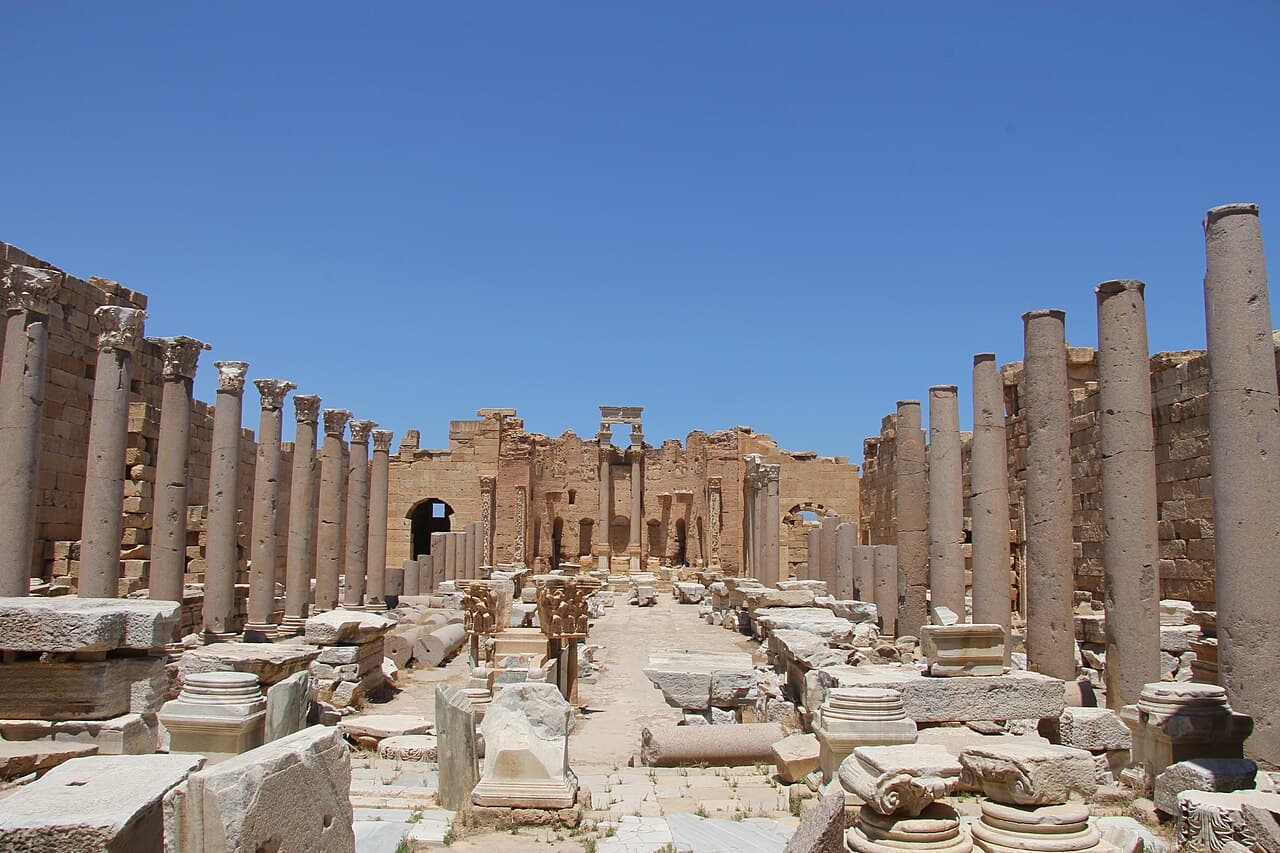
 Leptis Magna was the home city of the emperor Septimius Severus, who rebuilt it on an imperial scale, and sand buried it well enough to preserve it. Photograph by AbdAlrhman Abdulrasol, CC BY-SA 4.0, via Wikimedia Commons.
On the coast, Phoenician traders established Oea, Sabratha and Lpqy (Leptis Magna) from around the seventh century BC, while Greek colonists from the island of Thera founded Cyrene in about 631 BC. Cyrene grew into one of the great cities of the Hellenic world, head of a five-city federation, the Pentapolis, and home to a famous medical school and philosophers such as Aristippus. Under Rome the region flourished spectacularly. Leptis Magna produced an emperor, Septimius Severus (reigned AD 193 to 211), who endowed his birthplace with a new forum, basilica, harbour and triumphal arch; the city is now among the most complete Roman urban landscapes in the Mediterranean. Sabratha's three-storey theatre backdrop, re-erected by Italian archaeologists in the 1930s, remains the emblem of Roman Africa's wealth.
Arab armies brought Islam in the 640s, and the region passed through Umayyad, Abbasid, Fatimid and local dynasties before three and a half centuries of Ottoman rule, including the autonomous Karamanli dynasty of Tripoli (1711 to 1835). Italy invaded in 1911. Resistance in Cyrenaica, led for two decades by the teacher Omar al-Mukhtar, was crushed with extreme brutality: rural populations were driven into concentration camps, and al-Mukhtar was hanged in 1931. He remains the national symbol of dignity under occupation. After the Second World War, the United Nations steered the three provinces to unity, and on 24 December 1951 Libya became an independent kingdom under Idris al-Senussi. A military coup led by Muammar Gaddafi followed in 1969 and lasted forty-two years, ending in the uprising that began on 17 February 2011 and the civil conflicts that followed.
The name "Libya" is among the oldest country names in the world still in use. Egyptian inscriptions of the thirteenth century BC mention the "Libu", a people living west of the Nile; the Greeks turned this into "Libye" and used it for all of North Africa west of Egypt. The name was revived in the modern era when Italy applied it to its colony in 1934, and it passed to the independent state.
Arabic is the official language, and the everyday speech of the country is Libyan Arabic, a dialect with a strong Amazigh substrate and loanwords from Italian and Turkish that record the colonial and Ottoman centuries. Alongside it live several Amazigh languages: Nafusi in the western mountains, the distinctive speech of Ghadamès, and the endangered oasis varieties of Awjila and Sokna. The Tuareg of the south-west speak Tamasheq, historically written in the Tifinagh script, and the Tebu speak Tedaga, a Saharan language shared with communities in Chad and Niger. Under the former regime, public use of Amazigh languages was suppressed and Amazigh names could not be registered. Since 2011 the constitutional declaration has recognised the languages of the Amazigh, Tuareg and Tebu as part of Libya's shared heritage, Tamazight classes have entered schools in the Nafusa Mountains and Zuwara, and Tifinagh lettering has reappeared on shopfronts and in print.
Libya's flag, restored in 2011 from the independence era, carries the story of the country's regions: red for Fezzan, black for Cyrenaica and green for Tripolitania, with the crescent and star of Islam at the centre. National identity draws equally on the desert and the sea, on tribal and family honour, and on the memory of resistance to occupation.
Traditional dress survives for weddings and feast days. The jard, a long woven wrap of wool or fine cloth, is draped by men over a shirt and waistcoat in a style with clear ancient echoes, while women's festive dress features silk wraps, embroidered blouses and heavy silver or gold jewellery, much of it made in the old workshops of Tripoli's medina and in Ghadamès, whose embroidered leather slippers and wedding textiles are famous. Libyan cuisine is Maghrebi with an Italian accent: couscous and bazin, a firm barley dough served with lamb and tomato sauce, sit beside pasta dishes brought by the colonial period; sharba libiya, a spiced lamb and mint soup, opens Ramadan tables; and asida, a sweet dough with date syrup, marks births and the Prophet's birthday. Green tea, brewed strong, poured with foam and offered in rounds, often with roasted peanuts, is the everyday ritual of hospitality.
The classical music of the cities is ma'luf, the Andalusi suite tradition carried to North Africa by refugees from Iberia and sung at weddings and religious festivals. Folk traditions include the zokra bagpipe, drum ensembles and line dances of the coast, the poetry duels of the interior, and the distinct musical worlds of the Tuareg and Tebu south. The annual Ghadamès festival, held in the old town each autumn, gathers date-harvest celebrations, music and traditional games.
Nearly all Libyans are Sunni Muslims following the Maliki school of law, and Islam frames public and family life. Historically, religious life had a strong Sufi colour. The Senussi order, founded in the nineteenth century, built a network of desert lodges that spread education and eventually supplied the royal dynasty; the order of the Zliten saint Sidi Abdussalam al-Asmar made that city a centre of Qur'anic learning; and the mawlid, the Prophet's birthday, is still celebrated with processions and song in many towns.
The country's sacred architecture reflects its layered history. In Tripoli's medina stand the Karamanli and Gurgi mosques with their Ottoman tilework and octagonal minarets, and the Atiq mosques of Awjila and Ghadamès rank among the oldest in the Sahara. The mausoleum and zawiya of Sidi Abdussalam al-Asmar in Zliten, with its associated Asmariya university, remains a place of pilgrimage. This Sufi inheritance has also been a target: in 2012, and again later in the decade, hard-line groups bulldozed and burned shrines, including severe damage to the Zliten complex and the destruction of the Sha'ab mosque tombs in central Tripoli, attacks condemned by UNESCO and by human rights organisations. Small Christian congregations, chiefly serving migrant workers, worship in Tripoli and Benghazi. Libya's ancient Jewish community, present since antiquity, emigrated almost entirely between 1948 and 1967; the ruined Dar Bishi synagogue in Tripoli's old city is what remains of that strand of Libyan life.
Death in Libya is met quickly, simply and communally, in keeping with Islamic practice. The body is washed by family members or trusted attendants of the same sex, perfumed, and wrapped in a plain white shroud. The funeral prayer is performed at the mosque or graveside, usually on the day of death or the following morning, and men accompany the bier to the cemetery, where the deceased is laid on the right side facing Mecca in a grave marked modestly. Women traditionally remain at home, where the household becomes a place of gathered grief.
What follows is the aza, the condolence period, and it is one of the strongest institutions of Libyan social life. For three days the family receives visitors, men and women in separate spaces, often under a marquee raised in the street outside the house. Neighbours and relatives take over the family's cooking, sending meals so that a house in mourning does not light its own stove; visitors are received with bitter coffee or tea, verses of the Qur'an are recited, and the constant refrain of condolence is that the dead belong to God and to Him they return. A widow observes the Qur'anic waiting period, the iddah, of four months and ten days, spent quietly at home in plain dress.
Commemoration continues well beyond the aza. Many families gather relatives and reciters for a khatma, a complete reading of the Qur'an dedicated to the deceased, and give sadaqah, charity in the dead person's name, on Fridays and religious feasts. Visiting the cemetery on the mornings of the two Eids to greet the dead, tidy graves and distribute food to the poor is a widespread Libyan custom. In families shaped by Sufi tradition, especially in towns such as Zliten and Misrata, the fortieth day after death may be marked with recitation and a shared meal, a practice some stricter voices discourage but which endures. Saints are remembered collectively: annual mawlid gatherings at zawiyas bind the memory of holy men to whole towns, which is why the shrine destructions of 2012 were felt as an assault on communal memory itself.
The wars since 2011 have added a national layer of remembrance. Tripoli's central square was renamed Martyrs' Square, and towns across the country keep lists and photographs of their dead. Thousands of Libyans remain missing, and the mass graves uncovered at Tarhuna in 2020 gave painful urgency to the work of the state's missing-persons authority, whose forensic teams identify remains so that families can finally bury and mourn their dead by name. For Libyans, as this work shows, giving each person a known grave and a spoken name is not administration; it is the completion of grief.
Libyan records are thin, scattered and, since 2011, at risk, and the reason for each is different.
The Ottoman administration kept nüfus population registers here as it did elsewhere, and those that survive are the earliest systematic record of ordinary families. Italy took the country from 1911 and governed until 1943, and Italian colonial administration generated a substantial archive, most of which is in Rome rather than Tripoli. The Italian period included the reconquest campaigns of the late 1920s and early 1930s in Cyrenaica, when a large share of the population was moved into camps and tens of thousands died; the record of that is in Italian military and colonial files.
Under the monarchy and then the Jamahiriya, civil registration existed but was patchy and politically administered, and the state archives were not open in any ordinary sense.
The oldest and most reliable Libyan genealogy is tribal. Descent groups keep their own lines, and a Libyan can usually place a family by tribe and region without reference to any document. That knowledge does real work: it settles land, marriage and, in the years since 2011, political alignment.
The urgent problem is preservation. Fighting, looting and neglect since 2011 have damaged archives and manuscript collections, and the Ghadames and Zuwila material, along with private family libraries in the oasis towns, is the kind of record that disappears without anyone recording that it has gone.
Libya's five World Heritage sites, the archaeological sites of Cyrene, Leptis Magna and Sabratha (all inscribed in 1982), the rock-art sites of the Tadrart Acacus (1985) and the Old Town of Ghadamès (1986), were placed together on the List of World Heritage in Danger in 2016, when the World Heritage Committee cited conflict damage, the presence of armed groups near the sites and the threat of further harm. Responsibility for the sites rests with the Department of Antiquities, heir to a service first organised in the colonial period, working under the antiquities protection law of 1994 and with partners abroad.
The record since has mixed loss and quiet achievement. Looting and unregulated construction have eaten at site edges, and the Acacus paintings have suffered graffiti and vandalism. Yet Libyan and international teams kept working through the worst years. The Managing Libya's Cultural Heritage (MaLiCH) project, led from King's College London with the ALIPH Foundation and Libyan institutions, supported community-led conservation at Ghadamès from 2020, and in July 2025 the World Heritage Committee removed the Old Town of Ghadamès from the danger list, the first Libyan site to come off it. In Tripoli, the Government of National Unity funded a multi-year rehabilitation of the Red Castle with French archaeological cooperation and ALIPH support, and the national museum reopened to the public in December 2025. Libya has also pursued its scattered treasures: authorities have recovered more than twenty trafficked artefacts from France, Switzerland and the United States, with further returns under negotiation. The Society for Libyan Studies in London, custodian of a century of excavation records, continues to publish research and support Libyan archaeologists.
Because access to Libyan sites has been difficult for a decade, digital tools have carried much of the preservation effort. The Endangered Archaeology in the Middle East and North Africa (EAMENA) project, based at the Universities of Oxford, Leicester and Durham, uses satellite imagery to record and monitor threatened sites across Libya in an open database, and has trained Libyan Department of Antiquities staff in remote-sensing documentation so that monitoring capacity stays in the country. UNESCO's state-of-conservation reporting on the five World Heritage sites likewise relies on satellite assessment where ground missions cannot travel.
Documentation projects have digitised excavation archives, historical photographs and maps held abroad, notably in the collections of the Society for Libyan Studies, making a century of records available to Libyan researchers online. Inside the country, a striking grassroots movement has grown on social media: local history pages and volunteer groups photograph medina houses, Italian-era architecture, rock art and family archives, crowd-sourcing a national record that no institution could assemble alone. Virtual tours and 3D imagery of Leptis Magna and Sabratha now let Libyans abroad, and the wider world, walk streets that remain hard to visit.
Libyan letters have a global readership. Ibrahim al-Koni, born into a Tuareg family near Ghadamès, has made the Sahara one of the great settings of modern Arabic fiction in novels such as Gold Dust and The Bleeding of the Stone. Hisham Matar, writing in English, won the 2017 Pulitzer Prize for biography for The Return, his account of searching for his father, who disappeared into Gaddafi's prisons; the book has become a touchstone for how Libyans speak about loss and memory. Alessandro Spina's novel cycle The Confines of the Shadow chronicles Benghazi under Italian rule.
Since 2011 a determined arts scene has grown in the space the revolution opened. The Tanarout collective in Benghazi and the WaraQ art foundation in Tripoli run galleries, workshops and festivals in difficult conditions, and a young generation of photographers, film-makers, rappers and graphic designers treats heritage, from Tuareg patterns to medina doorways, as living raw material. Amazigh culture, publicly invisible for four decades, now has its own media, spring festivals and school curricula in the Nafusa Mountains and Zuwara. The diaspora, concentrated in the United Kingdom, Italy, Egypt and North America, sustains publishing houses, research networks and remembrance initiatives that keep Libyan memory active across borders.
Ghadamès leaves the danger list. Five years of community-led conservation, supported by the MaLiCH project and the ALIPH Foundation, persuaded the World Heritage Committee in July 2025 to remove the Old Town of Ghadamès from the List of World Heritage in Danger, a first for Libya and a rare piece of unambiguous good news for Saharan heritage.
The Red Castle reopens. In December 2025 Tripoli's national museum opened its doors for the first time since 2011, after a rehabilitation costing more than five million dollars. Staff had hidden and safeguarded the collection through years of fighting; its public return gave Libyans back their central treasure house.
Artefacts come home. Patient legal work has brought more than twenty smuggled antiquities back to Libya from Europe and the United States, including funerary sculpture from Cyrene, and set precedents for further returns.
A language returns to school. Tamazight, banned from public life for four decades, is now taught to Amazigh children in the Nafusa Mountains and Zuwara, and Tifinagh script is visible on Libyan streets for the first time in living memory.
Leptis Magna was the home city of the emperor Septimius Severus, who rebuilt it on an imperial scale, and sand buried it well enough to preserve it. Photograph by AbdAlrhman Abdulrasol, CC BY-SA 4.0, via Wikimedia Commons.
On the coast, Phoenician traders established Oea, Sabratha and Lpqy (Leptis Magna) from around the seventh century BC, while Greek colonists from the island of Thera founded Cyrene in about 631 BC. Cyrene grew into one of the great cities of the Hellenic world, head of a five-city federation, the Pentapolis, and home to a famous medical school and philosophers such as Aristippus. Under Rome the region flourished spectacularly. Leptis Magna produced an emperor, Septimius Severus (reigned AD 193 to 211), who endowed his birthplace with a new forum, basilica, harbour and triumphal arch; the city is now among the most complete Roman urban landscapes in the Mediterranean. Sabratha's three-storey theatre backdrop, re-erected by Italian archaeologists in the 1930s, remains the emblem of Roman Africa's wealth.
Arab armies brought Islam in the 640s, and the region passed through Umayyad, Abbasid, Fatimid and local dynasties before three and a half centuries of Ottoman rule, including the autonomous Karamanli dynasty of Tripoli (1711 to 1835). Italy invaded in 1911. Resistance in Cyrenaica, led for two decades by the teacher Omar al-Mukhtar, was crushed with extreme brutality: rural populations were driven into concentration camps, and al-Mukhtar was hanged in 1931. He remains the national symbol of dignity under occupation. After the Second World War, the United Nations steered the three provinces to unity, and on 24 December 1951 Libya became an independent kingdom under Idris al-Senussi. A military coup led by Muammar Gaddafi followed in 1969 and lasted forty-two years, ending in the uprising that began on 17 February 2011 and the civil conflicts that followed.
The name "Libya" is among the oldest country names in the world still in use. Egyptian inscriptions of the thirteenth century BC mention the "Libu", a people living west of the Nile; the Greeks turned this into "Libye" and used it for all of North Africa west of Egypt. The name was revived in the modern era when Italy applied it to its colony in 1934, and it passed to the independent state.
Arabic is the official language, and the everyday speech of the country is Libyan Arabic, a dialect with a strong Amazigh substrate and loanwords from Italian and Turkish that record the colonial and Ottoman centuries. Alongside it live several Amazigh languages: Nafusi in the western mountains, the distinctive speech of Ghadamès, and the endangered oasis varieties of Awjila and Sokna. The Tuareg of the south-west speak Tamasheq, historically written in the Tifinagh script, and the Tebu speak Tedaga, a Saharan language shared with communities in Chad and Niger. Under the former regime, public use of Amazigh languages was suppressed and Amazigh names could not be registered. Since 2011 the constitutional declaration has recognised the languages of the Amazigh, Tuareg and Tebu as part of Libya's shared heritage, Tamazight classes have entered schools in the Nafusa Mountains and Zuwara, and Tifinagh lettering has reappeared on shopfronts and in print.
Libya's flag, restored in 2011 from the independence era, carries the story of the country's regions: red for Fezzan, black for Cyrenaica and green for Tripolitania, with the crescent and star of Islam at the centre. National identity draws equally on the desert and the sea, on tribal and family honour, and on the memory of resistance to occupation.
Traditional dress survives for weddings and feast days. The jard, a long woven wrap of wool or fine cloth, is draped by men over a shirt and waistcoat in a style with clear ancient echoes, while women's festive dress features silk wraps, embroidered blouses and heavy silver or gold jewellery, much of it made in the old workshops of Tripoli's medina and in Ghadamès, whose embroidered leather slippers and wedding textiles are famous. Libyan cuisine is Maghrebi with an Italian accent: couscous and bazin, a firm barley dough served with lamb and tomato sauce, sit beside pasta dishes brought by the colonial period; sharba libiya, a spiced lamb and mint soup, opens Ramadan tables; and asida, a sweet dough with date syrup, marks births and the Prophet's birthday. Green tea, brewed strong, poured with foam and offered in rounds, often with roasted peanuts, is the everyday ritual of hospitality.
The classical music of the cities is ma'luf, the Andalusi suite tradition carried to North Africa by refugees from Iberia and sung at weddings and religious festivals. Folk traditions include the zokra bagpipe, drum ensembles and line dances of the coast, the poetry duels of the interior, and the distinct musical worlds of the Tuareg and Tebu south. The annual Ghadamès festival, held in the old town each autumn, gathers date-harvest celebrations, music and traditional games.
Nearly all Libyans are Sunni Muslims following the Maliki school of law, and Islam frames public and family life. Historically, religious life had a strong Sufi colour. The Senussi order, founded in the nineteenth century, built a network of desert lodges that spread education and eventually supplied the royal dynasty; the order of the Zliten saint Sidi Abdussalam al-Asmar made that city a centre of Qur'anic learning; and the mawlid, the Prophet's birthday, is still celebrated with processions and song in many towns.
The country's sacred architecture reflects its layered history. In Tripoli's medina stand the Karamanli and Gurgi mosques with their Ottoman tilework and octagonal minarets, and the Atiq mosques of Awjila and Ghadamès rank among the oldest in the Sahara. The mausoleum and zawiya of Sidi Abdussalam al-Asmar in Zliten, with its associated Asmariya university, remains a place of pilgrimage. This Sufi inheritance has also been a target: in 2012, and again later in the decade, hard-line groups bulldozed and burned shrines, including severe damage to the Zliten complex and the destruction of the Sha'ab mosque tombs in central Tripoli, attacks condemned by UNESCO and by human rights organisations. Small Christian congregations, chiefly serving migrant workers, worship in Tripoli and Benghazi. Libya's ancient Jewish community, present since antiquity, emigrated almost entirely between 1948 and 1967; the ruined Dar Bishi synagogue in Tripoli's old city is what remains of that strand of Libyan life.
Death in Libya is met quickly, simply and communally, in keeping with Islamic practice. The body is washed by family members or trusted attendants of the same sex, perfumed, and wrapped in a plain white shroud. The funeral prayer is performed at the mosque or graveside, usually on the day of death or the following morning, and men accompany the bier to the cemetery, where the deceased is laid on the right side facing Mecca in a grave marked modestly. Women traditionally remain at home, where the household becomes a place of gathered grief.
What follows is the aza, the condolence period, and it is one of the strongest institutions of Libyan social life. For three days the family receives visitors, men and women in separate spaces, often under a marquee raised in the street outside the house. Neighbours and relatives take over the family's cooking, sending meals so that a house in mourning does not light its own stove; visitors are received with bitter coffee or tea, verses of the Qur'an are recited, and the constant refrain of condolence is that the dead belong to God and to Him they return. A widow observes the Qur'anic waiting period, the iddah, of four months and ten days, spent quietly at home in plain dress.
Commemoration continues well beyond the aza. Many families gather relatives and reciters for a khatma, a complete reading of the Qur'an dedicated to the deceased, and give sadaqah, charity in the dead person's name, on Fridays and religious feasts. Visiting the cemetery on the mornings of the two Eids to greet the dead, tidy graves and distribute food to the poor is a widespread Libyan custom. In families shaped by Sufi tradition, especially in towns such as Zliten and Misrata, the fortieth day after death may be marked with recitation and a shared meal, a practice some stricter voices discourage but which endures. Saints are remembered collectively: annual mawlid gatherings at zawiyas bind the memory of holy men to whole towns, which is why the shrine destructions of 2012 were felt as an assault on communal memory itself.
The wars since 2011 have added a national layer of remembrance. Tripoli's central square was renamed Martyrs' Square, and towns across the country keep lists and photographs of their dead. Thousands of Libyans remain missing, and the mass graves uncovered at Tarhuna in 2020 gave painful urgency to the work of the state's missing-persons authority, whose forensic teams identify remains so that families can finally bury and mourn their dead by name. For Libyans, as this work shows, giving each person a known grave and a spoken name is not administration; it is the completion of grief.
Libyan records are thin, scattered and, since 2011, at risk, and the reason for each is different.
The Ottoman administration kept nüfus population registers here as it did elsewhere, and those that survive are the earliest systematic record of ordinary families. Italy took the country from 1911 and governed until 1943, and Italian colonial administration generated a substantial archive, most of which is in Rome rather than Tripoli. The Italian period included the reconquest campaigns of the late 1920s and early 1930s in Cyrenaica, when a large share of the population was moved into camps and tens of thousands died; the record of that is in Italian military and colonial files.
Under the monarchy and then the Jamahiriya, civil registration existed but was patchy and politically administered, and the state archives were not open in any ordinary sense.
The oldest and most reliable Libyan genealogy is tribal. Descent groups keep their own lines, and a Libyan can usually place a family by tribe and region without reference to any document. That knowledge does real work: it settles land, marriage and, in the years since 2011, political alignment.
The urgent problem is preservation. Fighting, looting and neglect since 2011 have damaged archives and manuscript collections, and the Ghadames and Zuwila material, along with private family libraries in the oasis towns, is the kind of record that disappears without anyone recording that it has gone.
Libya's five World Heritage sites, the archaeological sites of Cyrene, Leptis Magna and Sabratha (all inscribed in 1982), the rock-art sites of the Tadrart Acacus (1985) and the Old Town of Ghadamès (1986), were placed together on the List of World Heritage in Danger in 2016, when the World Heritage Committee cited conflict damage, the presence of armed groups near the sites and the threat of further harm. Responsibility for the sites rests with the Department of Antiquities, heir to a service first organised in the colonial period, working under the antiquities protection law of 1994 and with partners abroad.
The record since has mixed loss and quiet achievement. Looting and unregulated construction have eaten at site edges, and the Acacus paintings have suffered graffiti and vandalism. Yet Libyan and international teams kept working through the worst years. The Managing Libya's Cultural Heritage (MaLiCH) project, led from King's College London with the ALIPH Foundation and Libyan institutions, supported community-led conservation at Ghadamès from 2020, and in July 2025 the World Heritage Committee removed the Old Town of Ghadamès from the danger list, the first Libyan site to come off it. In Tripoli, the Government of National Unity funded a multi-year rehabilitation of the Red Castle with French archaeological cooperation and ALIPH support, and the national museum reopened to the public in December 2025. Libya has also pursued its scattered treasures: authorities have recovered more than twenty trafficked artefacts from France, Switzerland and the United States, with further returns under negotiation. The Society for Libyan Studies in London, custodian of a century of excavation records, continues to publish research and support Libyan archaeologists.
Because access to Libyan sites has been difficult for a decade, digital tools have carried much of the preservation effort. The Endangered Archaeology in the Middle East and North Africa (EAMENA) project, based at the Universities of Oxford, Leicester and Durham, uses satellite imagery to record and monitor threatened sites across Libya in an open database, and has trained Libyan Department of Antiquities staff in remote-sensing documentation so that monitoring capacity stays in the country. UNESCO's state-of-conservation reporting on the five World Heritage sites likewise relies on satellite assessment where ground missions cannot travel.
Documentation projects have digitised excavation archives, historical photographs and maps held abroad, notably in the collections of the Society for Libyan Studies, making a century of records available to Libyan researchers online. Inside the country, a striking grassroots movement has grown on social media: local history pages and volunteer groups photograph medina houses, Italian-era architecture, rock art and family archives, crowd-sourcing a national record that no institution could assemble alone. Virtual tours and 3D imagery of Leptis Magna and Sabratha now let Libyans abroad, and the wider world, walk streets that remain hard to visit.
Libyan letters have a global readership. Ibrahim al-Koni, born into a Tuareg family near Ghadamès, has made the Sahara one of the great settings of modern Arabic fiction in novels such as Gold Dust and The Bleeding of the Stone. Hisham Matar, writing in English, won the 2017 Pulitzer Prize for biography for The Return, his account of searching for his father, who disappeared into Gaddafi's prisons; the book has become a touchstone for how Libyans speak about loss and memory. Alessandro Spina's novel cycle The Confines of the Shadow chronicles Benghazi under Italian rule.
Since 2011 a determined arts scene has grown in the space the revolution opened. The Tanarout collective in Benghazi and the WaraQ art foundation in Tripoli run galleries, workshops and festivals in difficult conditions, and a young generation of photographers, film-makers, rappers and graphic designers treats heritage, from Tuareg patterns to medina doorways, as living raw material. Amazigh culture, publicly invisible for four decades, now has its own media, spring festivals and school curricula in the Nafusa Mountains and Zuwara. The diaspora, concentrated in the United Kingdom, Italy, Egypt and North America, sustains publishing houses, research networks and remembrance initiatives that keep Libyan memory active across borders.
Ghadamès leaves the danger list. Five years of community-led conservation, supported by the MaLiCH project and the ALIPH Foundation, persuaded the World Heritage Committee in July 2025 to remove the Old Town of Ghadamès from the List of World Heritage in Danger, a first for Libya and a rare piece of unambiguous good news for Saharan heritage.
The Red Castle reopens. In December 2025 Tripoli's national museum opened its doors for the first time since 2011, after a rehabilitation costing more than five million dollars. Staff had hidden and safeguarded the collection through years of fighting; its public return gave Libyans back their central treasure house.
Artefacts come home. Patient legal work has brought more than twenty smuggled antiquities back to Libya from Europe and the United States, including funerary sculpture from Cyrene, and set precedents for further returns.
A language returns to school. Tamazight, banned from public life for four decades, is now taught to Amazigh children in the Nafusa Mountains and Zuwara, and Tifinagh script is visible on Libyan streets for the first time in living memory.
National Overview
Notable Cities
Historical Foundations
Linguistic and Etymological Roots
Cultural Identity
Religion and Spirituality
Remembrance and Mourning Traditions
Tracing a Family in Libya
Heritage Preservation Efforts
Digital Heritage
Contemporary Cultural Influences
Success Stories
References and resources
- UNESCO World Heritage Centre: Libya state party page
- UNESCO World Heritage Centre: Libya's five World Heritage sites placed on the List of World Heritage in Danger (2016)
- UNESCO: Three sites on the African continent removed from the List of World Heritage in Danger (2025)
- King's College London: project helps remove Libyan World Heritage Site from UNESCO's danger list
- EAMENA: Endangered Archaeology in the Middle East and North Africa
- Society for Libyan Studies
- UN News: UNESCO calls for immediate stop to destruction of Sufi religious sites in Libya (2012)
- Human Rights Watch: Libya, new wave of attacks against Sufi sites (2017)
- Encyclopaedia Britannica: Libya