Heritage · Country
Lithuania Culture and Heritage
A pagan realm that grew into one of medieval Europe's largest states, Lithuania keeps its memory in baroque Vilnius, the island castle of Trakai and the candle-lit cemeteries of Velines. This guide follows the Grand Duchy and its archaic language, the sober record of the twentieth century, and the ways Lithuanians remember their dead.Written to last.
By Confinity Heritage Editorial · Updated 2026-07-31 · 8-minute readQuiet tools, kept out of the way.
Lithuania has long practised remembering as a form of survival. For a thousand years its people kept the last pagan faith in Europe, worshipping in oak groves until 1387; for four decades in the nineteenth century their language was banned from print in the Latin alphabet and carried across the border by book smugglers; and within living memory two million Baltic citizens joined hands across three republics to reclaim their independence. Between the sacred grove and the singing human chain run the wayside crosses of the village carver, the cold pink beet soup of a summer table, and the forests of candles that light the cemeteries each November.
Throughout, it attends to how Lithuanians mark their dead, from the Catholic funeral to Velines and the Hill of Crosses.
Lithuania is the largest and southernmost of the three Baltic states, covering about 65,300 square kilometres on the eastern shore of the Baltic Sea, bordered by Latvia, Belarus, Poland and the Russian exclave of Kaliningrad. The land is low and glaciated, a country of forests, some three thousand lakes, and the slow Nemunas river, edged on the coast by the sand barrier of the Curonian Spit. The population is just under 2.9 million, according to the 2021 census and later estimates, and the capital and largest city is Vilnius.
Lithuania restored its independence from the Soviet Union in 1990, joined both the European Union and NATO in 2004, and adopted the euro in 2015. The state language is Lithuanian, the majority of the population identifies as Roman Catholic, and the country's minorities include Poles and Russians concentrated in the east and the cities. For a small nation, its self-understanding is unusually historical, measured against a medieval empire, a lost commonwealth, a banned language and a hard-won return.
Vilnius. The capital first enters the record in the letters of Grand Duke Gediminas around 1323, and its old town is the largest baroque quarter north of the Alps, inscribed by UNESCO in 1994 across some 352 hectares of Gothic, Renaissance, baroque and classical streets. Gediminas Tower looks down on the cathedral and the university, founded in 1579. Vilnius was for centuries one of the foremost centres of Jewish learning in the world, known as the Jerusalem of the North, the city of the Vilna Gaon, before that community was destroyed in the Holocaust.
 Vilnius has one of the largest surviving medieval old towns in northern Europe, and was for centuries a major centre of Jewish learning until that community was destroyed. Photograph by Pofka, CC BY-SA 4.0, via Wikimedia Commons.
Kaunas. At the meeting of the Nemunas and Neris rivers, Kaunas served as the temporary capital of Lithuania between 1919 and 1939, after Vilnius was taken by Poland. In two decades it built one of Europe's largest and best-preserved collections of interwar modernist architecture, more than six thousand buildings that UNESCO recognised in 2023 as Modernist Kaunas. On its edge, the Ninth Fort is a memorial and museum on the site of wartime mass killing.
Klaipeda. Lithuania's only major seaport and its window on the Baltic, Klaipeda began as the Teutonic fortress of Memelburg in 1252 and spent centuries as the East Prussian town of Memel before passing to Lithuania in 1923, as Britannica records. Its old town keeps a distinct German-Baltic character, and it is the mainland gateway to the ferries of the Curonian Spit.
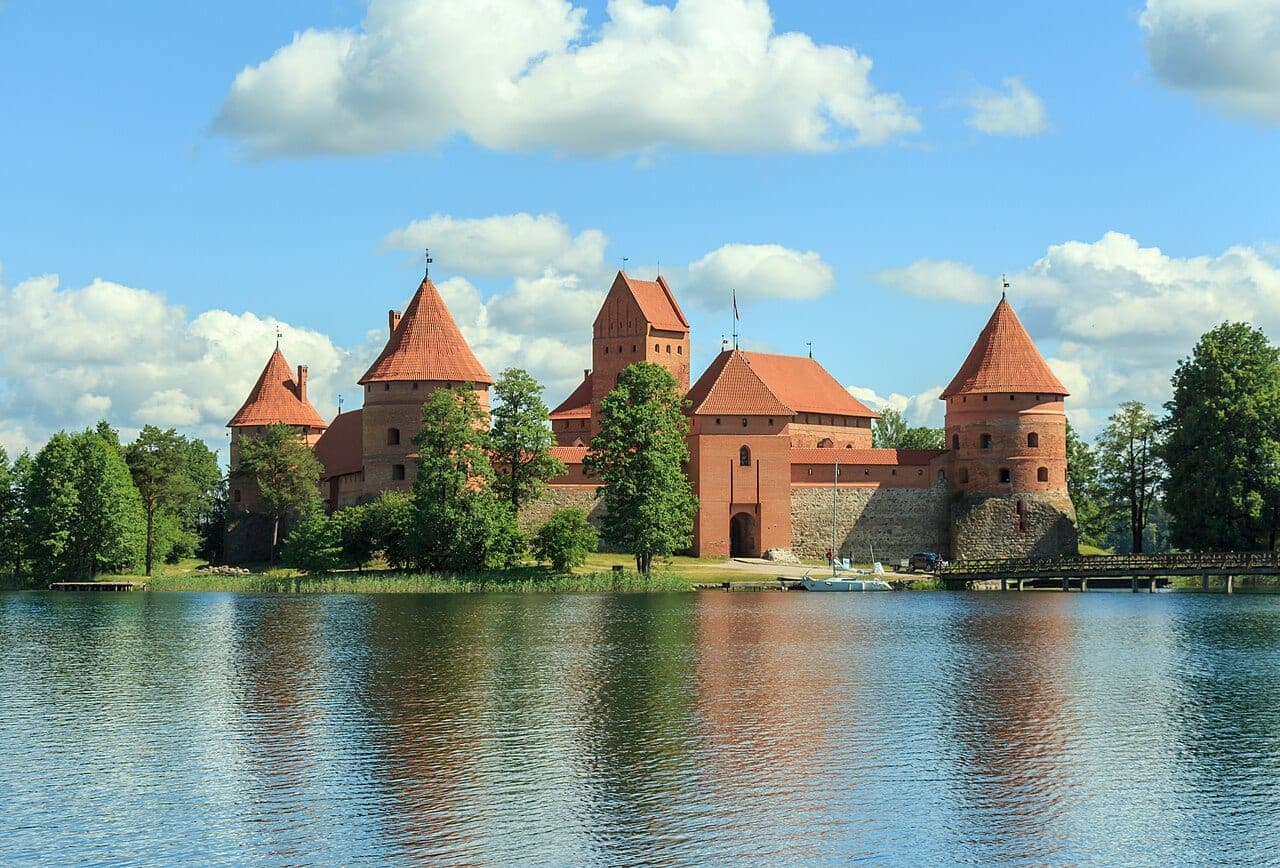
Trakai. The former medieval capital sits among lakes west of Vilnius, and its red-brick Island Castle on Lake Galve, begun by Grand Duke Kestutis and completed under Vytautas the Great in the early fifteenth century, is among the most recognisable buildings in the country. Trakai is also the historic centre of the Karaim, a small Turkic community brought here by Vytautas in the fourteenth century, who preserve their own language, prayer house and cuisine.
The ancestors of the Lithuanians were the Balts, Indo-European peoples settled along the Baltic coast since the second millennium BC. In 1253 Mindaugas was crowned the first and only King of Lithuania; after his death the country reverted to its old faith, and under the Gediminid dynasty the Grand Duchy of Lithuania expanded across the lands of the former Kievan Rus, reaching from the Baltic to the Black Sea and becoming, by the early fifteenth century, one of the largest states in Europe.
Lithuania was the last pagan state on the continent. Its conversion came through dynastic union: Grand Duke Jogaila was baptised in Krakow in 1386, married the Polish queen and ordered the mass baptism of Vilnius in 1387, while the western region of Samogitia was Christianised only in 1413. The Union of Krewo of 1385 bound Lithuania to Poland, the joint armies broke the Teutonic Order at the Battle of Grunwald in 1410, and the Union of Lublin of 1569 formed the Polish-Lithuanian Commonwealth, one of the largest and most populous states of its age. That commonwealth declined across the eighteenth century and was erased by its neighbours, the bulk of Lithuania passing to the Russian Empire in the Third Partition of 1795.
More than a century of Russian rule followed, including a ban on printing Lithuanian in Latin script from 1864 to 1904, resisted by the knygnesiai, the book smugglers who kept the language in circulation. Lithuania declared the restoration of its independence on 16 February 1918. The interwar republic lost Vilnius to Poland and governed from Kaunas, until the Molotov-Ribbentrop Pact reassigned the Baltic states to the Soviet sphere. The Soviet Union occupied and annexed Lithuania in June 1940, and in June 1941 carried out the first mass deportations to Siberia.
The German occupation from June 1941 brought the Holocaust in Lithuania. The Jewish community, which numbered roughly 200,000 and had made Vilnius a world centre of learning, was almost entirely destroyed, most of its members murdered by the end of 1941, many at the Paneriai forest outside Vilnius and the Ninth Fort at Kaunas. It was among the most complete national destructions of European Jewry. When Soviet forces returned in 1944, a second occupation began: further deportations sent well over 100,000 Lithuanians to Siberia and the Soviet interior, tens of thousands dying there, while an armed partisan resistance, the Forest Brothers, fought on until 1953.
Renewal came peacefully. The reform movement Sajudis formed in 1988; on 23 August 1989 about two million people linked hands from Tallinn through Riga to Vilnius in the Baltic Way; and on 11 March 1990 Lithuania became the first Soviet republic to declare the restoration of its independence. Soviet forces stormed the Vilnius television tower on 13 January 1991, killing fourteen unarmed civilians, but the state held, and its independence was recognised internationally later that year.
Lithuanian belongs, with Latvian, to the small Baltic branch of the Indo-European family, and it is often described as the most archaic living Indo-European language, retaining more features of the ancestral proto-language than almost any other. Its resemblances to Sanskrit have fascinated linguists for two centuries: pairs such as Lithuanian dievas and Sanskrit devas for god, sunus and sunu for son, or dantis and danta for tooth show how slowly the language has changed, as the Lithuanian language record makes clear. The first printed Lithuanian book, the Catechism of Martynas Mazvydas, appeared in 1547.
The name of the country carries its own long memory. Lietuva is first recorded in 1009, in the Annals of Quedlinburg, which mention the land as Litua, a date Lithuanians marked as a national millennium in 2009. The origin of the word remains debated, with the leading proposals pointing to a small local river or to an old term for a marshy place. Whatever its source, the survival of the language itself, through the printing ban and the Soviet decades, is treated in Lithuania as a form of continuous remembrance.
Lithuanian folk culture grew from a rural, wooded world, and its signature craft is cross-crafting, the making and raising of ornate wooden and iron memorial crosses and roofed pole-shrines by village artisans. Alongside it stand the working of Baltic amber, the fossil resin still called the gold of Lithuania, and a folk-art tradition of wood carving, woven sashes and the delicate straw mobiles known as sodai, hung above the table.
The country's most distinctive musical form is the sutartines, the multi-part polyphonic songs of north-eastern Lithuania, sung mainly by women in dense, close harmonies and inscribed by UNESCO on its intangible-heritage list. Every few years the vast Song and Dance Celebration, a Baltic tradition shared with Latvia and Estonia, gathers tens of thousands of singers and dancers. The table is rooted in potato, rye and dairy: cepelinai, the large potato dumplings named for their zeppelin shape; saltibarsciai, the cold beetroot soup that turns summer plates bright pink; kugelis, a baked potato pudding; dark rye bread; and the spiked, tree-shaped celebration cake sakotis. Basketball, meanwhile, is treated as something close to a national religion.
Roman Catholicism has shaped Lithuania since the conversion of the late fourteenth century, and about three quarters of the population identify as Catholic. That identity hardened under Russian and then Soviet rule, when the Church became a vessel for national feeling and open faith was an act of quiet resistance. Smaller Orthodox, Old Believer, Lutheran, Reformed and Jewish communities are also part of the country's religious life.
Beneath the Catholic surface lies the memory of the old Baltic paganism, the last such faith in Europe to fall. Its sky-god Perkunas, the god of thunder, and the earth-goddess Zemyna are remembered in folklore, place names and seasonal custom, and the oak and the sacred grove keep their symbolic weight. A modern revival movement, Romuva, seeks to reconstruct this native religion, and the boundary between Christian devotion and older nature-piety often blurs at the roadside cross and the holy spring.
Lithuanian mourning joins Christian rite to far older habits of tending the dead. Traditionally the body was laid out at home for a wake, the sarvojimas, where family and neighbours kept vigil, prayed the Rosary and sang, before the requiem Mass and burial; the community's presence, then as now, was the essential act.
Vilnius has one of the largest surviving medieval old towns in northern Europe, and was for centuries a major centre of Jewish learning until that community was destroyed. Photograph by Pofka, CC BY-SA 4.0, via Wikimedia Commons.
Kaunas. At the meeting of the Nemunas and Neris rivers, Kaunas served as the temporary capital of Lithuania between 1919 and 1939, after Vilnius was taken by Poland. In two decades it built one of Europe's largest and best-preserved collections of interwar modernist architecture, more than six thousand buildings that UNESCO recognised in 2023 as Modernist Kaunas. On its edge, the Ninth Fort is a memorial and museum on the site of wartime mass killing.
Klaipeda. Lithuania's only major seaport and its window on the Baltic, Klaipeda began as the Teutonic fortress of Memelburg in 1252 and spent centuries as the East Prussian town of Memel before passing to Lithuania in 1923, as Britannica records. Its old town keeps a distinct German-Baltic character, and it is the mainland gateway to the ferries of the Curonian Spit.
Trakai. The former medieval capital sits among lakes west of Vilnius, and its red-brick Island Castle on Lake Galve, begun by Grand Duke Kestutis and completed under Vytautas the Great in the early fifteenth century, is among the most recognisable buildings in the country. Trakai is also the historic centre of the Karaim, a small Turkic community brought here by Vytautas in the fourteenth century, who preserve their own language, prayer house and cuisine.
The ancestors of the Lithuanians were the Balts, Indo-European peoples settled along the Baltic coast since the second millennium BC. In 1253 Mindaugas was crowned the first and only King of Lithuania; after his death the country reverted to its old faith, and under the Gediminid dynasty the Grand Duchy of Lithuania expanded across the lands of the former Kievan Rus, reaching from the Baltic to the Black Sea and becoming, by the early fifteenth century, one of the largest states in Europe.
Lithuania was the last pagan state on the continent. Its conversion came through dynastic union: Grand Duke Jogaila was baptised in Krakow in 1386, married the Polish queen and ordered the mass baptism of Vilnius in 1387, while the western region of Samogitia was Christianised only in 1413. The Union of Krewo of 1385 bound Lithuania to Poland, the joint armies broke the Teutonic Order at the Battle of Grunwald in 1410, and the Union of Lublin of 1569 formed the Polish-Lithuanian Commonwealth, one of the largest and most populous states of its age. That commonwealth declined across the eighteenth century and was erased by its neighbours, the bulk of Lithuania passing to the Russian Empire in the Third Partition of 1795.
More than a century of Russian rule followed, including a ban on printing Lithuanian in Latin script from 1864 to 1904, resisted by the knygnesiai, the book smugglers who kept the language in circulation. Lithuania declared the restoration of its independence on 16 February 1918. The interwar republic lost Vilnius to Poland and governed from Kaunas, until the Molotov-Ribbentrop Pact reassigned the Baltic states to the Soviet sphere. The Soviet Union occupied and annexed Lithuania in June 1940, and in June 1941 carried out the first mass deportations to Siberia.
The German occupation from June 1941 brought the Holocaust in Lithuania. The Jewish community, which numbered roughly 200,000 and had made Vilnius a world centre of learning, was almost entirely destroyed, most of its members murdered by the end of 1941, many at the Paneriai forest outside Vilnius and the Ninth Fort at Kaunas. It was among the most complete national destructions of European Jewry. When Soviet forces returned in 1944, a second occupation began: further deportations sent well over 100,000 Lithuanians to Siberia and the Soviet interior, tens of thousands dying there, while an armed partisan resistance, the Forest Brothers, fought on until 1953.
Renewal came peacefully. The reform movement Sajudis formed in 1988; on 23 August 1989 about two million people linked hands from Tallinn through Riga to Vilnius in the Baltic Way; and on 11 March 1990 Lithuania became the first Soviet republic to declare the restoration of its independence. Soviet forces stormed the Vilnius television tower on 13 January 1991, killing fourteen unarmed civilians, but the state held, and its independence was recognised internationally later that year.
Lithuanian belongs, with Latvian, to the small Baltic branch of the Indo-European family, and it is often described as the most archaic living Indo-European language, retaining more features of the ancestral proto-language than almost any other. Its resemblances to Sanskrit have fascinated linguists for two centuries: pairs such as Lithuanian dievas and Sanskrit devas for god, sunus and sunu for son, or dantis and danta for tooth show how slowly the language has changed, as the Lithuanian language record makes clear. The first printed Lithuanian book, the Catechism of Martynas Mazvydas, appeared in 1547.
The name of the country carries its own long memory. Lietuva is first recorded in 1009, in the Annals of Quedlinburg, which mention the land as Litua, a date Lithuanians marked as a national millennium in 2009. The origin of the word remains debated, with the leading proposals pointing to a small local river or to an old term for a marshy place. Whatever its source, the survival of the language itself, through the printing ban and the Soviet decades, is treated in Lithuania as a form of continuous remembrance.
Lithuanian folk culture grew from a rural, wooded world, and its signature craft is cross-crafting, the making and raising of ornate wooden and iron memorial crosses and roofed pole-shrines by village artisans. Alongside it stand the working of Baltic amber, the fossil resin still called the gold of Lithuania, and a folk-art tradition of wood carving, woven sashes and the delicate straw mobiles known as sodai, hung above the table.
The country's most distinctive musical form is the sutartines, the multi-part polyphonic songs of north-eastern Lithuania, sung mainly by women in dense, close harmonies and inscribed by UNESCO on its intangible-heritage list. Every few years the vast Song and Dance Celebration, a Baltic tradition shared with Latvia and Estonia, gathers tens of thousands of singers and dancers. The table is rooted in potato, rye and dairy: cepelinai, the large potato dumplings named for their zeppelin shape; saltibarsciai, the cold beetroot soup that turns summer plates bright pink; kugelis, a baked potato pudding; dark rye bread; and the spiked, tree-shaped celebration cake sakotis. Basketball, meanwhile, is treated as something close to a national religion.
Roman Catholicism has shaped Lithuania since the conversion of the late fourteenth century, and about three quarters of the population identify as Catholic. That identity hardened under Russian and then Soviet rule, when the Church became a vessel for national feeling and open faith was an act of quiet resistance. Smaller Orthodox, Old Believer, Lutheran, Reformed and Jewish communities are also part of the country's religious life.
Beneath the Catholic surface lies the memory of the old Baltic paganism, the last such faith in Europe to fall. Its sky-god Perkunas, the god of thunder, and the earth-goddess Zemyna are remembered in folklore, place names and seasonal custom, and the oak and the sacred grove keep their symbolic weight. A modern revival movement, Romuva, seeks to reconstruct this native religion, and the boundary between Christian devotion and older nature-piety often blurs at the roadside cross and the holy spring.
Lithuanian mourning joins Christian rite to far older habits of tending the dead. Traditionally the body was laid out at home for a wake, the sarvojimas, where family and neighbours kept vigil, prayed the Rosary and sang, before the requiem Mass and burial; the community's presence, then as now, was the essential act.
 Soviet authorities bulldozed the Hill of Crosses at least three times and burned what they cleared. People put the crosses back each time, at night, and there are now well over a hundred thousand. Photograph by Diego Delso, CC BY-SA 3.0, via Wikimedia Commons.
The heart of the calendar of the dead is Velines, All Souls, on 2 November, when families across the country visit the graves of their relatives and light candles upon them, so that whole cemeteries glow after dark with thousands of small flames. The custom of candle-lighting is relatively modern, but it rests on a much older autumn festival of the ancestors, once called Ilges, when the living set out food for the returning souls, the veles. In Vilnius the Rasos Cemetery, founded in 1769, is the oldest and most revered burial ground, its Hill of Literati holding writers and cultural figures.
No place gathers Lithuanian remembrance more powerfully than the Hill of Crosses near Siauliai, where pilgrims have planted crosses for generations, many in memory of the dead and the deported. Soviet authorities bulldozed the hill at least three times in the 1960s and 1970s, burning the crosses and levelling the ground; each time Lithuanians returned by night to raise them again. Today it carries well over a hundred thousand crosses, and Pope John Paul II prayed there in 1993, so that a hill of private griefs has become a monument to collective endurance.
The most closely kept Lithuanian meal of the year is also a meal with the dead at it. Kūčios, the Christmas Eve supper, runs to twelve dishes with no meat among them, opens with a shared wafer, and includes an empty place set for anyone in the family who died during the year.
Lithuanian records sit at the meeting point of three record systems, and knowing which one applies is most of the work.
Catholic parish registers are the substance, running from the seventeenth and eighteenth centuries and written in Latin, then Polish, then Russian, then Lithuanian as authority changed. From 1864, after the January Uprising, the Russian administration banned the Latin alphabet for Lithuanian, so records of that period are in Cyrillic even where the language is Lithuanian. The State Historical Archives in Vilnius hold the parish books and the revision lists, and Epaveldas publishes a great deal of it free.
The Grand Duchy's own record is older and grander: the Lithuanian Metrica, the chancery register of the state from the fifteenth century, survives and is held in Moscow, with copies and publications elsewhere. For noble families it is the foundation document.
Vilnius was one of the great centres of Jewish life, and Lithuanian Jewish records, the community registers, the tax lists, the yeshiva records, survive in quantity at the archives. The community was almost entirely destroyed in 1941 and 1942, much of it by shooting at Paneriai outside the city, and the registers are what remain of it.
The Soviet deportations of 1941 and 1948 to 1951 took hundreds of thousands, and the lists are published. The partisan resistance that followed produced its own records, kept underground and now held by the Genocide and Resistance Research Centre.
Lithuania holds five UNESCO World Heritage Sites. The Historic Centre of Vilnius was inscribed in 1994; the Curonian Spit, the great shifting dune barrier, was inscribed in 2000 as a cultural landscape shared with Russia; the Kernave Archaeological Site, an ancient capital and set of hill forts, followed in 2004; the transnational Struve Geodetic Arc, a nineteenth-century chain of survey points running through ten countries, with three stations in Lithuania, was inscribed in 2005; and Modernist Kaunas joined the list in 2023.
On the intangible-heritage list, UNESCO has recognised cross-crafting and its symbolism in 2008, the Baltic Song and Dance Celebrations the same year, the sutartines polyphonic songs in 2010, and more recently the tradition of making straw gardens. Domestically, the Department of Cultural Heritage protects monuments and historic centres, and the Genocide and Resistance Research Centre of Lithuania documents the occupations, the deportations and the partisan war, maintaining the former KGB building in Vilnius as the Museum of Occupations and Freedom Fights.
Lithuania has moved much of its documentary memory online. The national portal ePaveldas gathers digitised books, manuscripts, periodicals, maps and images from the country's libraries, archives and museums into a single searchable resource, while the Lithuanian Integral Museum Information System, LIMIS, brings together the holdings of museums nationwide. The State Historical Archives have opened parish and census records used by the diaspora to trace family roots.
One project speaks directly to the country's twentieth-century losses. The archives of Vilnius Jewry, split during the war between the city and New York, are being reunited digitally through the Edward Blank YIVO Vilna Online Collections, putting hundreds of thousands of documents and books from the pre-war Jerusalem of the North back within reach of scholars and descendants worldwide.
For a small country, Lithuania carries a long cultural reach. The painter and composer Mikalojus Konstantinas Ciurlionis fused image and music at the turn of the twentieth century; the poet Czeslaw Milosz, born in the Lithuanian countryside and later a Nobel laureate, and the poet and dissident Tomas Venclova both wrote out of this borderland; and the emigre filmmaker Jonas Mekas became a central figure of American avant-garde cinema, as George Maciunas, another Lithuanian, did of the Fluxus movement.
Contemporary Lithuania keeps that momentum. Vilnius has grown into a creative and technology hub, its restaurants have begun to earn international recognition, and its designers have reinvented amber for a modern market. Basketball remains a unifying passion. Above all, the Song and Dance Celebration and local sutartines revivals show a living folk culture renewing itself, carried by choirs and ensembles rather than preserved behind glass.
The nation that smuggled its own books. When Russia banned Lithuanian printing in the Latin script from 1864 to 1904, the knygnesiai carried books across the border by night, sustaining a language now honoured as one of the oldest living in Europe. They are commemorated as national heroes, proof that a culture can outlast a ban.
The hill that could not be levelled. The Hill of Crosses near Siauliai was bulldozed at least three times by Soviet authorities, yet Lithuanians rebuilt it each time in the dark. It now holds well over a hundred thousand crosses and drew a papal pilgrimage in 1993, turning an act of suppression into an enduring monument of memory.
Two million hands. On 23 August 1989 the peoples of Lithuania, Latvia and Estonia joined in the Baltic Way, a human chain of roughly two million people stretching some 675 kilometres. Within six months Lithuania declared the restoration of its independence, and the human chain is now inscribed on UNESCO's Memory of the World register.
A lost world reassembled. The pre-war Jewish archives of Vilnius, torn apart by the war and dispersed between Lithuania and the United States, are being digitally reunited through the YIVO Vilna Collections, returning the record of a destroyed community to public memory.
Soviet authorities bulldozed the Hill of Crosses at least three times and burned what they cleared. People put the crosses back each time, at night, and there are now well over a hundred thousand. Photograph by Diego Delso, CC BY-SA 3.0, via Wikimedia Commons.
The heart of the calendar of the dead is Velines, All Souls, on 2 November, when families across the country visit the graves of their relatives and light candles upon them, so that whole cemeteries glow after dark with thousands of small flames. The custom of candle-lighting is relatively modern, but it rests on a much older autumn festival of the ancestors, once called Ilges, when the living set out food for the returning souls, the veles. In Vilnius the Rasos Cemetery, founded in 1769, is the oldest and most revered burial ground, its Hill of Literati holding writers and cultural figures.
No place gathers Lithuanian remembrance more powerfully than the Hill of Crosses near Siauliai, where pilgrims have planted crosses for generations, many in memory of the dead and the deported. Soviet authorities bulldozed the hill at least three times in the 1960s and 1970s, burning the crosses and levelling the ground; each time Lithuanians returned by night to raise them again. Today it carries well over a hundred thousand crosses, and Pope John Paul II prayed there in 1993, so that a hill of private griefs has become a monument to collective endurance.
The most closely kept Lithuanian meal of the year is also a meal with the dead at it. Kūčios, the Christmas Eve supper, runs to twelve dishes with no meat among them, opens with a shared wafer, and includes an empty place set for anyone in the family who died during the year.
Lithuanian records sit at the meeting point of three record systems, and knowing which one applies is most of the work.
Catholic parish registers are the substance, running from the seventeenth and eighteenth centuries and written in Latin, then Polish, then Russian, then Lithuanian as authority changed. From 1864, after the January Uprising, the Russian administration banned the Latin alphabet for Lithuanian, so records of that period are in Cyrillic even where the language is Lithuanian. The State Historical Archives in Vilnius hold the parish books and the revision lists, and Epaveldas publishes a great deal of it free.
The Grand Duchy's own record is older and grander: the Lithuanian Metrica, the chancery register of the state from the fifteenth century, survives and is held in Moscow, with copies and publications elsewhere. For noble families it is the foundation document.
Vilnius was one of the great centres of Jewish life, and Lithuanian Jewish records, the community registers, the tax lists, the yeshiva records, survive in quantity at the archives. The community was almost entirely destroyed in 1941 and 1942, much of it by shooting at Paneriai outside the city, and the registers are what remain of it.
The Soviet deportations of 1941 and 1948 to 1951 took hundreds of thousands, and the lists are published. The partisan resistance that followed produced its own records, kept underground and now held by the Genocide and Resistance Research Centre.
Lithuania holds five UNESCO World Heritage Sites. The Historic Centre of Vilnius was inscribed in 1994; the Curonian Spit, the great shifting dune barrier, was inscribed in 2000 as a cultural landscape shared with Russia; the Kernave Archaeological Site, an ancient capital and set of hill forts, followed in 2004; the transnational Struve Geodetic Arc, a nineteenth-century chain of survey points running through ten countries, with three stations in Lithuania, was inscribed in 2005; and Modernist Kaunas joined the list in 2023.
On the intangible-heritage list, UNESCO has recognised cross-crafting and its symbolism in 2008, the Baltic Song and Dance Celebrations the same year, the sutartines polyphonic songs in 2010, and more recently the tradition of making straw gardens. Domestically, the Department of Cultural Heritage protects monuments and historic centres, and the Genocide and Resistance Research Centre of Lithuania documents the occupations, the deportations and the partisan war, maintaining the former KGB building in Vilnius as the Museum of Occupations and Freedom Fights.
Lithuania has moved much of its documentary memory online. The national portal ePaveldas gathers digitised books, manuscripts, periodicals, maps and images from the country's libraries, archives and museums into a single searchable resource, while the Lithuanian Integral Museum Information System, LIMIS, brings together the holdings of museums nationwide. The State Historical Archives have opened parish and census records used by the diaspora to trace family roots.
One project speaks directly to the country's twentieth-century losses. The archives of Vilnius Jewry, split during the war between the city and New York, are being reunited digitally through the Edward Blank YIVO Vilna Online Collections, putting hundreds of thousands of documents and books from the pre-war Jerusalem of the North back within reach of scholars and descendants worldwide.
For a small country, Lithuania carries a long cultural reach. The painter and composer Mikalojus Konstantinas Ciurlionis fused image and music at the turn of the twentieth century; the poet Czeslaw Milosz, born in the Lithuanian countryside and later a Nobel laureate, and the poet and dissident Tomas Venclova both wrote out of this borderland; and the emigre filmmaker Jonas Mekas became a central figure of American avant-garde cinema, as George Maciunas, another Lithuanian, did of the Fluxus movement.
Contemporary Lithuania keeps that momentum. Vilnius has grown into a creative and technology hub, its restaurants have begun to earn international recognition, and its designers have reinvented amber for a modern market. Basketball remains a unifying passion. Above all, the Song and Dance Celebration and local sutartines revivals show a living folk culture renewing itself, carried by choirs and ensembles rather than preserved behind glass.
The nation that smuggled its own books. When Russia banned Lithuanian printing in the Latin script from 1864 to 1904, the knygnesiai carried books across the border by night, sustaining a language now honoured as one of the oldest living in Europe. They are commemorated as national heroes, proof that a culture can outlast a ban.
The hill that could not be levelled. The Hill of Crosses near Siauliai was bulldozed at least three times by Soviet authorities, yet Lithuanians rebuilt it each time in the dark. It now holds well over a hundred thousand crosses and drew a papal pilgrimage in 1993, turning an act of suppression into an enduring monument of memory.
Two million hands. On 23 August 1989 the peoples of Lithuania, Latvia and Estonia joined in the Baltic Way, a human chain of roughly two million people stretching some 675 kilometres. Within six months Lithuania declared the restoration of its independence, and the human chain is now inscribed on UNESCO's Memory of the World register.
A lost world reassembled. The pre-war Jewish archives of Vilnius, torn apart by the war and dispersed between Lithuania and the United States, are being digitally reunited through the YIVO Vilna Collections, returning the record of a destroyed community to public memory.
National Overview
Notable Cities
Historical Foundations
Linguistic and Etymological Roots
Cultural Identity
Religion and Spirituality
Remembrance and Mourning Traditions
Tracing a Family in Lithuania
Heritage Preservation Efforts
Digital Heritage
Contemporary Cultural Influences
Success Stories
References and resources
- UNESCO World Heritage Centre, Lithuania state party and List of World Heritage Sites in Lithuania covering Vilnius, the Curonian Spit, Kernave, the Struve Geodetic Arc and Modernist Kaunas.
- UNESCO Intangible Cultural Heritage, Lithuania for cross-crafting, the sutartines and the Baltic Song and Dance Celebrations.
- Encyclopaedia Britannica, Lithuania and Grand Duchy of Lithuania for geography, the medieval state and the conversion of 1387.
- Encyclopaedia Britannica, Union of Lublin on the formation of the Polish-Lithuanian Commonwealth in 1569.
- The Baltic Way and the Lithuanian Ministry of Foreign Affairs path towards independence on the events of 1989 to 1991.
- Facing History and Ourselves, The Holocaust in Lithuania on the destruction of the Jewish community.
- The Hill of Crosses and Velines on remembrance customs and the calendar of the dead.
- Lithuanian language on the archaic Baltic tongue and its links to Sanskrit.
- ePaveldas national digital heritage portal and the YIVO Vilna Online Collections reuniting the Jewish archives of Vilnius.