Heritage · Landmark
Venice — memory at high water
A city built on water for more than a millennium now contends with rising seas, a vast mobile barrier, tens of millions of visitors, and a resident population smaller than the crowds that arrive on a busy day.Written to last.
By Confinity Heritage Editorial · 2026-07-10 · 7-minute readQuiet tools, kept out of the way.
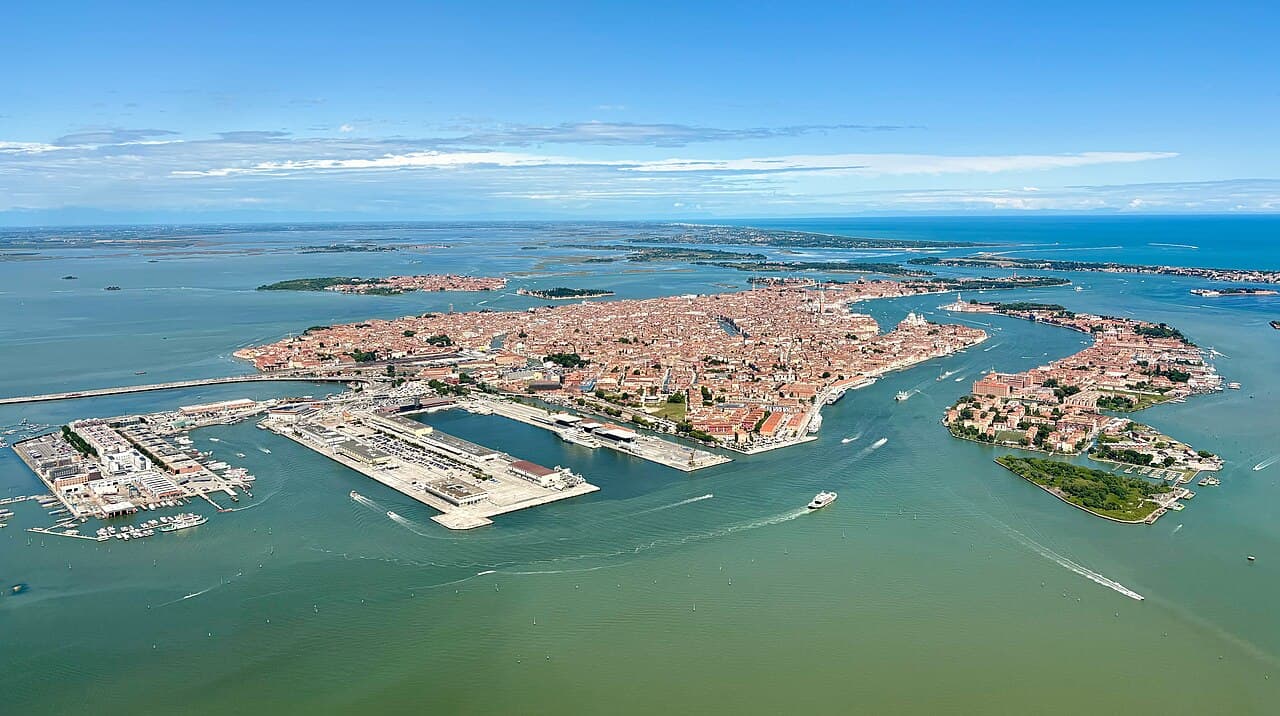
Every city keeps its memory in stone. Venice keeps its memory in stone that stands in water, and that changes everything. The palaces along the Grand Canal rest on millions of wooden piles driven into lagoon mud a thousand years ago; the mosaics of St Mark's Basilica begin barely a metre above the tide. Nowhere else does a great historic city live in such intimate negotiation with the sea, and nowhere else is the question of how to keep a place, and who will be left to keep it, posed quite so starkly.
Venice began as a refuge. From the fifth century onward, communities from the Roman mainland retreated into the marshes of the lagoon, out of reach of invading armies, and learned to build where there was no ground to build on. Out of those settlements grew the Republic of Venice, which for roughly a thousand years, until Napoleon extinguished it in 1797, ran one of the great maritime trading empires of the Mediterranean. Its wealth is still legible in the fabric of the city: Byzantine, Gothic, and Renaissance facades stacked along canals, a cathedral sheathed in golden mosaic, an arsenal that once launched a warship a day.
In 1987 UNESCO inscribed Venice and its Lagoon on the World Heritage List: the famous islands together with the whole 550-square-kilometre lagoon system of mudflats, salt marshes, and fishing settlements that made the city possible. The listing recognised what Venetians have always known: the city and the water are one artefact. Neither can be conserved without the other.
Seasonal high tides, acqua alta, have flooded the lowest parts of Venice for as long as records exist. What has changed is their frequency and reach. Over the twentieth century the city lost roughly twenty-three centimetres to the sea, through a combination of rising water and subsidence, much of it caused by industrial groundwater pumping on the mainland that was halted in the 1970s. Floods that were once rare events now arrive many times each winter, and St Mark's Square, the lowest point of the city, floods first.
 The Piazza is the lowest point in the city, so it floods first and drains last. Photograph by Tatiana Kormina, public domain, via Wikimedia Commons.
Two dates frame the modern story. On 4 November 1966 the tide reached 194 centimetres above the standard datum, the highest ever measured, and submerged the city for the better part of a day. And on 12 November 2019 the water rose to 187 centimetres, the second-highest level since measurements began in 1923, flooding more than four fifths of the city, inundating the crypt of St Mark's, and causing damage estimated at around a billion euros. Shopkeepers and residents met the 2019 flood as Venetians always have: with pumps, plywood, and salvage. But it made plain how narrow the margin has become.
The engineering answer is MOSE, Modulo Sperimentale Elettromeccanico, a system of seventy-eight mobile steel gates lying on the seabed at the three inlets that connect the lagoon to the Adriatic. When a dangerous tide is forecast, compressed air empties the gates of water and they swing up to close the lagoon off from the sea. Conceived in the 1980s and under construction from 2003, the project was delayed for years by engineering setbacks and a major corruption scandal, and its cost has run to several billion euros. It was raised in earnest for the first time on 3 October 2020, and it worked. For the first time in the city's history, a forecast flood simply did not arrive.
Since then the barrier has been raised far more often than its designers once predicted, dozens of times in its first two winters alone. That success carries its own bargains. Each closure costs hundreds of thousands of euros and interrupts the port. More profoundly, the lagoon is a living system that depends on the exchange of tides: close it too often, scientists warn, and the salt marshes, fish nurseries, and the lagoon's ability to flush itself begin to suffer. And MOSE was designed against the sea levels of the late twentieth century. If the higher projections for sea-level rise this century prove accurate, the barrier built to save Venice may spend more and more of the year closed, until closure itself becomes the problem.
The dangers to Venice are three, and they compound one another.
The first is water. Beyond the drama of record floods, the slow chemistry of salt is eating the city from below, rising damp wicks salt water into brick and marble, spalling surfaces and hollowing walls. Even ordinary tides now lap into St Mark's, which is why a low glass wall was recently built around the basilica to hold back routine flooding while larger defences are debated.
The second is people, or their absence. In 2022 the resident population of the historic centre fell below 50,000 for the first time in centuries, in 1951 it was around 175,000. A digital counter in a pharmacy window near the Rialto has tracked the decline for years, and campaigners now count fewer than 45,000. Housing converted to tourist lets, the cost of maintaining ancient buildings, and the disappearance of ordinary shops and jobs push families to the mainland. A city can survive floods; it cannot survive becoming uninhabited.
The third is tourism itself. Venice receives tens of millions of visitors a year, with peak days bringing crowds that outnumber residents twofold. In 2021, days before UNESCO's World Heritage Committee was to consider placing the city on the List of World Heritage in Danger, Italy banned large cruise ships from the Giudecca Canal and St Mark's basin. In 2023 UNESCO's advisers again recommended the in-danger listing, citing mass tourism and climate change; the committee again declined, while pressing Italy for stronger action. The debate is unresolved because the underlying tension is unresolved: the visitor economy sustains Venice and consumes it at the same time.
Venice has become a laboratory for how a historic city manages itself. In 2024 it became the first city in the world to charge day visitors for entry, trialling a five-euro access fee on twenty-nine peak days; in 2025 the scheme roughly doubled in scope, with late bookers paying ten euros. Group sizes have been capped and loudspeakers banned in the historic centre. MOSE stands guard at the inlets, and research programmes monitor the lagoon it protects.
But the quieter keeping matters as much. The remaining squeri still build and repair gondolas by hand; the makers of forcole, the sculptural rowlocks unique to Venetian rowing, still carve them from single blocks of walnut; the city's rowing clubs still teach children to stand and row in the Venetian style, keeping alive the skill the city was built on. Residents' associations count their neighbours, contest hotel conversions, and insist, against the tide of postcards, that Venice is a home before it is a destination. Every one of these acts is small. Together they are the difference between a city and a stage set.
Venice shows that a place is kept by two systems at once: the hard defences that hold back catastrophe, and the daily habits of the people who stay. The barrier can stop a flood; it cannot row a boat, raise a child in a campo, or keep a bakery open through the winter. Family memory obeys the same rule. The archive, the backed-up photographs, the recorded voices, is the barrier, and it matters. But what keeps a family's memory alive is habitation: the stories retold at the table, the recipes still cooked, the return visits made even when the water is rising. Confinity exists for both kinds of keeping, the vault and the visit, because Venice's lesson is that neither survives long without the other.
The Piazza is the lowest point in the city, so it floods first and drains last. Photograph by Tatiana Kormina, public domain, via Wikimedia Commons.
Two dates frame the modern story. On 4 November 1966 the tide reached 194 centimetres above the standard datum, the highest ever measured, and submerged the city for the better part of a day. And on 12 November 2019 the water rose to 187 centimetres, the second-highest level since measurements began in 1923, flooding more than four fifths of the city, inundating the crypt of St Mark's, and causing damage estimated at around a billion euros. Shopkeepers and residents met the 2019 flood as Venetians always have: with pumps, plywood, and salvage. But it made plain how narrow the margin has become.
The engineering answer is MOSE, Modulo Sperimentale Elettromeccanico, a system of seventy-eight mobile steel gates lying on the seabed at the three inlets that connect the lagoon to the Adriatic. When a dangerous tide is forecast, compressed air empties the gates of water and they swing up to close the lagoon off from the sea. Conceived in the 1980s and under construction from 2003, the project was delayed for years by engineering setbacks and a major corruption scandal, and its cost has run to several billion euros. It was raised in earnest for the first time on 3 October 2020, and it worked. For the first time in the city's history, a forecast flood simply did not arrive.
Since then the barrier has been raised far more often than its designers once predicted, dozens of times in its first two winters alone. That success carries its own bargains. Each closure costs hundreds of thousands of euros and interrupts the port. More profoundly, the lagoon is a living system that depends on the exchange of tides: close it too often, scientists warn, and the salt marshes, fish nurseries, and the lagoon's ability to flush itself begin to suffer. And MOSE was designed against the sea levels of the late twentieth century. If the higher projections for sea-level rise this century prove accurate, the barrier built to save Venice may spend more and more of the year closed, until closure itself becomes the problem.
The dangers to Venice are three, and they compound one another.
The first is water. Beyond the drama of record floods, the slow chemistry of salt is eating the city from below, rising damp wicks salt water into brick and marble, spalling surfaces and hollowing walls. Even ordinary tides now lap into St Mark's, which is why a low glass wall was recently built around the basilica to hold back routine flooding while larger defences are debated.
The second is people, or their absence. In 2022 the resident population of the historic centre fell below 50,000 for the first time in centuries, in 1951 it was around 175,000. A digital counter in a pharmacy window near the Rialto has tracked the decline for years, and campaigners now count fewer than 45,000. Housing converted to tourist lets, the cost of maintaining ancient buildings, and the disappearance of ordinary shops and jobs push families to the mainland. A city can survive floods; it cannot survive becoming uninhabited.
The third is tourism itself. Venice receives tens of millions of visitors a year, with peak days bringing crowds that outnumber residents twofold. In 2021, days before UNESCO's World Heritage Committee was to consider placing the city on the List of World Heritage in Danger, Italy banned large cruise ships from the Giudecca Canal and St Mark's basin. In 2023 UNESCO's advisers again recommended the in-danger listing, citing mass tourism and climate change; the committee again declined, while pressing Italy for stronger action. The debate is unresolved because the underlying tension is unresolved: the visitor economy sustains Venice and consumes it at the same time.
Venice has become a laboratory for how a historic city manages itself. In 2024 it became the first city in the world to charge day visitors for entry, trialling a five-euro access fee on twenty-nine peak days; in 2025 the scheme roughly doubled in scope, with late bookers paying ten euros. Group sizes have been capped and loudspeakers banned in the historic centre. MOSE stands guard at the inlets, and research programmes monitor the lagoon it protects.
But the quieter keeping matters as much. The remaining squeri still build and repair gondolas by hand; the makers of forcole, the sculptural rowlocks unique to Venetian rowing, still carve them from single blocks of walnut; the city's rowing clubs still teach children to stand and row in the Venetian style, keeping alive the skill the city was built on. Residents' associations count their neighbours, contest hotel conversions, and insist, against the tide of postcards, that Venice is a home before it is a destination. Every one of these acts is small. Together they are the difference between a city and a stage set.
Venice shows that a place is kept by two systems at once: the hard defences that hold back catastrophe, and the daily habits of the people who stay. The barrier can stop a flood; it cannot row a boat, raise a child in a campo, or keep a bakery open through the winter. Family memory obeys the same rule. The archive, the backed-up photographs, the recorded voices, is the barrier, and it matters. But what keeps a family's memory alive is habitation: the stories retold at the table, the recipes still cooked, the return visits made even when the water is rising. Confinity exists for both kinds of keeping, the vault and the visit, because Venice's lesson is that neither survives long without the other.
A republic built on water
Acqua alta: the water as clock
MOSE: the barrier and its bargains
What is at risk
The keeping now
What Venice teaches about keeping
References and resources
- UNESCO World Heritage Centre, Venice and its Lagoon
- UNESCO World Heritage Centre, Large cruise ships banned from entering Venice Lagoon
- NPR, Venice is not added to UNESCO World Heritage in Danger list (September 2023)
- CNN, Venice holds back the water for first time in 1,200 years (MOSE's first operation, October 2020)
- Comune di Venezia / Venezia Unica, the Venice Access Fee, official information
- MOSE Venezia, official project site for the mobile-barrier system
- Campaign for a Living Venice, Venice drops below 49,000 residents