Culture · Essay
The Navajo Blessingway: what the Diné teach about knowledge that is not written down
The central ceremony of the Diné lives in trained voices, and much of it is deliberately never recorded. On hózhó, oral transmission, and the wisdom of deciding what an archive should not hold.Written to last.
By Confinity Editorial · 2026-07-10 · 6-minute readQuiet tools, kept out of the way.
A few years ago the Indigenous news outlet ICT ran a story about winter storytelling in the Navajo Nation under a headline that doubles as an instruction: "Bring the tobacco, turn off the recorder." The modern gospel of preservation says capture everything and back it all up. Anyone raised on that will feel the sentence snag. Here is a community famous for one of the richest oral traditions in North America, saying plainly that some of it is not to be taped.
This essay is written from outside that tradition, and it tries to behave accordingly. The Blessingway is not folklore; it is a living religious practice of the Diné, the Navajo people, whose nation spans parts of Arizona, New Mexico and Utah and is the largest in the United States. Portions of its ceremonial knowledge are restricted, held by those trained and authorised to carry them. What follows stays within what Diné institutions, and singers who chose to speak publicly, have themselves made available. The restrictions are the story's point.
To understand why the Blessingway matters, start with the word it exists to restore. Hózhó is usually glossed in English as "beauty" or "harmony", but Diné writers insist the translation always underdescribes it. Michelle Kahn-John, a Diné nursing scholar, and her co-author Mary Koithan describe hózhó as a complete wellness philosophy, a state gathering up beauty, harmony, goodness, order, health and wellbeing all at once, and as a discipline that guides one's thoughts, speech and behaviour towards maintaining that state. It is less a doctrine than a way of moving through the world; the common English rendering of its ideal is "walking in beauty". The fuller ceremonial phrase, Sá'ah Naagháí Bik'eh Hózhóón, is profound enough that Diné College, the Nation's tribal college, has placed it at the centre of its whole educational philosophy.
Life, in this understanding, drifts out of hózhó through illness, loss, contact with danger and death, or simple disorder. The ceremonial system exists to restore and protect it.
Within that system, the Blessingway (Hózhǫ́ǫ́jí in Diné bizaad, the Navajo language) holds a singular place. Unlike the ceremonies that treat an existing illness or misfortune, published scholarship describes the Blessingway as preventive and generative, performed to invoke blessing, protection and good outcome. Accounts place it at the thresholds of life: for an expectant mother, a new home, a marriage, a person setting out or returning. Elements of it run through other rites, including the Kinaaldá, the coming-of-age ceremony for young women. It is anchored in the Diné creation account, and singers who cooperated with the anthropologist Leland Wyman for his 1970 study told him the Blessingway was the backbone of the ceremonial system, the rite from which the others take their bearings.
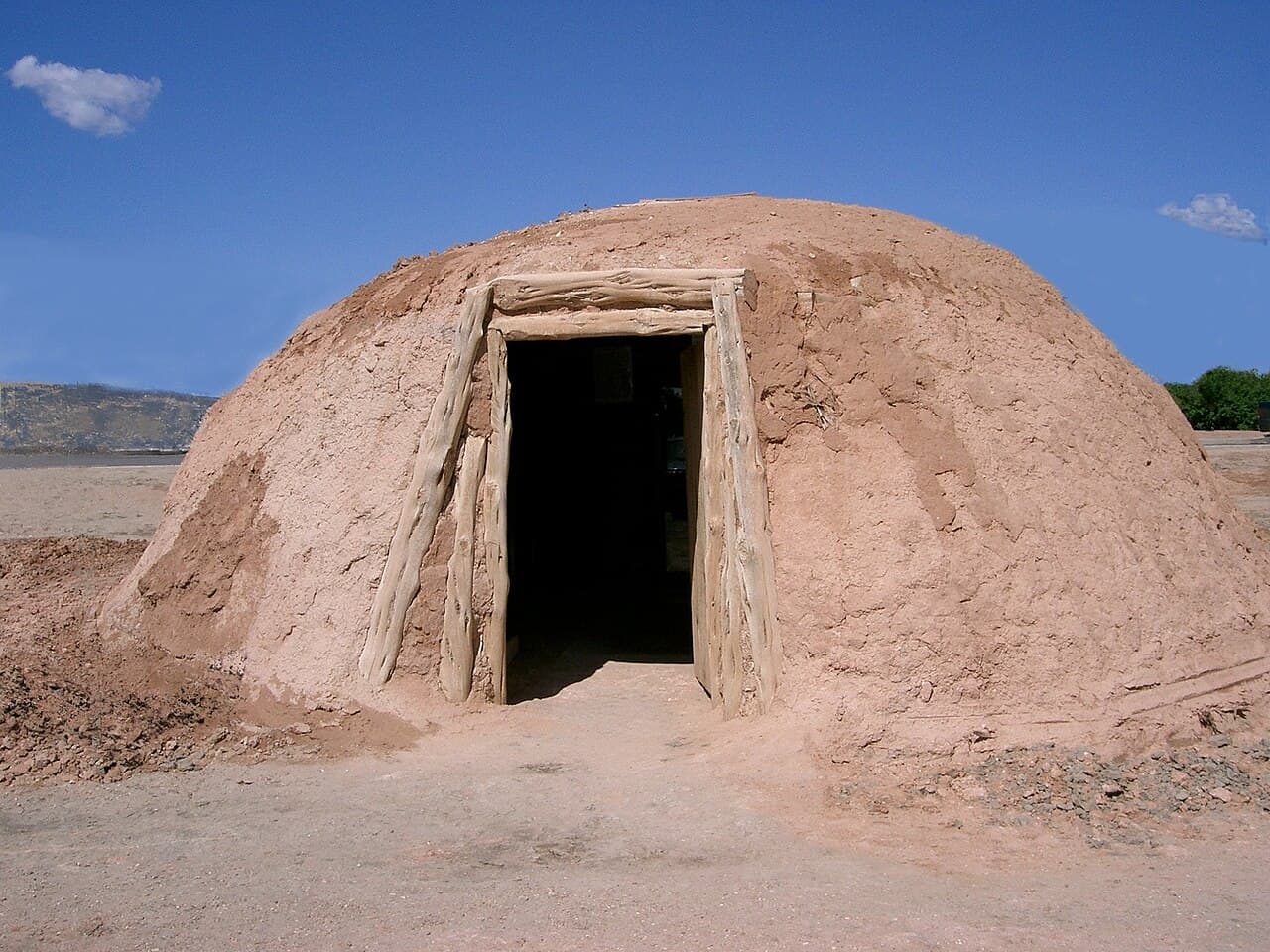 A hogan, where the ceremony is held. The door faces east, and the building itself is understood in the terms the songs use. The ceremony is not photographed here, and should not be. Photograph by PRA, CC BY 2.5, via Wikimedia Commons.
That is roughly where a respectful public description should stop. The songs, prayers and procedures themselves belong to the ceremony and to the people trained to conduct it. Summarising them second-hand would not only be discourteous; by Diné lights it would be false, because the knowledge does not exist apart from the conditions under which it is given: the training, the relationships, the proper season.
The carriers of this knowledge are the hataałii, usually translated "singers" or "medicine people". Their training is among the most demanding apprenticeships on earth: years, often decades, spent memorising bodies of song, prayer and procedure that must be rendered exactly for a ceremony to do its work. A single ceremonial "way" can hold thousands of lines, and a hataałii may master only one or a few in a lifetime. There are no scripts to consult. The person is the library.
One of the few inside accounts in print exists because its subject wanted it to. Frank Mitchell (1881–1967), a respected Blessingway singer from Chinle, Arizona, chose late in life to tell his story, working with the researchers Charlotte Frisbie and David McAllester; the resulting autobiography, Navajo Blessingway Singer, is a classic precisely because it is consented testimony rather than extraction. That distinction matters, because much early anthropology in the Southwest did not ask. Sacred objects were bought or taken for museums; ceremonies were photographed and transcribed for audiences that had no right to them. Diné institutions have since drawn firm lines: the Navajo Nation reviews research conducted on its lands, and the Diné Hataałii Association, a body of practising singers, states its mission as protecting and preserving all Diné traditional ceremonies, and it names the songs, the prayers, the processes and the sacred sites as things to be guarded.
The restrictions are not a wall around the culture so much as a grammar within it. Some teachings are seasonal: the great winter stories, including the creation and star narratives, are properly told only in the cold months, roughly between the first frost and the first thunder of spring, when, as teachers explain, the beings those stories concern are asleep. Some knowledge is transactional in the oldest sense: given person to person, when the learner is ready, by someone entitled to give it, sometimes acknowledged with a gift of tobacco. And some knowledge is simply not for general circulation at all, because it is powerful and capable of harm if handled wrongly, or because it only functions inside the ceremony it belongs to.
"Turn off the recorder", read this way, is not a refusal of memory. It is a different theory of memory: that the important things are kept safest not in storage but in relationship; that a story severed from its teller, season and purpose is not the same story; and that writing something down can be a way of no longer having to know it. The tradition does not oppose remembering. It opposes remembering carelessly.
None of this makes the present easy. Reporting on Diné College's efforts to train new practitioners notes that where the Nation had close to a thousand hataałii four decades ago, the number has since fallen by roughly two-thirds, and that the number of ceremonies still performed has been cut in half. Some rites are now effectively lost, their last singers having died without apprentices. The causes are the familiar machinery of assimilation: boarding schools that punished the language, a wage economy with no room for decade-long apprenticeships, generations urged towards college and salaried work.
The responses, crucially, are coming from within the Nation. Diné College has been developing a healing-practitioner programme with the guidance of medicine people such as Rex Lee Jim. Language, ethics and philosophy are taught in the classroom, but the real learning happens where it always has, in the hogan and at ceremonies. The Diné Hataałii Association supports and credentials practitioners. What should be strengthened, what may be shared, and what should be allowed to rest are questions the Diné are answering for themselves. That is, in the end, the only arrangement that was ever legitimate.
The Blessingway tradition asks the question our habits least prepare us for: is recording always the right act of love? The Diné answer is that stewardship includes the right to withhold; that consent, timing and the proper hands matter more than completeness; and that a culture can be fiercely devoted to memory while declining to put all of it in a file. Most families hold a smaller version of the same truth. Some stories are for everyone; some are for the family only; some are for one person, at the right moment, told face to face and never written down. An archive built with that grammar, generous where openness is right and silent where silence is the tradition, is not an incomplete archive. It is a respectful one.
A hogan, where the ceremony is held. The door faces east, and the building itself is understood in the terms the songs use. The ceremony is not photographed here, and should not be. Photograph by PRA, CC BY 2.5, via Wikimedia Commons.
That is roughly where a respectful public description should stop. The songs, prayers and procedures themselves belong to the ceremony and to the people trained to conduct it. Summarising them second-hand would not only be discourteous; by Diné lights it would be false, because the knowledge does not exist apart from the conditions under which it is given: the training, the relationships, the proper season.
The carriers of this knowledge are the hataałii, usually translated "singers" or "medicine people". Their training is among the most demanding apprenticeships on earth: years, often decades, spent memorising bodies of song, prayer and procedure that must be rendered exactly for a ceremony to do its work. A single ceremonial "way" can hold thousands of lines, and a hataałii may master only one or a few in a lifetime. There are no scripts to consult. The person is the library.
One of the few inside accounts in print exists because its subject wanted it to. Frank Mitchell (1881–1967), a respected Blessingway singer from Chinle, Arizona, chose late in life to tell his story, working with the researchers Charlotte Frisbie and David McAllester; the resulting autobiography, Navajo Blessingway Singer, is a classic precisely because it is consented testimony rather than extraction. That distinction matters, because much early anthropology in the Southwest did not ask. Sacred objects were bought or taken for museums; ceremonies were photographed and transcribed for audiences that had no right to them. Diné institutions have since drawn firm lines: the Navajo Nation reviews research conducted on its lands, and the Diné Hataałii Association, a body of practising singers, states its mission as protecting and preserving all Diné traditional ceremonies, and it names the songs, the prayers, the processes and the sacred sites as things to be guarded.
The restrictions are not a wall around the culture so much as a grammar within it. Some teachings are seasonal: the great winter stories, including the creation and star narratives, are properly told only in the cold months, roughly between the first frost and the first thunder of spring, when, as teachers explain, the beings those stories concern are asleep. Some knowledge is transactional in the oldest sense: given person to person, when the learner is ready, by someone entitled to give it, sometimes acknowledged with a gift of tobacco. And some knowledge is simply not for general circulation at all, because it is powerful and capable of harm if handled wrongly, or because it only functions inside the ceremony it belongs to.
"Turn off the recorder", read this way, is not a refusal of memory. It is a different theory of memory: that the important things are kept safest not in storage but in relationship; that a story severed from its teller, season and purpose is not the same story; and that writing something down can be a way of no longer having to know it. The tradition does not oppose remembering. It opposes remembering carelessly.
None of this makes the present easy. Reporting on Diné College's efforts to train new practitioners notes that where the Nation had close to a thousand hataałii four decades ago, the number has since fallen by roughly two-thirds, and that the number of ceremonies still performed has been cut in half. Some rites are now effectively lost, their last singers having died without apprentices. The causes are the familiar machinery of assimilation: boarding schools that punished the language, a wage economy with no room for decade-long apprenticeships, generations urged towards college and salaried work.
The responses, crucially, are coming from within the Nation. Diné College has been developing a healing-practitioner programme with the guidance of medicine people such as Rex Lee Jim. Language, ethics and philosophy are taught in the classroom, but the real learning happens where it always has, in the hogan and at ceremonies. The Diné Hataałii Association supports and credentials practitioners. What should be strengthened, what may be shared, and what should be allowed to rest are questions the Diné are answering for themselves. That is, in the end, the only arrangement that was ever legitimate.
The Blessingway tradition asks the question our habits least prepare us for: is recording always the right act of love? The Diné answer is that stewardship includes the right to withhold; that consent, timing and the proper hands matter more than completeness; and that a culture can be fiercely devoted to memory while declining to put all of it in a file. Most families hold a smaller version of the same truth. Some stories are for everyone; some are for the family only; some are for one person, at the right moment, told face to face and never written down. An archive built with that grammar, generous where openness is right and silent where silence is the tradition, is not an incomplete archive. It is a respectful one.
The word the ceremony serves
The backbone
A library carried by people
Knowledge that keeps its own calendar
The question of survival
Whether recording is always the right act
References and resources
- Diné Hataałii Association, "About D.H.A.", the mission of practising Diné singers
- Michelle Kahn-John (Diné) and Mary Koithan, "Living in Health, Harmony, and Beauty: The Diné (Navajo) Hózhó Wellness Philosophy", Global Advances in Health and Medicine 4:3 (2015)
- Frank Mitchell, Navajo Blessingway Singer: The Autobiography of Frank Mitchell, 1881–1967, edited by Charlotte J. Frisbie and David P. McAllester (University of New Mexico Press)
- Fronteras Desk, "Diné College Tries To Save Navajo Medicine People"
- ICT (Indian Country Today), "Winter stories: 'Bring the tobacco, turn off the recorder'"
- Navajo Times, "50 years ago: Medicine men note fewer apprentices"
- Wikipedia, "Navajo medicine", an overview of the ceremonial system and the hataałii