Culture · Essay
The ceilidh before the dancing: Scotland's houses of stories
Long before cèilidh meant a night of reels, it meant a visit: an evening at the township house where tales, songs and genealogies were kept alive by firelight. On the taigh-cèilidh, its long decline, and its quiet return.Written to last.
By Confinity Editorial · 2026-07-10 · 6-minute readQuiet tools, kept out of the way.
Say "ceilidh" today, almost anywhere in the world, and people picture a hall, a fiddle band, and a caller shouting instructions for Strip the Willow over the happy chaos of a wedding crowd. The dancing is real and glorious, but it's the younger meaning of the word. In Scottish Gaelic, cèilidh meant, and still means, simply a visit. And for centuries, in the townships of the Highlands and Islands, the visit in question happened on winter nights, in a particular croft house with a good fire and a better storyteller, where the community gathered to listen.
That house was the taigh-cèilidh, the ceilidh house, and it was one of the great unwritten institutions of Gaelic Scotland: part theatre, part newsroom, part night school, part archive. Nearly everything a community knew about itself passed through its door: tales, songs, genealogies, place names, proverbs and jokes.
The folklorist Alexander Carmichael, who spent the second half of the nineteenth century collecting oral tradition across the Hebrides, left the classic description in the introduction to his Carmina Gadelica (1900). The cèilidh, he wrote, is "a literary entertainment where stories and tales, poems and ballads, are rehearsed and recited, and songs are sung, conundrums are put, proverbs are quoted, and many other literary matters are related and discussed". Note the word literary. Carmichael was insisting, against the prejudices of his lowland and English readers, that what happened around a peat fire in a blackhouse on a November night was literature: composed, memorised, criticised and performed in a language most of Britain dismissed.
The scene itself was workaday. People came in after the day's labour on the croft or at sea; the women often carried their spinning or knitting, the men something to mend. News was exchanged first. Who was ill, who was home from the fishing, what the factor had said. Then the evening deepened into its real business: the tales. In a culture with little access to books in its own tongue, the taigh-cèilidh supplied everything that print, radio and television would later supply, and it did so nightly, communally, for free.
At the centre of the ceilidh house sat the seanchaidh, the tradition-bearer, the one who carried the stories. The word is often translated "storyteller", but the office was closer to registrar and historian combined. Seanchaidhean held the genealogies of the district, its history and its ethics. They held its entertainment too: hero tales of Fionn and his warriors that could run for hours, international wonder tales, ghost stories, and sharp local anecdotes about people two crofts away.
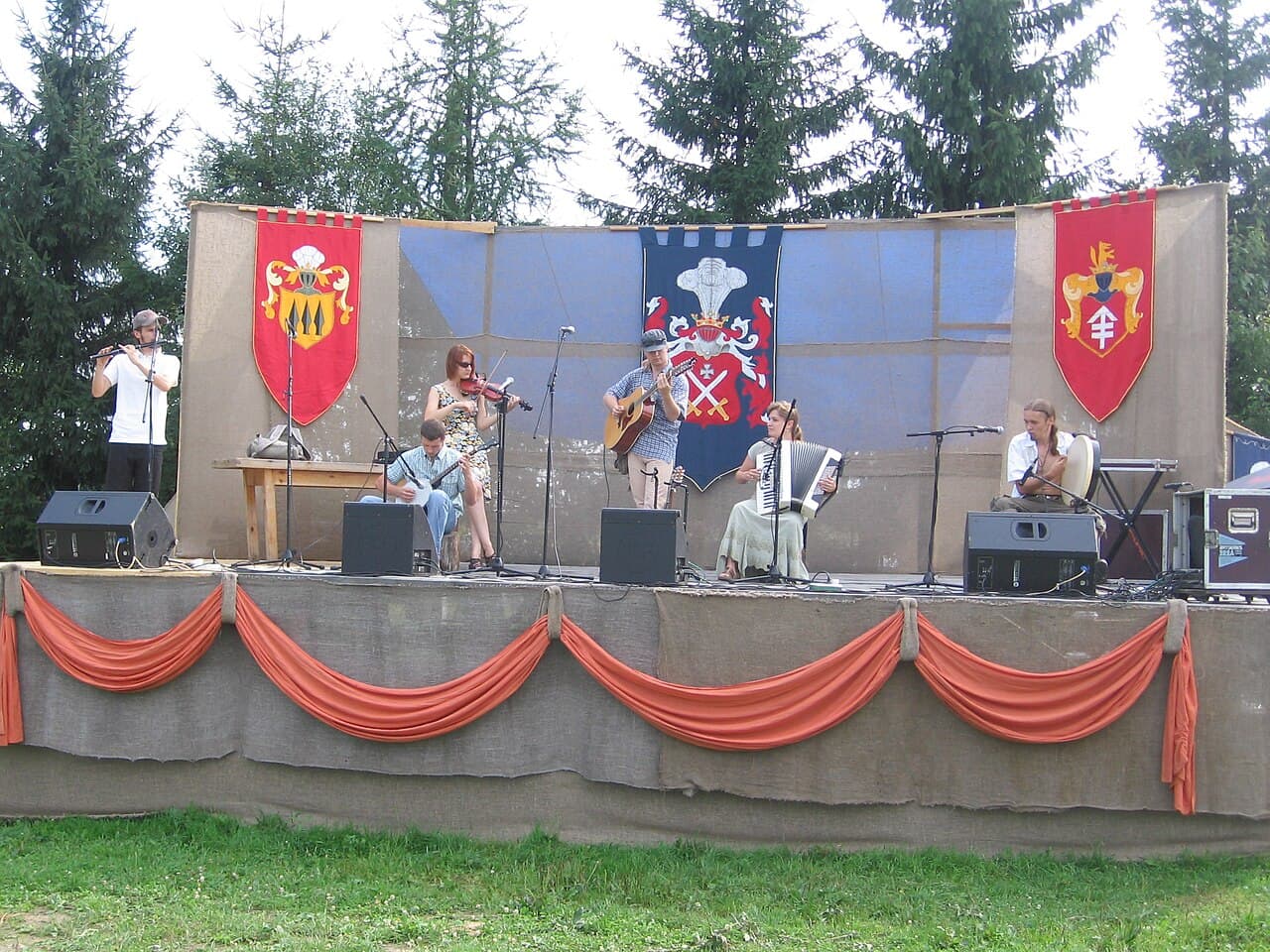 A ceilidh in its modern sense. The older one was a house visit at which the music was incidental and the talk was the point. Photograph by Gruszecki, CC BY-SA 3.0, via Wikimedia Commons.
We know how astonishing these repertoires were because, at the last possible moment, some of them were recorded. Angus MacLellan of South Uist, born in 1869, farm servant and fisherman, carried one of the greatest story hoards ever documented in Scotland; in his eighties he was recorded by the folklorist John Lorne Campbell and by Calum Maclean of the School of Scottish Studies, and more than four hundred tracks of his telling survive, everything from Fenian hero tales to humorous local history. A selection appeared in translation as Stories from South Uist (1961), and MacLellan was appointed MBE in old age for services to Gaelic tradition. It was official recognition, at the very end, of a lifetime's unpaid curatorship. He had learned his tales the only way they could be learned: by sitting in ceilidh houses as a boy and listening until the stories were his.
It's worth pausing on the mechanics, because the taigh-cèilidh was a memory technology of real sophistication. Transmission was scheduled: the long winter nights imposed a season of telling, year after year, so that important tales were rehearsed on something like an annual cycle. Transmission was redundant: a good tale lived in several heads in every district, so no single death could take it. And transmission was error-checked: collectors noted that a Gaelic audience was no passive one. Listeners knew the tales, and a skipped episode or a mangled genealogy would be challenged from the bench by the fire. Repetition, redundancy, correction: a modern archivist would recognise every part of the design. The difference is that this archive required no building and no catalogue, only the willingness of neighbours to keep showing up in one another's houses.
Policy and economics broke the system. Forgetfulness had nothing to do with it. The Education (Scotland) Act of 1872 made schooling compulsory and English-only in effect; Gaelic had no place in the new classrooms, and generations of children were taught, sometimes with the strap, to associate their parents' language with backwardness. Emigration and clearance had already thinned the townships that the ceilidh houses served. Then, in the twentieth century, came the wireless and the television, which supplied the news, the music and the stories the taigh-cèilidh had supplied, and asked nobody to walk through the rain to a neighbour's door.
The rescue effort began as the tradition was visibly dying. Carmichael had collected through the late 1800s. In 1951 the School of Scottish Studies was founded at the University of Edinburgh. Its fieldworkers went township to township with recording machines, reaching the last generation reared in the ceilidh houses. None was more driven than Calum Maclean, who began recording on New Year's Day of that year and in nine years captured what colleagues reckoned at around a hundred miles of tape. The School's archive now holds roughly 33,000 field recordings, and through the Tobar an Dualchais / Kist o Riches project, thousands of hours of it have been digitised and put online, free, searchable, in Gaelic and Scots: the voices of the taigh-cèilidh, audible in any kitchen on earth.
The story since then is quieter but genuinely hopeful. The dance-hall cèilidh kept the word alive while the house tradition slept. The fèis movement rebuilt the apprenticeship of song and music that the ceilidh house once provided; Fèisean nan Gàidheal now supports dozens of local festivals reaching many thousands of young people a year. Storytelling itself has professional champions again, from the Scottish Storytelling Centre in Edinburgh to Gaelic organisations working in the islands. And in December 2022, in Stornoway on the Isle of Lewis, a community project opened An Taigh Cèilidh, a Gaelic cultural centre and café named, deliberately, for the old institution, with the stated aim of reintroducing the ceilidh-house tradition. It is a room in the middle of town where people drop in, speak Gaelic, sing, and tell stories to one another for no better reason than company.
No one pretends the taigh-cèilidh can be restored exactly as it was; the world that required it has gone. But the thing it protected turns out to be portable: a community's knowledge of itself, kept alive by regular, unhurried gathering.
The ceilidh house is a lesson in infrastructure. Gaelic Scotland preserved its stories by maintaining a place and a rhythm in which telling was ordinary: same fire, same season, same faces, until the young had absorbed what the old carried. Writing came almost too late. Most families once had something similar, a kitchen table or a Sunday phone call that did the same quiet work, and most have felt it thin out for the same reasons the ceilidh houses emptied. The remedy is the same in both directions. Keep a recording when you can, since the hundred miles of tape are why we can still hear Angus MacLellan. But above all keep the visit. An archive preserves the story; only the habit of gathering preserves the telling.
A ceilidh in its modern sense. The older one was a house visit at which the music was incidental and the talk was the point. Photograph by Gruszecki, CC BY-SA 3.0, via Wikimedia Commons.
We know how astonishing these repertoires were because, at the last possible moment, some of them were recorded. Angus MacLellan of South Uist, born in 1869, farm servant and fisherman, carried one of the greatest story hoards ever documented in Scotland; in his eighties he was recorded by the folklorist John Lorne Campbell and by Calum Maclean of the School of Scottish Studies, and more than four hundred tracks of his telling survive, everything from Fenian hero tales to humorous local history. A selection appeared in translation as Stories from South Uist (1961), and MacLellan was appointed MBE in old age for services to Gaelic tradition. It was official recognition, at the very end, of a lifetime's unpaid curatorship. He had learned his tales the only way they could be learned: by sitting in ceilidh houses as a boy and listening until the stories were his.
It's worth pausing on the mechanics, because the taigh-cèilidh was a memory technology of real sophistication. Transmission was scheduled: the long winter nights imposed a season of telling, year after year, so that important tales were rehearsed on something like an annual cycle. Transmission was redundant: a good tale lived in several heads in every district, so no single death could take it. And transmission was error-checked: collectors noted that a Gaelic audience was no passive one. Listeners knew the tales, and a skipped episode or a mangled genealogy would be challenged from the bench by the fire. Repetition, redundancy, correction: a modern archivist would recognise every part of the design. The difference is that this archive required no building and no catalogue, only the willingness of neighbours to keep showing up in one another's houses.
Policy and economics broke the system. Forgetfulness had nothing to do with it. The Education (Scotland) Act of 1872 made schooling compulsory and English-only in effect; Gaelic had no place in the new classrooms, and generations of children were taught, sometimes with the strap, to associate their parents' language with backwardness. Emigration and clearance had already thinned the townships that the ceilidh houses served. Then, in the twentieth century, came the wireless and the television, which supplied the news, the music and the stories the taigh-cèilidh had supplied, and asked nobody to walk through the rain to a neighbour's door.
The rescue effort began as the tradition was visibly dying. Carmichael had collected through the late 1800s. In 1951 the School of Scottish Studies was founded at the University of Edinburgh. Its fieldworkers went township to township with recording machines, reaching the last generation reared in the ceilidh houses. None was more driven than Calum Maclean, who began recording on New Year's Day of that year and in nine years captured what colleagues reckoned at around a hundred miles of tape. The School's archive now holds roughly 33,000 field recordings, and through the Tobar an Dualchais / Kist o Riches project, thousands of hours of it have been digitised and put online, free, searchable, in Gaelic and Scots: the voices of the taigh-cèilidh, audible in any kitchen on earth.
The story since then is quieter but genuinely hopeful. The dance-hall cèilidh kept the word alive while the house tradition slept. The fèis movement rebuilt the apprenticeship of song and music that the ceilidh house once provided; Fèisean nan Gàidheal now supports dozens of local festivals reaching many thousands of young people a year. Storytelling itself has professional champions again, from the Scottish Storytelling Centre in Edinburgh to Gaelic organisations working in the islands. And in December 2022, in Stornoway on the Isle of Lewis, a community project opened An Taigh Cèilidh, a Gaelic cultural centre and café named, deliberately, for the old institution, with the stated aim of reintroducing the ceilidh-house tradition. It is a room in the middle of town where people drop in, speak Gaelic, sing, and tell stories to one another for no better reason than company.
No one pretends the taigh-cèilidh can be restored exactly as it was; the world that required it has gone. But the thing it protected turns out to be portable: a community's knowledge of itself, kept alive by regular, unhurried gathering.
The ceilidh house is a lesson in infrastructure. Gaelic Scotland preserved its stories by maintaining a place and a rhythm in which telling was ordinary: same fire, same season, same faces, until the young had absorbed what the old carried. Writing came almost too late. Most families once had something similar, a kitchen table or a Sunday phone call that did the same quiet work, and most have felt it thin out for the same reasons the ceilidh houses emptied. The remedy is the same in both directions. Keep a recording when you can, since the hundred miles of tape are why we can still hear Angus MacLellan. But above all keep the visit. An archive preserves the story; only the habit of gathering preserves the telling.
The older meaning
The keepers of the tales
How a story stayed alive
The fire goes out
The long way back
The ceilidh house was infrastructure
References and resources
- Wikipedia, "Cèilidh", on the etymology and the older visiting tradition, with Carmichael's description
- Alexander Carmichael, Carmina Gadelica, vol. 1 (1900), introduction
- Tobar an Dualchais / Kist o Riches, "Angus MacLellan", the contributor page, with recordings
- Tobar an Dualchais / Kist o Riches, "Calum Iain Maclean", on his fieldwork from 1951
- School of Scottish Studies Archives, University of Edinburgh
- Fèisean nan Gàidheal, the Gaelic arts youth movement
- Seachdain na Gàidhlig, "Stornoway's An Taigh Cèilidh Now Open"
- TRACS, "Storytelling in the Gaelic Tradition"